Figure shows a vertical wall of horizontal length L = 5.0 m and depth H = 3.0 m that is fully submerged in water , with its top surface of the water . What is the force on the wall due to the water pressure ?
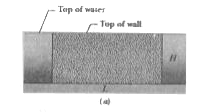
Figure shows a vertical wall of horizontal length L = 5.0 m and depth H = 3.0 m that is fully submerged in water , with its top surface of the water . What is the force on the wall due to the water pressure ?
Text Solution
Verified by Experts
Let y represent the depth below the top water surface . Then the gauge pressure is
`p_(g) = rho gy " " (14-25)`
Note that because the expression contains a variable (namely , depth y) , we cannot use p = F/A to find the force on the wall because there is no one value of pressure . However , if we pick a small area dA on the wall Fig , we can relate the pressure p and force dF on the wall by
`p_(g) = (dF)/(dA) " " (14-26)`
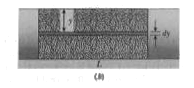
(We use the "d" notation to indicate that we are dealing with tiny portions and differential amounts.) Equation 14-26 tells us that the force on dA is
`dF = p_(g) dA " " (14-27)`
For area dA, we could choose a small square at some depth y . However , note that the variable in Eq 14-25 is y and not x . Thus , the pressure at a given depth y is the same at any horizontal position along the wall . So , we can choose dA to be the area of a strip of length L and tiny height dy . That is ,
dA = Ldy `" " (14-28)`
Then the force on that strip is
`dF = p_(g) L dy, `
or , with Eq. 14-25 ,
`dF = rho gy L dy " " (14-29)`
To find the total force on the wall , we need to add the forces on all the horizontal strips from top to bottom of the wall . Of course , because each strip has the tiny height dy , there are a huge number of strips along the wall and adding up their forces would take "for ever" (much longer than our patience) . However , we can add them via integration rather quickly . Integrating both sides of Eq. 14-29 , we find
`int dF = int rho gy L dy " " (14-30)`
We want to include all the strips between y = 0 (at the top of the wall) and y = 3. 0 m (at the bottom of the wall) . To do so , we use those values as the limits to the integral on the right side of Eq. 14-30 . The integration on the left side yields the total force F we seek . We find
`F = rho g L int_(0)^(3.0 m) y dy `
`= rho g L (1)/(2) y^(2) |_(0)^(3.0 m)`
` = (1000 kg // m^(3) ) (9.8 m//s^(2)) (5.0 m) (1)/(2) (3.0 m)^(2)`
`2.21 xx 10^(5) N`.
`p_(g) = rho gy " " (14-25)`
Note that because the expression contains a variable (namely , depth y) , we cannot use p = F/A to find the force on the wall because there is no one value of pressure . However , if we pick a small area dA on the wall Fig , we can relate the pressure p and force dF on the wall by
`p_(g) = (dF)/(dA) " " (14-26)`
(We use the "d" notation to indicate that we are dealing with tiny portions and differential amounts.) Equation 14-26 tells us that the force on dA is
`dF = p_(g) dA " " (14-27)`
For area dA, we could choose a small square at some depth y . However , note that the variable in Eq 14-25 is y and not x . Thus , the pressure at a given depth y is the same at any horizontal position along the wall . So , we can choose dA to be the area of a strip of length L and tiny height dy . That is ,
dA = Ldy `" " (14-28)`
Then the force on that strip is
`dF = p_(g) L dy, `
or , with Eq. 14-25 ,
`dF = rho gy L dy " " (14-29)`
To find the total force on the wall , we need to add the forces on all the horizontal strips from top to bottom of the wall . Of course , because each strip has the tiny height dy , there are a huge number of strips along the wall and adding up their forces would take "for ever" (much longer than our patience) . However , we can add them via integration rather quickly . Integrating both sides of Eq. 14-29 , we find
`int dF = int rho gy L dy " " (14-30)`
We want to include all the strips between y = 0 (at the top of the wall) and y = 3. 0 m (at the bottom of the wall) . To do so , we use those values as the limits to the integral on the right side of Eq. 14-30 . The integration on the left side yields the total force F we seek . We find
`F = rho g L int_(0)^(3.0 m) y dy `
`= rho g L (1)/(2) y^(2) |_(0)^(3.0 m)`
` = (1000 kg // m^(3) ) (9.8 m//s^(2)) (5.0 m) (1)/(2) (3.0 m)^(2)`
`2.21 xx 10^(5) N`.



Topper's Solved these Questions
FLUIDS
RESNICK AND HALLIDAY|Exercise SAMPLE PROBLEM 14.08|1 VideosFLUIDS
RESNICK AND HALLIDAY|Exercise SAMPLE PROBLEM 14.09|1 VideosFLUIDS
RESNICK AND HALLIDAY|Exercise SAMPLE PROBLEM 14.06|1 VideosELECTROMAGNETIC WAVES
RESNICK AND HALLIDAY|Exercise PRACTICE QUESTIONS (Integer Type)|3 VideosFORCE AND MOTION - I
RESNICK AND HALLIDAY|Exercise PRACTICE QUESTIONS (Integer Type)|3 Videos
Similar Questions
Explore conceptually related problems
A flotation device is in the shape of a right cylinder, with a height of 0.650 m and a face area of 4.00 m^(2) on top and bottom, and its density is 0.300 times that of fresh water. It is initially held fully submerged in fresh water, with its top face at the water surface. Then it is allowed to ascend gradually until it begins to float. How much work does the buoyant force do on the device during the ascent?
A glass prism has its principal section in form of an equilateral triangle of side length l . The length of the prism is L (see fig.). The prism, with its base horizontal, is supported by a vertical spring of force constant k. Half the slant surface of the prism is submerged in water. Surface tension of water is T and contact angle between water and glass is 0^(@) . Density of glass is d and that of water is rho ( lt d) . Calculate the extension in the spring in this position of equilibrium.
A ladder is resting against a vertical wall and its bottom is 2·5 m away from the wall. If it slips 0.8 m sown the wall, then its bottom will move away from the wall by 1.4 m. What is the length of the. ladder ?
The pressure at the bottom of a lake due to water is 4.9xx 10^(6)N//m^(2) . What is the depth of the lake?
Water stands at a depth H in a tank whose side walls are vertical. A hole is made on one of the walls at a depth h below the water surface. Find at what distance from the foot of the wall does the emerging stream of water strike the floor and for what value of h this range is maximum ? What is the maximum possible range ?
A tank with vertical walls is mounted so that its base is at a height H above the horizontal ground. The tak is filled with water to a depth h . A hole is puched in the side wall of the tank at a depth x below the water surface. To have maximum range of the emerging stream, the value of x is
A tank with length 10 m, breadth 8 m and depth 6 m is filled with water upto top . If G=10m//s^2 . And density of water =1000kg//m^3 , then the thrust on the bottom is:
A uniform wooden bar of length l and mass m hinged on a vertical wall of a containing water, at one end. 3//5th part of the bar is submerged in water. Find the ratio of densities of the liquid and the bar.
Figure shows a large closed cylindrical tank containing water. Initially, the air trapped above the water surface has a height h_(0) and pressure 2p_(0) where rh_(0) is the atmospheric pressure. There is a hole in the wall of the tank at a depth h_(1) below the top from which water comes out. A long vertical tube is connected as shown. Find the height of the water in the long tube above the top when the water stops coming out of the hole.