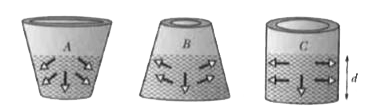
In vessel C , forces due to fluid pressure on the sides of the container are horizontally . Forces on any two diametrically opposite points on the walls of the container are equal and opposite , thus , the net force on the container walls is zero . The force on the bottom is
`F = p A = (rho g d) (pi r^(2))`
The volume of mercury in the cylinder is `V = pi r^(2) d` . So `F = rho g V = (rho V) g = mg `
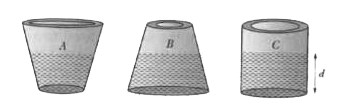
The force on the bottom of vessel C is equal to the weight of the mercury . The forces due to fluid pressure on the sides of the containers A and B have vertical components also , So the force between the fluid and the base of container will not be equal to the weight of the fluid . These containers support the fluid by exerting an upward force equal in magnitude to the weight of the fluid but some force is being applied by the sidewalls and the remaining by the bottom . Fig shows the forces acting on each container due to mercury .
The force on the bottom of vessel A is less than the weight of the mercury in the container , while the force on the bottom of vessel B is greater than the weight of the mercury . In vessel A , the forces on the container walls have downward components as well as horizontal components . The sum of the downward components of the forces on the walls and the downward force on the bottom of the container is equal to the weight of the water . Similarly , the forces on the walls of vessel B have upward components . In each case , the total force on the bottom and sides of the container due to mercury is equal to the weight of the mercury .