The angular velocity , `omega` of a rotating body or shaft can be measured by attaching an open cylinder of liquid , as shown in Fig and measuring the change in the fluid level , `H- h_(0)` , caused by the rotation of the fluid . Determine the relationship between this change in fluid level and the angular velocity . Assume no fluid is spilling out of the vessel.
The angular velocity , `omega` of a rotating body or shaft can be measured by attaching an open cylinder of liquid , as shown in Fig and measuring the change in the fluid level , `H- h_(0)` , caused by the rotation of the fluid . Determine the relationship between this change in fluid level and the angular velocity . Assume no fluid is spilling out of the vessel.
Text Solution
Verified by Experts
The height h , of the free surface above the tank bottom can be determined as follows
`h - (omega^(2) r^(2))/(2 g) + h_(0)`
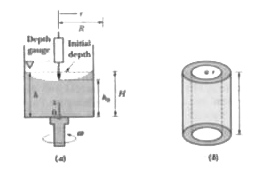
The initial volume of fluid in the tank , `V_(i) = pi R^(2) H`
The volume of the fluid with the rotating tank can be found by considering a differential element of cylindrical shape as shown in Fig . This cylindrical shell is taken at some arbitary radius , r and thickness dr . Thus , its volume is
`dV = 2 pi r h dr`
The total volume is , therefore ,
`V. = 2 pi int_(0)^(R) r ((omega^(2) r^(2))/(2 g) + h_(0)) dr = (pi omega^(2) R^(4))/( 4 g) + pi R^(2) h_(0)`
Since the volume of the fluid in the tank must remain constant (given that none spills over the top) , it follows that `pi R^(2) H = (pi omega^(2) R^(4))/(4 g) = pi R^(2) h_(0)`
or `H - h_(0) = (omega^(2) R^(2))/(4 g)`
`h - (omega^(2) r^(2))/(2 g) + h_(0)`
The initial volume of fluid in the tank , `V_(i) = pi R^(2) H`
The volume of the fluid with the rotating tank can be found by considering a differential element of cylindrical shape as shown in Fig . This cylindrical shell is taken at some arbitary radius , r and thickness dr . Thus , its volume is
`dV = 2 pi r h dr`
The total volume is , therefore ,
`V. = 2 pi int_(0)^(R) r ((omega^(2) r^(2))/(2 g) + h_(0)) dr = (pi omega^(2) R^(4))/( 4 g) + pi R^(2) h_(0)`
Since the volume of the fluid in the tank must remain constant (given that none spills over the top) , it follows that `pi R^(2) H = (pi omega^(2) R^(4))/(4 g) = pi R^(2) h_(0)`
or `H - h_(0) = (omega^(2) R^(2))/(4 g)`



Topper's Solved these Questions
FLUIDS
RESNICK AND HALLIDAY|Exercise SAMPLE PROBLEM 14.15|1 VideosFLUIDS
RESNICK AND HALLIDAY|Exercise SAMPLE PROBLEM 14.16|1 VideosFLUIDS
RESNICK AND HALLIDAY|Exercise SAMPLE PROBLEM 14.13|1 VideosELECTROMAGNETIC WAVES
RESNICK AND HALLIDAY|Exercise PRACTICE QUESTIONS (Integer Type)|3 VideosFORCE AND MOTION - I
RESNICK AND HALLIDAY|Exercise PRACTICE QUESTIONS (Integer Type)|3 Videos
Similar Questions
Explore conceptually related problems
A hemispherical bowl of radius R=0.1m is rotating about its own axis (which is verticle) with an angular velocity omega . A particle of mass 10^(-2)kg on the smooth inner surface of the bowl is also rotating with the same omega . The particle is at a height h from the bottom of the bowl (a) obtain the relation betweemn h and omega . what is the minimum value of omega needed, in order to have a non-zero value of h ? (b) it is desired to measure g using this set up, by measuring h accurately. assuming that R and Omega are known precisely and least count in the measurement of h is 10^(-4)m , what is the minimum possible error Deltag in the measured value of g ? (g=10m//s^(2))
A simple accelerometer (an instrument for measuring acceleration) can be made in the form of a tube filled with a liquid and bent as shown. During motion, the level of the liquid in the left arm will be at a height h_(1) and in the right arm at a height h_(2) . Determine the acceleration a of a carriage in which the accelerometer is installed, assuming that the diameter of the tube is much smaller than h_(1) and h_(2) .
A U -tube rotates with angular velocity omega about the vertical axis AB . What is the difference in fluid level h in terms of omega the radii r_(1) and r_(2) and the fluid density rho?
A unifom cylinder of steel of mass M radius R is placed on frictionless bearings and sct to rotate about its axis with angular velocity omega_(0) After the cylinder has reached the specified state of rotation, it is heated from temperature T_(0)to (T_(0)+DeltaT) without any mechanical contact. If (DeltaI)/I is the fractional change in moment of inertia of the cylinder and (Deltaomega)/(omega_(0)) be the fractional change in the angular velocity of the cylinder and alpha be the coefficient of linear expansion, then
Two cylinders having radiii R_(1) and R_(2) and rotational inertia I_(1) and I_(2) respectively, are supported by fixed axes perpendicular to the plane of figure-5.52. The large cylinder is initially rotating with angular velocity omega_(0) . The small cylinder is moved to the right until it touches the large cylinder and is caused to rotate by the frictional force between the two. Eventually, slipping ceases, and the two cylinders rotate at constant rates in opposite directions, (a) Find the final angular velocity omega_(2) of the small cylinder in terms of I_(1) , I_(2) , R_(1) , R_(2) and omega_(0) . (b) Is total angular momentum conserved in this case ?
A horizontally oriented bent thin tube ABC of length 1.4 m rotates with a constant angular velocity omega about a stationary vertical axis OO' passing through the end A as shown in figure. The portion BC of tube is parallel to OO' and its length is equal 0.4 m . At t=0 , AB part of tube is filled with an ideal fluid. The end A of tube is open, the closed end C has a very small orifice. Find the maximum height reached by fluid relative to end C . (take g=10//s^(2) and omega=10 rad//s )
A bullet of mass m moving with velocity v strikes and becomes embedded at the edge of a cylinder of mass M and radius R_(0) as shown in fig. The cylinder, initially at rest, begins to rotate about its symmetry axis, which remains fixed in position. Assuming no frictional torque, what is the angular velocity of the cylinder after this collision? Kinetic energy conseved?
A fluid with viscosity eta fills the space between two long co-axial cylinders of radii R_1 and R_2 , with R_1 lt R_2 . The inner cylinder is stationary while the outer one is rotated with a constant angular velocity omega_2 . The fluid flow is laminar. Taking into account that the friction force acting on a unit area of a cylindrical surface of radius r is defined by the formula sigma=etar(delomega//delr) , find: (a) the angular velocity of the rotating fluid is as a function of radius r, (b) the moment of the friction forces acting on a unit length of the outer cylinder.
A cylinderical tank of radiuus 20 cm and height 50 cm has water up to 30 cm of height. What will be the rise in level of liquid at the periphery if the cylinder be givenan angular velocity of 10 rad s^(-1) ? Also determine the frequency of rotation when water just starts spilling over the sides of the vessel.