Home
Class 12
PHYSICS
A liquid flows through a horizontal tube...

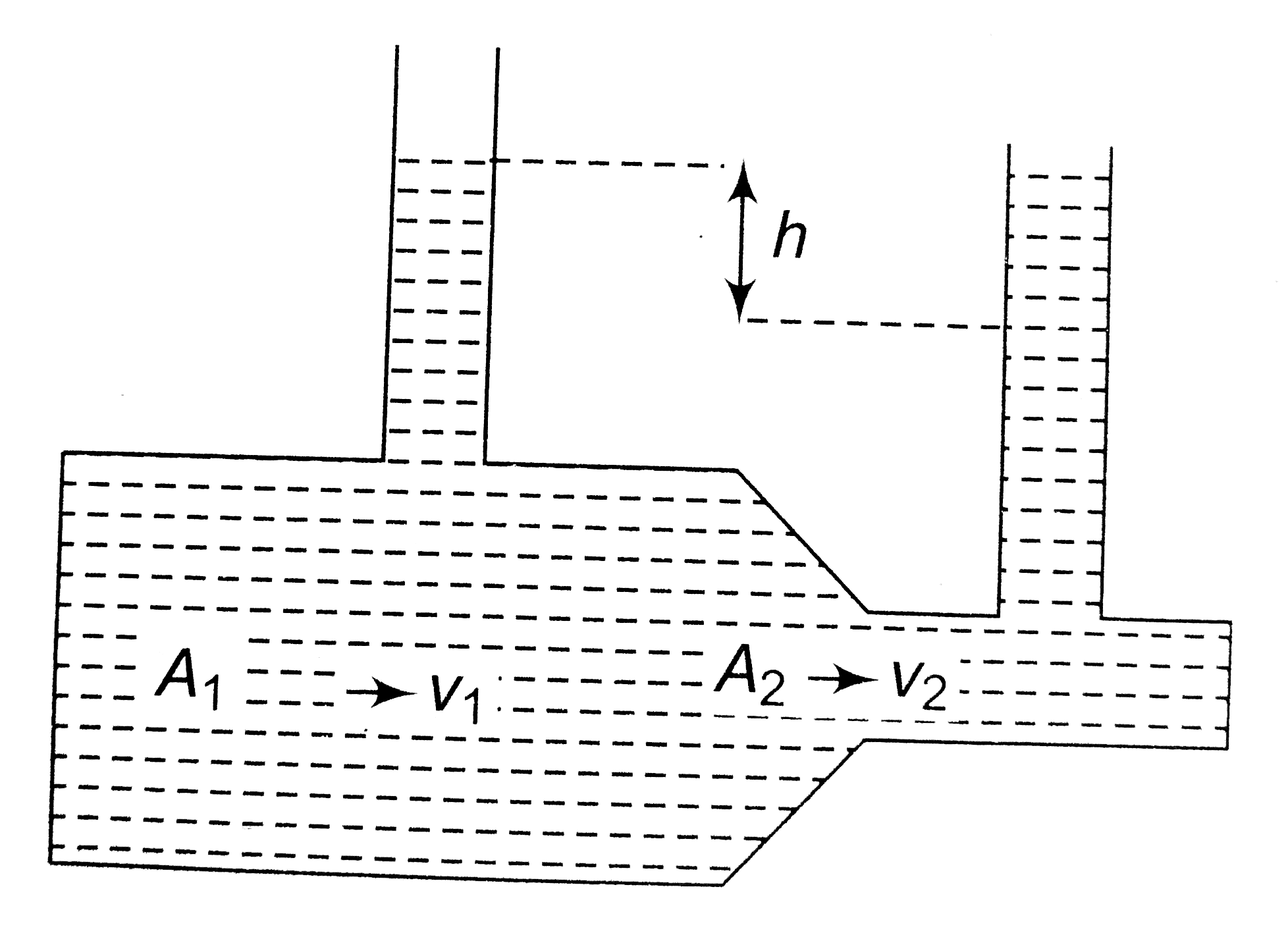
A liquid flows through a horizontal tube as shown in figure. The velocities of the liquid in the two sections, which have areas of cross-section `A_(1)` and `A_(2)` and `v_(1)` and `v_(2)` respectively. The differnece in the levels of the liquid in the two vertical tubes is `h`. then

A

the volume of the liquid flowing through the tube in unit time is `A_(1) Y_(1)`

B

`v_(2) - v_(1) = sqrt(2 gh )`

C

`v_(2)^(2) - v_(1)^(2) = 2 gh `

D

the energy per unit mass of the liquid is the same in both sections of the tube .

Text Solution

Verified by Experts

The correct Answer is:

A, C, D
Promotional Banner

Topper's Solved these Questions

  • FLUIDS

    RESNICK AND HALLIDAY|Exercise PRACTICE QUESTIONS (Linked Comprehension )|9 Videos
  • FLUIDS

    RESNICK AND HALLIDAY|Exercise PRACTICE QUESTIONS (Matrix - Match )|7 Videos
  • FLUIDS

    RESNICK AND HALLIDAY|Exercise PRACTICE QUESTIONS (SINGLE CORRECT CHOICE TYPE)|48 Videos
  • ELECTROMAGNETIC WAVES

    RESNICK AND HALLIDAY|Exercise PRACTICE QUESTIONS (Integer Type)|3 Videos
  • FORCE AND MOTION - I

    RESNICK AND HALLIDAY|Exercise PRACTICE QUESTIONS (Integer Type)|3 Videos

Similar Questions

Explore conceptually related problems

A liquid flows through a horizontal tube. The velocities of the liquid in the two sections, which have areas of cross section A_(1) and A_(2) are v_(1) and v_(2) respectively. The difference in the levels of the liquid in the two vertical tubes is h . Then

An incompressible liquid flows through a horizontal tube as shown in the figure. Then the velocity 'v' of the fluid is:

An incompressible liquid flows through a horizontal tube LMN as shown in the figure. Then the velocity V of the liquid throught he tube N is:

From a horizontal tube with area of cross-section A_(1) and A_(2) as shosn in fiugre liquid is flowing in the level of the liauid in the two veritcal tunes is h.

Water flows through a horizontal tube as shown in figure. If the difference of heights of water colun in the vertical tubes is 2 cm and the area of cross section at A and B are 4cm^2 and 2cm^2 respectively, find the rate of flow of water across any section.

An incompressible, non-viscous liquis of density r flows through a horizontal tube as shown below. The flow condition is steady. Area of cross section at A and B are a_(1) and a_(2) respectively. The height difference of liquid in two tubes inserted at A and B is h.

Two liquids which do not react chemically are placed in a bent tube as shown in figure. The height of the liquids above their surface of separation are

Water flows through the tubes shown in figure. The areas of cross-section of the wide and the narrow portions of the tube are 5 cm^(2) and 2 cm^(2) respectively. The rate of flow of water through the tube is 500 cm^(3)//s . Find the difference of mercury levels in the U-tube.

A liquid flows through a pipe of non-uniform cross-section. If A_(1) and A_(2) are the cross-sectional areas of the pipe at two points, the ratio of velocities of the liquid at these points will be

(i) Air (density= rho ) flows through a horizontal venturi tube that discharges to the atmosphere. The area of cross section of the tube is A_(1) and at the constriction it is A_(2) . The constriction is connected to a water (density =rho_(0) ) tank through a vertical pipe of lenght H. Find the volume flow rate (Q) of the air through tube that is needed to just draw the water into the tube. (ii) A non viscous liquid of constant density rho flows in a stremline motion along a tube of variable cross section. The tube is kept inclined in the vertical plane as shown in the figure. The area of cross section of the tube at two points P and Q at heights of h_(1) and h_(2) are respectively A_(1) and A_(2) . The velocity of the liquid at point P is v. Find the work done on a small volume DeltaV of fluid by the neighbouring fluid as the small volume moves from P to Q.
