

Home
Class 11
PHYSICS
In a paricular crash test, a car of mass...

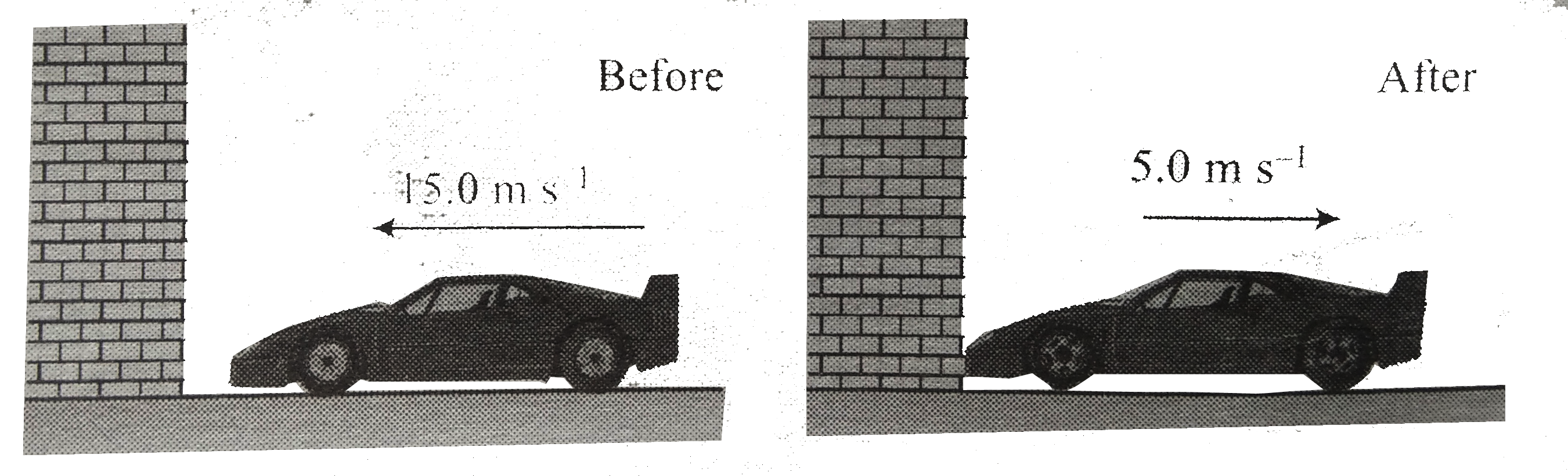
In a paricular crash test, a car of mass 1500 kg collies with a wall as shown in fig. The initial and final velocites on the car are `vec(v_i)=-15.0 hat(i)ms^(-1)` and `vec(v_f)=5.00 hat(i) ms^(-1)`, respectively. If the collision lasts `0.150s`, find the impulse caused by the collision and the average force exerted on the car.

Promotional Banner

Similar Questions

Explore conceptually related problems

In a particular crash test, a car of mass 1500 kg collies with a wall as shown in fig. The initial and final velocities on the car are vec(v_i)=-15.0 hat(i)ms^(-1) and vec(v_f)=5.00 hat(i) ms^(-1) , respectively. If the collision lasts 0.150s , find the impulse caused by the collision and the average force exerted on the car.

In a particular crash test, a car of mass 1500 kg collies with a wall as shown in fig. The initial and final velocities on the car are →vi=-15.0ˆims-1 and →vf=5.00ˆims-1, respectively. If the collision lasts 0.150s, find the impulse caused by the collision and the average force exerted on the car.

A solid sphere of mass 2 kg is resting inside a cube as shown in fig. The cube is moving with a velocity vec(v)=(5t hat(i)+2t hat(j))ms^(-1) . Here t is time in seconds. All surface are smooth. The sphere is at rest with respect to the cube. What is the total force exerted by the sphere on the cube?

A solid sphere of mass 2 kg is resting inside a cube as shown in fig. The cube is moving with a velocity vec(v)=(5t hat(i)+2t hat(j))ms^(-1) . Here t is time in seconds. All surface are smooth. The sphere is at rest with respect to the cube. What is the total force exerted by the sphere on the cube?

A particle of mass 2kg moves with an initial velocity of vec(v)=4hat(i) +4hat(j) ms^(-1) . A constant force of vec(F) =20hat(j)N is applied on the particle. Initially, the particle was at (0,0). The x-coordinates of the particle when its y-coordinates again becomes zero is given by

A particle of mass 2kg moves with an initial velocity of vec(v)=4hat(i) +4hat(j) ms^(-1) . A constant force of vec(F) =20hat(j)N is applied on the particle. Initially, the particle was at (0,0). The x-coordinates of the particle when its y-coordinates again becomes zero is given by

A particle of mass 2kg moves with an initial velocity of vec(v)=4hat(i) +4hat(j) ms^(-1) . A constant force of vec(F) =20hat(j)N is applied on the particle. Initially, the particle was at (0,0). The x-coordinates of the particle when its y-coordinates again becomes zero is given by

A machine carries a 4.0 kg package from an initial position of vec(d)_(i)=(0.50 m)hat(i)+(0.75 m)hat(j)+(0.20 m)hat(k) at t=0 to a final position of vec(d)_(f)=(7.50 m)hat(i)+(12.0 m) hat(k) at t=12 s. The constant force applied by the machine on the package is vec(F)= (2.00 N) hat(i) + (4.00 N) hat(j) + (6.00 N) hat(k) . For that displacement, find (a) the work done on the package by the machine's force and (b) the average power of the machine's force on the package.

A 2000 kg car travelling at 20 ms^(-1) hits concret wall and stops in 0.05 s . What magnitude of impulse did the wall exert on the car ?

A body of mass 5 kg statrs from the origin with an initial velocity vec(u) = (30 hat(i) + 40 hat(j)) ms^(-1) . If a constant force (-6 hat(i) - 5 hat(j))N acts on the body, the time in which they component of the velocity becomes zero is