

Home
Class 11
PHYSICS
Materials get deformed when force is app...

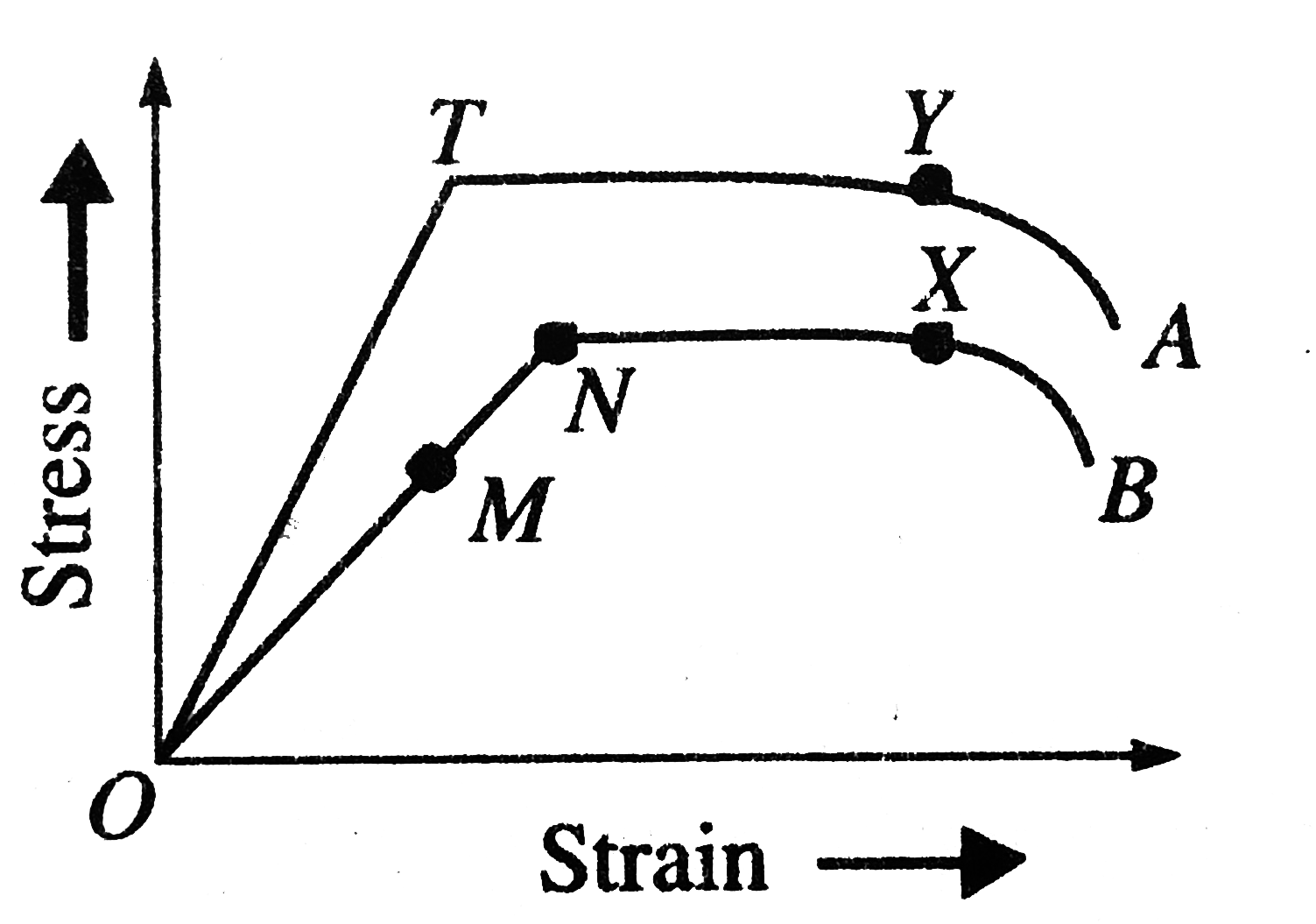
Materials get deformed when force is applied. Some of them regain their status when the applied force is removed. They are termed as elastic. Those of which not regaining are called plastic. There may be delay in the regaining in some materials. They are said to have got elastic aftereffect, since they have gone beyond the elastic limit. Repeated application and removal of force leads to fatigueness in the material. Fatigued materials may break at any point time and so are avoided.
The stress strain graph for two materials A and B is shown in the following figure:

The time in which the two materials regain their original status is `t_(A)` and `t_(B)` related as `t_(B)=2t_(B)`. Then the material under elastic aftereffect (relatively) is

Promotional Banner

Similar Questions

Explore conceptually related problems

Materials get deformed when force is applied. Some of them regain their status when the applied force is removed. They are termed as elastic. Those of which not regaining are called plastic. There may be delay in the regaining in some materials. They are said to have got elastic aftereffect, since they have gone beyond the elastic limit. Repeated application and removal of force leads to fatigueness in the material. Fatigued materials may break at any point time and so are avoided. The stress strain graph for two materials A and B is shown in the following figure: If the intensity of A and B is E_(A) and E_(B) , respectively

Materials get deformed when force is applied. Some of them regain their status when the applied force is removed. They are termed as elastic. Those of which not regaining are called plastic. There may be delay in the regaining in some materials. They are said to have got elastic aftereffect, since they have gone beyond the elastic limit. Repeated application and removal of force leads to fatigueness in the material. Fatigued materials may break at any point time and so are avoided. The stress strain graph for two materials A and B is shown in the following figure: If the intensity of A and B is E_(A) and E_(B) , respectively

Materials get deformed when force is applied. Some of them regain their status when the applied force is removed. They are termed as elastic. Those of which not regaining are called plastic. There may be delay in the regaining in some materials. They are said to have got elastic aftereffect, since they have gone beyond the elastic limit. Repeated application and removal of force leads to fatigueness in the material. Fatigued materials may break at any point time and so are avoided. The stress strain graph for two materials A and B is shown in the following figure: The strength of the material A and B is S_(A) and S_(B) , respectively, while the longevity of plastic behaviour is L_(A) and L_(B) . Then

Materials get deformed when force is applied. Some of them regain their status when the applied force is removed. They are termed as elastic. Those of which not regaining are called plastic. There may be delay in the regaining in some materials. They are said to have got elastic aftereffect, since they have gone beyond the elastic limit. Repeated application and removal of force leads to fatigueness in the material. Fatigued materials may break at any point time and so are avoided. The stress strain graph for two materials A and B is shown in the following figure: The strength of the material A and B is S_(A) and S_(B) , respectively, while the longevity of plastic behaviour is L_(A) and L_(B) . Then

On applying external force beyond the elastic limit,

On applying external force beyond the elastic limit,

With the help of graph explain the elastic limit of a material.

Can you name objects which do not regain their original shape and size when the external force is removed?

Which of the following is not the application of elastic behaviour of material

Which of the following is not the application of elastic behaviour of material