

Home
Class 12
PHYSICS
A thin plank of mass m and length l is ...

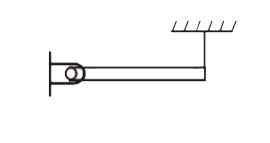
A thin plank of mass m and length l is pivoted at one end and it is held stationary in horizontal position by means of a light thread as shown in the figure then find out the force on the pivot.

Promotional Banner

Similar Questions

Explore conceptually related problems

One-fourth length of a uniform rod of mass m and length l is placed on a rough horizontal surface and it is held stationary in horizontal position by means of a light thread as shown in the figure. The thread is then burnt and the rod start rotating about the edge. Find the angle between the rod and the horizontal when it is about to slide on the edge. The coefficient of friction between the rod and surface is mu .

One-fourth length of a uniform rod of mass m and length l is placed on a rough horizontal surface and it is held stationary in horizontal position by means of a light thread as shown in the figure. The thread is then burnt and the rod start rotating about the edge. Find the angle between the rod and the horizontal when it is about to slide on the edge. The coefficient of friction between the rod and surface is mu .

A square plate is hinged as shown in figure and it is held stationary by means of a light thread as shown in figure. Then find out force exerted by the hinge.

A thin plank of mass M and length l is pivoted at one end. The plank is releaed at 60^(@) from the vertical. What is the magnitude and direction of the force on the pivot when the plank is horizontal?

A thin plank of mass M and length l is pivoted at one end. The plank is releaed at 60^(@) from the vertical. What is the magnitude and direction of the force on the pivot when the plank is horizontal?

A stick of mass m and length l is pivoted at one end and is displaced through an angle theta. The increase in potential energy is

A stick of mass m and length l is pivoted at one end and is displaced through an angle theta. The increase in potential energy is

A rigid rod of mass m & length l is pivoted at one of its ends. If it is released from its horizontal position, find the speed of the centre of mass of the rod when it becomes vertical.

A rigid rod of mass m & length l is pivoted at one of its ends. If it is released from its horizontal position, find the speed of the centre of mass of the rod when it becomes vertical.