

Home
Class 11
PHYSICS
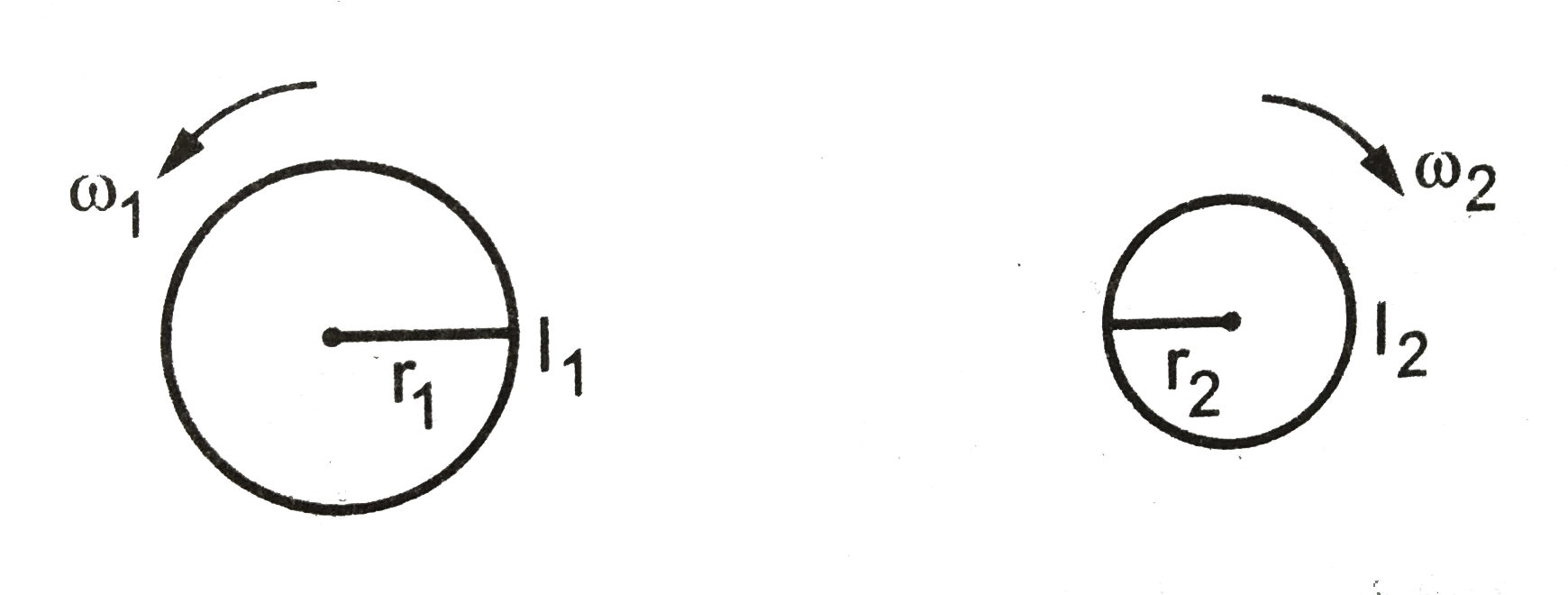
Figure shows two cylinders of raddi r1 a...

Figure shows two cylinders of raddi `r_1 and r_2` having moments of inertia `I_1 and I_2` about their respective axes. Initially the cylinders rotate about their axes with angular speed `omega_1 and omega_2` as shown in the figure. The cylinders are moved closer to touch each other keeping the axes parallel. The cylinders first slipover each other at the contact but the slipping finally ceases due to the friction between them. Find the angular speeds of the sylinders after the slipping ceases.

Promotional Banner

Similar Questions

Explore conceptually related problems

Figure shows two cylinders of radii r_1 and r_2 having moments of inertia I_1 and I_2 about their respective axes. Initially the cylinders rotate about their axes with angular speed omega_1 and omega_2 as shown in the figure. The cylinders are moved closer to touch each other keeping the axes parallel. The cylinders first slip over each other at the contact but the slipping finally ceases due to the friction between them. Find the angular speeds of the cylinders after the slipping ceases.

Figure shows two cylinders of radii r_1 and r_2 having moments of inertia I_1 and I_2 about their respective axes. Initially the cylinders rotate about their axes with angular speed omega_1 and omega_2 as shown in the figure. The cylinders are moved closer to touch each other keeping the axes parallel. The cylinders first slip over each other at the contact but the slipping finally ceases due to the friction between them. Find the angular speeds of the cylinders after the slipping ceases.

Two horizontal discs A and B of radii r and 2r having moments of inertia I and 4I about their axes. Initially, disc A is rotating with omega_(0) and disc B is at rest. Their rims are now brought in contact. The discs first slip over each other at the contact but slipping finally ceases due to the fricition between them. Find the angular speeds of the discs after the slipping ceases. Also, find the loss in kinetic energy.

Two dics of moments of inertia I_1 and I_2 about their respective axes (normal to the disc and passing through the centre), and rotating with angular speed omega_1 and omega_2 are brought into contact face to face with their axes of rotation coincident. Account for this loss.

Two dics of moments of inertia I_1 and I_2 about their respective axes (normal to the disc and passing through the centre), and rotating with angular speed omega_1 and omega_2 are brought into contact face to face with their axes of rotation coincident. Find the angular speed of the two-disc system.

Two discs of moments of inertia I_1 and I_2 about their respective axes normal to the disc and passing through the centre and rotating with angular speeds omega_1 and omega_2 are brought into contact face to face with their axes of rotation coinciding. Then the angular speed of the two disc system is

Two dics of moments of inertia I_1 and I_2 about their respective axes (normal to the disc and passing through the centre), and rotating with angular speed omega_1 and omega_2 are brought into contact face to face with their axes of rotation coincident. Does the law of conservation of angular momentum apply to the situation? Why?

Two discs of moments of inertia I_1 and I_2 about their respective axes (normal to the disc and passing through the centre), and rotating with angular speed omega_1 and omega_2 are brought into contact face to face with their axes of rotation coincident. What is the loss in kinetic energy of the system in the process?