

Home
Class 11
PHYSICS
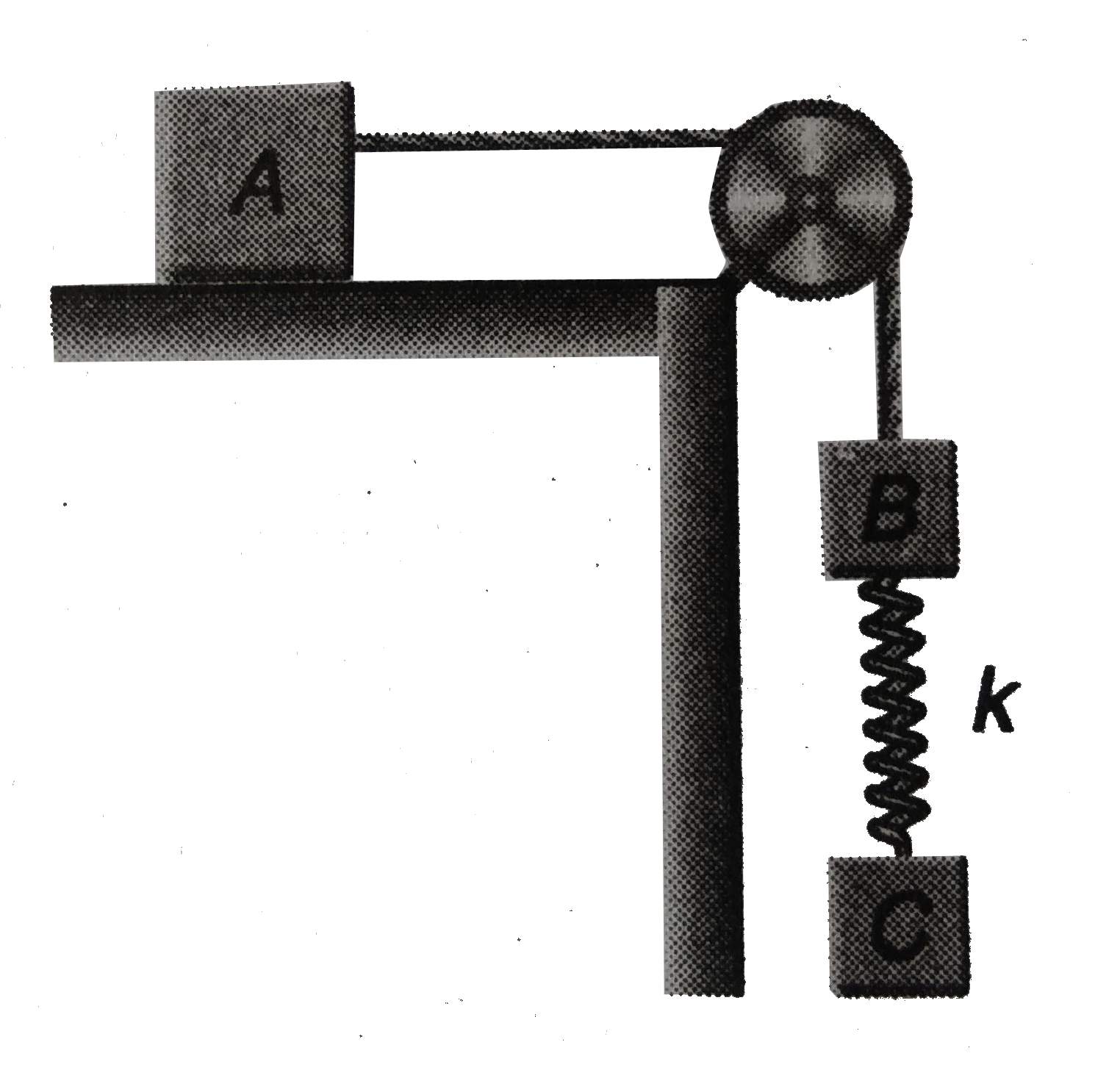
In the figure shown masses of the blocks...

In the figure shown masses of the blocks A, B and C are 6kg, 2kg and 1kg respectively. Mass of the spring is negligibly small and its stiffness is 1000 N//m. The coefficient of friction between the block A snd the table is `mu =0.8`. Initially block C is held such that spring is in relaxed position. The block is released from rest. Find `(g=10 m//s^(2))`.

(a) the maximum distance moved by the kinetic `C`.
the acceleration of each block, when clongation in the spring is maximum.

Promotional Banner

Similar Questions

Explore conceptually related problems

A block of mass 2 kg, initially at rest on a horizontal floor, is now acted upon by a horizontal force of 10 N . The coefficient of friction between the block and the floor is 0.2. If g = 10 m//s^(2) , then :

In the figure show below, calculate the coefficient of friction between the block and the inclined plane. Assume that the mass of the block s 1 kg. The block is released from rest and stops by covering the distance of 0.1 m on the plane.

In the figure shown co-efficient of friction between the block B and C is 0.4. There is no friction between the block C and hte surface on which it is placed. The system of blocks is released from rest in the shown situation. Find the distance moved by the block C when block A descends through a distance 2m. Given masses of the blocks are m_(A)=3 kg, m_(B)=5 kg and m_(C)=10 kg .

A block of mass 0.18 kg is attached to a spring of force-constant 2 N//m . The coefficient of friction between the block and the floor is 0.1 Initially the block is at rest and the spring is un-stretched. An impulse is given to the block as shown in the figure. The block slides a distance of 0.06 m and comes to rest for the first time. The initial velocity of the block in m//s is V = N//10 . Then N is : .

A block of mass 0.18 kg is attached to a spring of force-constant 2 N//m . The coefficient of friction between the block and the floor is 0.1 Initially the block is at rest and the spring is un-stretched. An impulse is given to the block as shown in the figure. The block slides a distance of 0.06 m and comes to rest for the first time. The initial velocity of the block in m//s is V = N//10 . Then N is : .

The coefficient of friction between the block A of mass m & block B of mass 2m is mu . There is no friction between block B & the inclined plane. If the system of blocks A & B is released from rest & there is no slipping between A & B then :

In the system as shown in figure, the blocks have masses m_(1) and m_(2) , the spring constant is k, coefficient of friction between the block of mass m_(1) and the surface is mu . The system is released with zero initial speed from the position where the spring is in its natural length.

A force of 200N is applied as shown in the figure on block of 3 kg. The coefficient of friction between the block and the wall is 0.3. Find the friction acting on the block. (in N) {Take g = 10 m//s^(2)