

Home
Class 11
PHYSICS
Two cylinders having radii 2R and R and ...

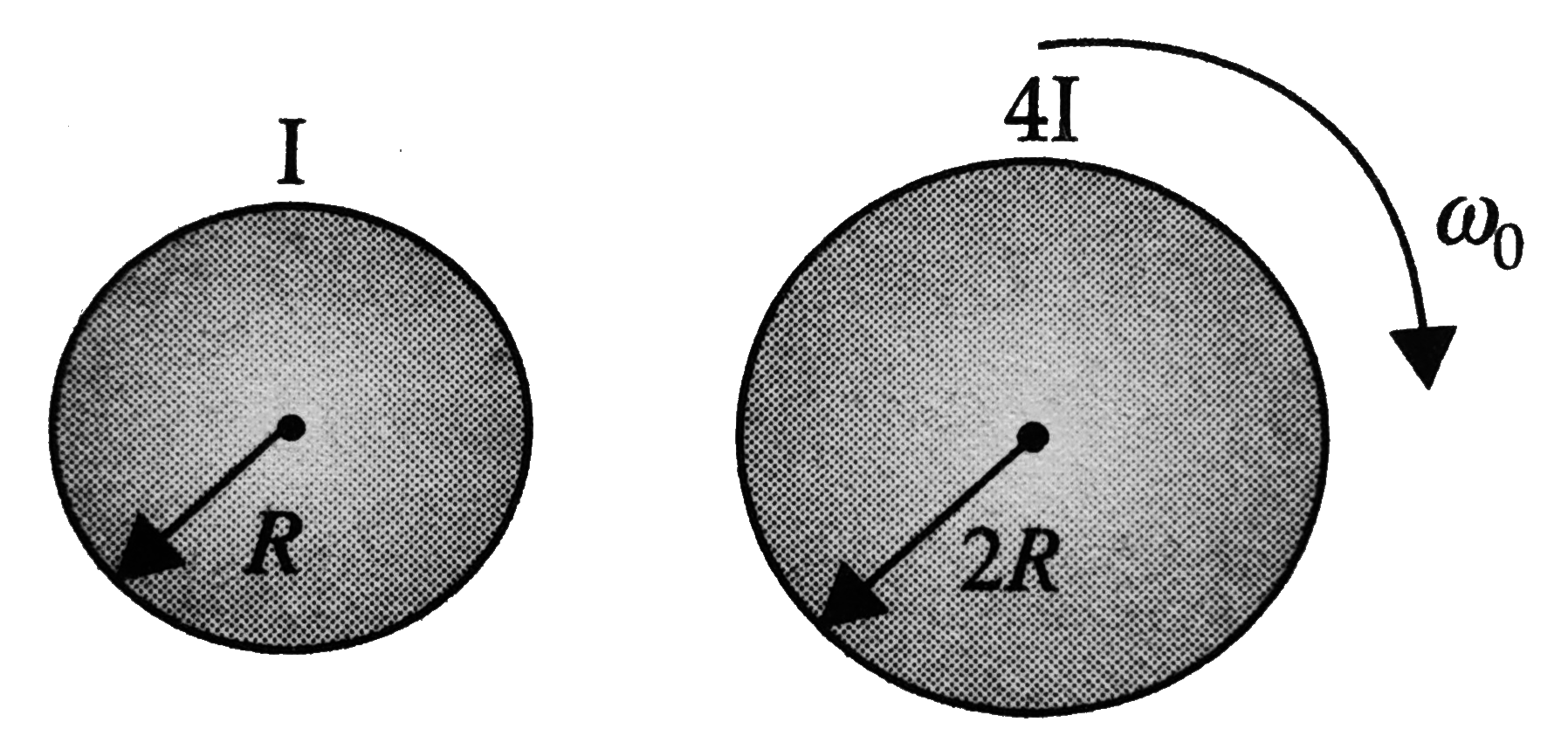
Two cylinders having radii `2R` and `R` and moment of inertia `4I` and `I` about their central axes are supported by axles perpendicular to their planes. The large cylinder is initially rotating clockwise with angular velocity `omega_(0)`. The small cylinder is moved to the right until it touches the large cylinder and is caused to rotate by the frictional force between the two. Eventually slipping ceases and the two cylinders rotate at constant rates in opposite directions. During this

Promotional Banner

Similar Questions

Explore conceptually related problems

Two cylinders having radiii R_(1) and R_(2) and rotational inertia I_(1) and I_(2) respectively, are supported by fixed axes perpendicular to the plane of figure-5.52. The large cylinder is initially rotating with angular velocity omega_(0) . The small cylinder is moved to the right until it touches the large cylinder and is caused to rotate by the frictional force between the two. Eventually, slipping ceases, and the two cylinders rotate at constant rates in opposite directions, (a) Find the final angular velocity omega_(2) of the small cylinder in terms of I_(1) , I_(2) , R_(1) , R_(2) and omega_(0) . (b) Is total angular momentum conserved in this case ?

Two cylinders with radii r_(1) and r_(2) and rotational inertia I_(1) and I_(2) are supported on their horizontal axles. The first one is set in rotation with angular velocity epsilon . The axle of the other cylinder (smaller) is moved until it touches the large cylinder and is caused to rotate by the frictional forces between the two. Find the angualr velocity of the two cylinders after slipping ceases between them. [Hint: Consider angular impulse received by the cylinders]

Figure shows two cylinders of radii r_1 and r_2 having moments of inertia I_1 and I_2 about their respective axes. Initially the cylinders rotate about their axes with angular speed omega_1 and omega_2 as shown in the figure. The cylinders are moved closer to touch each other keeping the axes parallel. The cylinders first slip over each other at the contact but the slipping finally ceases due to the friction between them. Find the angular speeds of the cylinders after the slipping ceases.

Figure shows two cylinders of radii r_1 and r_2 having moments of inertia I_1 and I_2 about their respective axes. Initially the cylinders rotate about their axes with angular speed omega_1 and omega_2 as shown in the figure. The cylinders are moved closer to touch each other keeping the axes parallel. The cylinders first slip over each other at the contact but the slipping finally ceases due to the friction between them. Find the angular speeds of the cylinders after the slipping ceases.

A cylinder is rotating with angular velocity omega_(0) and is gently put on a rough horizontal floor. Assume mass of the cylinder is m and radius R. Calculate the velocity of cylinder when it starts pure rolling on the surface.

A solid cylinder of mass 20 kg rotates about its axis with angular velocity of 100 radian s^(-1) . The radius of the cylinder is 0.25m . The magnitude of the angular momentum of the cylinder about its axis of rotation is

A solid cylinder of mass 20 kg rotates about its axis with angular velocity of 100 radian s^(-1) . The radius of the cylinder is 0.25m . The magnitude of the angular momentum of the cylinder about its axis of rotation is

Figure shows two cylinders of raddi r_1 and r_2 having moments of inertia I_1 and I_2 about their respective axes. Initially the cylinders rotate about their axes with angular speed omega_1 and omega_2 as shown in the figure. The cylinders are moved closer to touch each other keeping the axes parallel. The cylinders first slipover each other at the contact but the slipping finally ceases due to the friction between them. Find the angular speeds of the sylinders after the slipping ceases.

A cylinder rests on a horizontal rotating disc, as shown in the figure. Find at what angular velocity, omega , the cylinder falls off the disc, if the distance between the axes of the disc and cylinder is R , and the coefficient of friction mugtD//h where D is the diameter of the cylinder and It is its height.