

Home
Class 12
PHYSICS
A conducting rod of mass 50 gm and lengt...

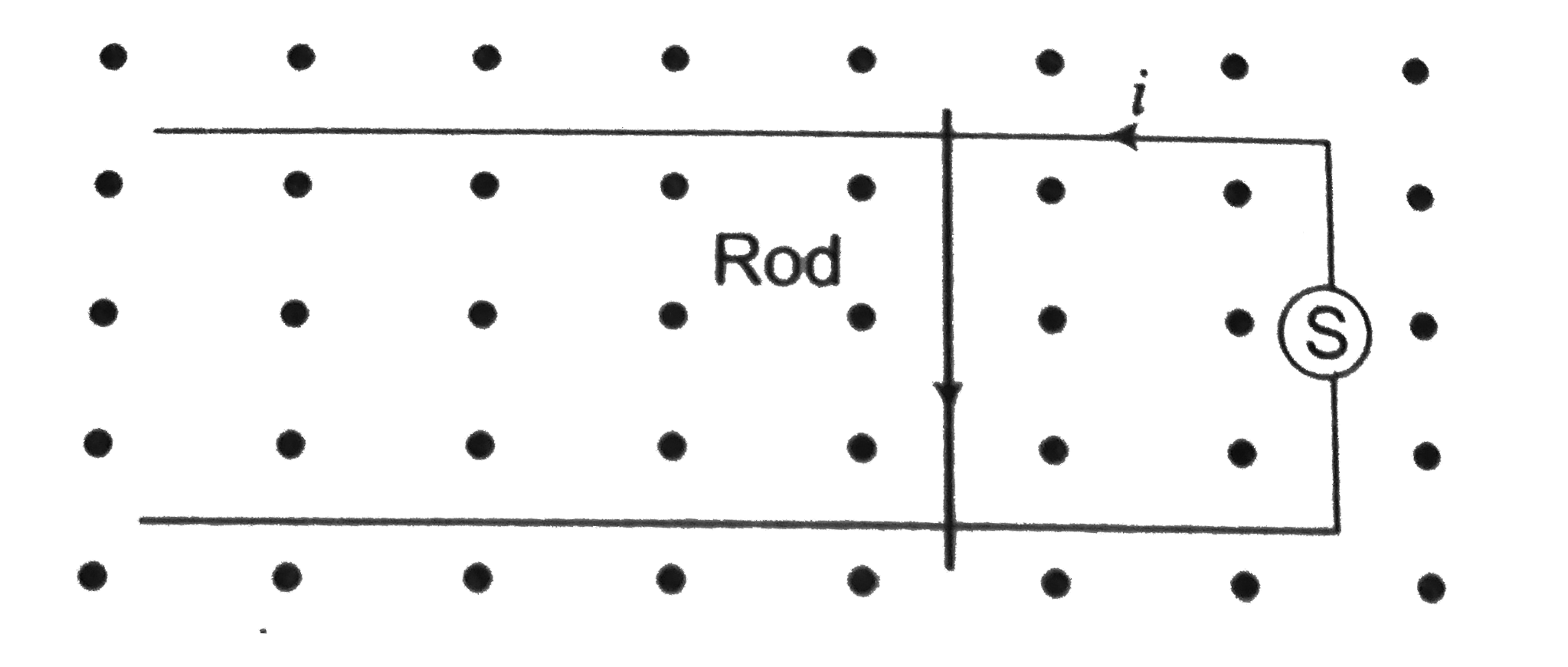
A conducting rod of mass `50 gm` and length `10 cm` can slide without friction on two long, horizontal rails. A uniform magnetic field of magnitude `5 mT` exists in the region as shown. A source `S` is used to maintain a constant current `2 A` through the rod. If motion of the rod starts from the rest, its speed after `10 s` from the start of the motion will be

Promotional Banner

Similar Questions

Explore conceptually related problems

A conducting rod of mass 200 gm and length 10 cm can slide without friction on two long, horizontal rails. A uniform magnetic field of magnitude 5 m T exists in the region as shown. A source S is used to maintain a constant current 2 A through the rod. If motion of the rod starts from the rest, find its speed (in cm/s) after 10 s from the start of the motion

A conducting rod of mass 200 gm and length 10 cm can slide without friction on two long, horizontal rails. A uniform magnetic field of magnitude 5 m T exists in the region as shown. A source S is used to maintain a constant current 2 A through the rod. If motion of the rod starts from the rest, find its speed (in cm/s) after 10 s from the start of the motion

A conducting wire of length l and mass m can slide without friction on two parallel rails and is connected to capacitance C . Whole system lies in a magnetic field B and a constant force F is applied to the rod. Then

A conducting wire of length l and mass m can slide without friction on two parallel rails and is connected to capacitance C . The whole system lies in amagnetic field B and a constant force F is applied to the rod . Then

A conducting wire of length l and mass m can slide without friction on two parallel rails and is connected to capacitance C . The whole system lies in amagnetic field B and a constant force F is applied to the rod . Then

A conducting rod of mass 1 kg and length 1 m is suspended by two strings, so as to remain horizontal. If 2T horizontal magnetic field is applied perpendicular to the length of the rod then what amount of current should be passed through this rod to remove tension in two strings ? (Take g = 10ms^(-2) )

A 20 cm long conducting rod is set into pure translation with a uniform velocity of 10cm s ^(-1) perpendicuarl to its length. A uniform magnetic field jof magnitude 0.10 T exissts in a direction perpendicuarl to the plane of motion.

A 20 cm long conducting rod is set into pure translation with a uniform velocity of 10cm s ^(-1) perpendicular to its length. A uniform magnetic field of magnitude 0.10 T exists in a direction perpendicular to the plane of motion. Find emf developed in the rod.