Home
Class 12
CHEMISTRY
The total energy of molecules is divided...

The total energy of molecules is divided equally amongst the various degrees of freedom of a molecule. The distribution of kinetic energy along x, y, z axis are `E_(K_(x)), E_(K_(y)), E_(K_(z))`
Total K.e `=E_(K_(x)) + E_(K_(y)) + E_(K_(z))`
Since the motion of molecule is equally probable in all the three directions, therefore
`E_(K_(x)) = E_(K_(y)) = E_(K_(z)) =1/3 E_(K) =1/3 xx 3/2 kT = 1/2 kT`, where `k =R/N_(A)` = Botzman constant.
`K.E. = 1/2 kT` per molecule or `=1/2 RT` per mole.
In vibration motion, molecules possess both kinetic energy as well as potential energy. This means energy of vibration involves two degrees of fiuedom.
Vibration energy `=2 xx 1/2kT =2 xx 1/2RT` [`therefore` two degrees of freedom per mole]
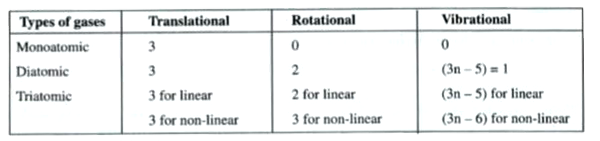
If the gas molecules have `n_(1)` translational degrees of freedom, `n_2` rotational degrees of freedom and `n_(3)` vibrational degrees of freedom, that total energy = `n_(1)[(kT)/2] + n_(2) [(kT)/2] + n_(3) [(kT)/2] xx 2`

Where 'n' is atomicity of gas.
How many total degrees of freedom are present in `H_(2)` molecules in all types of motions ?

A

3

B

5

C

6

D

4

Text Solution

Verified by Experts

The correct Answer is:

C
Promotional Banner

Topper's Solved these Questions

  • STATES OF MATTER

    AAKASH SERIES|Exercise PRACTICE SHEET (EXERCISE-III) (KINETIC MOLECULAR THEORY, MOLECULAR VELOCITY, MEAN FREE PATH, COLLISION FREQUENCY) LEVEL-II (MATRIX MATCHING TYPE QUESTIONS)|1 Videos
  • STATES OF MATTER

    AAKASH SERIES|Exercise PRACTICE SHEET (EXERCISE-III) (KINETIC MOLECULAR THEORY, MOLECULAR VELOCITY, MEAN FREE PATH, COLLISION FREQUENCY) LEVEL-II (INTEGER TYPE QUESTIONS)|1 Videos
  • STATES OF MATTER

    AAKASH SERIES|Exercise PRACTICE SHEET (EXERCISE-III) (KINETIC MOLECULAR THEORY, MOLECULAR VELOCITY, MEAN FREE PATH, COLLISION FREQUENCY) LEVEL-II (MORE THAN ONE CORRECT ANSWER TYPE QUESTIONS)|2 Videos
  • SOLUTIONS

    AAKASH SERIES|Exercise Objective Exercise -4|50 Videos
  • STOICHIOMETRY

    AAKASH SERIES|Exercise PRACTICE SHEET (ADVANCED) (INTEGER TYPE QUESTION)|2 Videos

Similar Questions

Explore conceptually related problems

The total energy of molecules is divided equally amongst the various degrees of freedom of a molecule. The distribution of kinetic energy along x, y, z axis are E_(K_(x)), E_(K_(y)), E_(K_(z)) Total K.e =E_(K_(x)) + E_(K_(y)) + E_(K_(z)) Since the motion of molecule is equally probable in all the three directions, therefore E_(K_(x)) = E_(K_(y)) = E_(K_(z)) =1/3 E_(K) =1/3 xx 3/2 kT = 1/2 kT , where k =R/N_(A) = Botzman constant. K.E. = 1/2 kT per molecule or =1/2 RT per mole. In vibration motion, molecules possess both kinetic energy as well as potential energy. This means energy of vibration involves two degrees of fiuedom. Vibration energy =2 xx 1/2kT =2 xx 1/2RT [ therefore two degrees of freedom per mole] If the gas molecules have n_(1) translational degrees of freedom, n_2 rotational degrees of freedom and n_(3) vibrational degrees of freedom, that total energy = n_(1)[(kT)/2] + n_(2) [(kT)/2] + n_(3) [(kT)/2] xx 2 Where 'n' is atomicity of gas. The rotational kinetic energy of H20 molecule is equal to

The total energy of molecules is divided equally amongst the various degrees of freedom of a molecule. The distribution of kinetic energy along x, y, z axis are E_(K_(x)), E_(K_(y)), E_(K_(z)) Total K.e =E_(K_(x)) + E_(K_(y)) + E_(K_(z)) Since the motion of molecule is equally probable in all the three directions, therefore E_(K_(x)) = E_(K_(y)) = E_(K_(z)) =1/3 E_(K) =1/3 xx 3/2 kT = 1/2 kT , where k =R/N_(A) = Botzman constant. K.E. = 1/2 kT per molecule or =1/2 RT per mole. In vibration motion, molecules possess both kinetic energy as well as potential energy. This means energy of vibration involves two degrees of fiuedom. Vibration energy =2 xx 1/2kT =2 xx 1/2RT [ therefore two degrees of freedom per mole] If the gas molecules have n_(1) translational degrees of freedom, n_2 rotational degrees of freedom and n_(3) vibrational degrees of freedom, that total energy = n_(1)[(kT)/2] + n_(2) [(kT)/2] + n_(3) [(kT)/2] xx 2 Where 'n' is atomicity of gas. The vibrational kinetic energy of CO_2 molecule is

The numerical expression for kinetic energy is K.E. = ……………………

The total energy of electron in an atom is a combination of potential energy and kinetic energy. If total energy is -E for an electron in an atom, then its K.E. and P.E. respectively are

The K.E. of a satellite is 2MJ. Its total energy is

The average K.E. of one mole of an ideal gas in calories is equal to

AAKASH SERIES-STATES OF MATTER -PRACTICE SHEET (EXERCISE-III) (KINETIC MOLECULAR THEORY, MOLECULAR VELOCITY, MEAN FREE PATH, COLLISION FREQUENCY) LEVEL-II (LINKED COMPREHENSION TYPE QUESTIONS) Passage- I
  1. The total energy of molecules is divided equally amongst the various d...

    Text Solution

    |

  2. The total energy of molecules is divided equally amongst the various d...

    Text Solution

    |

  3. The total energy of molecules is divided equally amongst the various d...

    Text Solution

    |
