Home
Class 12
CHEMISTRY
The total energy of molecules is divided...

The total energy of molecules is divided equally amongst the various degrees of freedom of a molecule. The distribution of kinetic energy along x, y, z axis are `E_(K_(x)), E_(K_(y)), E_(K_(z))`
Total K.e `=E_(K_(x)) + E_(K_(y)) + E_(K_(z))`
Since the motion of molecule is equally probable in all the three directions, therefore
`E_(K_(x)) = E_(K_(y)) = E_(K_(z)) =1/3 E_(K) =1/3 xx 3/2 kT = 1/2 kT`, where `k =R/N_(A)` = Botzman constant.
`K.E. = 1/2 kT` per molecule or `=1/2 RT` per mole.
In vibration motion, molecules possess both kinetic energy as well as potential energy. This means energy of vibration involves two degrees of fiuedom.
Vibration energy `=2 xx 1/2kT =2 xx 1/2RT` [`therefore` two degrees of freedom per mole]
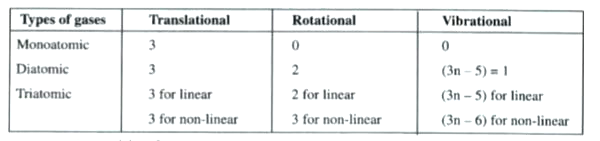
If the gas molecules have `n_(1)` translational degrees of freedom, `n_2` rotational degrees of freedom and `n_(3)` vibrational degrees of freedom, that total energy = `n_(1)[(kT)/2] + n_(2) [(kT)/2] + n_(3) [(kT)/2] xx 2`

Where 'n' is atomicity of gas.
The rotational kinetic energy of H20 molecule is equal to

A

`3/2 kT`

B

`1/2 kT`

C

kT

D

2kT

Text Solution

Verified by Experts

The correct Answer is:

A
Promotional Banner

Topper's Solved these Questions

  • STATES OF MATTER

    AAKASH SERIES|Exercise PRACTICE SHEET (EXERCISE-III) (KINETIC MOLECULAR THEORY, MOLECULAR VELOCITY, MEAN FREE PATH, COLLISION FREQUENCY) LEVEL-II (MATRIX MATCHING TYPE QUESTIONS)|1 Videos
  • STATES OF MATTER

    AAKASH SERIES|Exercise PRACTICE SHEET (EXERCISE-III) (KINETIC MOLECULAR THEORY, MOLECULAR VELOCITY, MEAN FREE PATH, COLLISION FREQUENCY) LEVEL-II (INTEGER TYPE QUESTIONS)|1 Videos
  • STATES OF MATTER

    AAKASH SERIES|Exercise PRACTICE SHEET (EXERCISE-III) (KINETIC MOLECULAR THEORY, MOLECULAR VELOCITY, MEAN FREE PATH, COLLISION FREQUENCY) LEVEL-II (MORE THAN ONE CORRECT ANSWER TYPE QUESTIONS)|2 Videos
  • SOLUTIONS

    AAKASH SERIES|Exercise Objective Exercise -4|50 Videos
  • STOICHIOMETRY

    AAKASH SERIES|Exercise PRACTICE SHEET (ADVANCED) (INTEGER TYPE QUESTION)|2 Videos

Similar Questions

Explore conceptually related problems

The total energy of molecules is divided equally amongst the various degrees of freedom of a molecule. The distribution of kinetic energy along x, y, z axis are E_(K_(x)), E_(K_(y)), E_(K_(z)) Total K.e =E_(K_(x)) + E_(K_(y)) + E_(K_(z)) Since the motion of molecule is equally probable in all the three directions, therefore E_(K_(x)) = E_(K_(y)) = E_(K_(z)) =1/3 E_(K) =1/3 xx 3/2 kT = 1/2 kT , where k =R/N_(A) = Botzman constant. K.E. = 1/2 kT per molecule or =1/2 RT per mole. In vibration motion, molecules possess both kinetic energy as well as potential energy. This means energy of vibration involves two degrees of fiuedom. Vibration energy =2 xx 1/2kT =2 xx 1/2RT [ therefore two degrees of freedom per mole] If the gas molecules have n_(1) translational degrees of freedom, n_2 rotational degrees of freedom and n_(3) vibrational degrees of freedom, that total energy = n_(1)[(kT)/2] + n_(2) [(kT)/2] + n_(3) [(kT)/2] xx 2 Where 'n' is atomicity of gas. The vibrational kinetic energy of CO_2 molecule is

The total energy of molecules is divided equally amongst the various degrees of freedom of a molecule. The distribution of kinetic energy along x, y, z axis are E_(K_(x)), E_(K_(y)), E_(K_(z)) Total K.e =E_(K_(x)) + E_(K_(y)) + E_(K_(z)) Since the motion of molecule is equally probable in all the three directions, therefore E_(K_(x)) = E_(K_(y)) = E_(K_(z)) =1/3 E_(K) =1/3 xx 3/2 kT = 1/2 kT , where k =R/N_(A) = Botzman constant. K.E. = 1/2 kT per molecule or =1/2 RT per mole. In vibration motion, molecules possess both kinetic energy as well as potential energy. This means energy of vibration involves two degrees of fiuedom. Vibration energy =2 xx 1/2kT =2 xx 1/2RT [ therefore two degrees of freedom per mole] If the gas molecules have n_(1) translational degrees of freedom, n_2 rotational degrees of freedom and n_(3) vibrational degrees of freedom, that total energy = n_(1)[(kT)/2] + n_(2) [(kT)/2] + n_(3) [(kT)/2] xx 2 Where 'n' is atomicity of gas. How many total degrees of freedom are present in H_(2) molecules in all types of motions ?

The numerical expression for kinetic energy is K.E. = ……………………

The average K.E. of one mole of an ideal gas in calories is equal to

The total energy of electron in an atom is a combination of potential energy and kinetic energy. If total energy is -E for an electron in an atom, then its K.E. and P.E. respectively are

The K.E. of a satellite is 2MJ. Its total energy is

AAKASH SERIES-STATES OF MATTER -PRACTICE SHEET (EXERCISE-III) (KINETIC MOLECULAR THEORY, MOLECULAR VELOCITY, MEAN FREE PATH, COLLISION FREQUENCY) LEVEL-II (LINKED COMPREHENSION TYPE QUESTIONS) Passage- I
  1. The total energy of molecules is divided equally amongst the various d...

    Text Solution

    |

  2. The total energy of molecules is divided equally amongst the various d...

    Text Solution

    |

  3. The total energy of molecules is divided equally amongst the various d...

    Text Solution

    |
