

Home
Class 12
PHYSICS
An aluminium wire and a steel wire of sa...

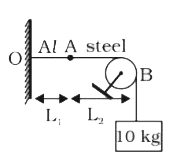
An aluminium wire and a steel wire of same cross-sectional of `10^(-2)cm^(2)` were connected together. A 10 kg block loaded on the compound wire as shown in figure. Waves are set up in the compound wire. The minimum frequency of excitation for which standing waves are observed with point A as a node is `[L_(1)=60cm,L_(2)=86.6cm]` density of aluminium `=2.6g//cm^(3)` and of steel=`7.8g//cm^(3)`]

Promotional Banner

Similar Questions

Explore conceptually related problems

A steel wire of length 50sqrt(3) cm is connected to an aluminium wire of length 60 cm and stretched between two fixed supports. The tension produced is 104 N , if the cross section area of each wire is 1mm^(2) . If a transverse wave is set up in the wire, find the lowest frequency for which standing waves with node at the joint are produced . (density of aluminimum = 2.6 gm//cm^(3) and density of steel = 7.8 gm//cm^(3) ).

A steel wire of length 50sqrt(3) cm is connected to an aluminium wire of length 60 cm and stretched between two fixed supports. The tension produced is 104 N , if the cross section area of each wire is 1mm^(2) . If a transverse wave is set up in the wire, find the lowest frequency for which standing waves with node at the joint are produced . (density of aluminimum = 2.6 gm//cm^(3) and density of steel = 7.8 gm//cm^(3) ).

Figure shows an aluminium wire of length 60 cm joined to a steel wire of length 80 cm and stretched between two fixed supports. The tension produced is 40 N . The cross-sectional area of the steel wire is 1.0 mm^(2) and that of the aluminimum wire is 3.0 mm^(2) The minimum frequency of a tuning fork which can produce standing waves in the system with the joint as a node is 10P (in Hz ) the find P . Given density of aluminimum is 2.6 g//cm^(3) and that of steel is 7.8 g//cm^(3) .

Figure shows an aluminium wire of length 60 cm joined to a steel wire of length 80 cm and stretched between two fixed supports. The tension produced is 40 N . The cross-sectional area of the steel wire is 1.0 mm^(2) and that of the aluminimum wire is 3.0 mm^(2) The minimum frequency of a tuning fork which can produce standing waves in the system with the joint as a node is 10P (in Hz ) the find P . Given density of aluminimum is 2.6 g//cm^(3) and that of steel is 7.8 g//cm^(3) .

Figure shows an aluminium wire of length 60 cm joined to a steel wire of length 80 cm and stretched between two fixed supports. The tension produced is 40 N . The cross-sectional area of the steel wire is 1.0 mm^(2) and that of the aluminimum wire is 3.0 mm^(2) The minimum frequency of a tuning fork which can produce standing waves in the system with the joint as a node is 10P (in Hz ) the find P . Given density of aluminimum is 2.6 g//cm^(3) and that of steel is 7.8 g//cm^(3) .

An aluminium wire of length 0.6 m and cross sectioal are and length 0.866 m .The compound wire is loaded with 10kg.Find the lowest frequency of exciation for which the joint In the the wire.The density of alumimium is 2600 kg m^(-3) and that of steel is 7800 kgm^(-3)

An aluminium wire of cross-sectional area (10^-6)m^2 is joined to a steel wire of the same cross-sectional area. This compound wire is stretched on a sonometer pulled by a weight of 10kg. The total length of the compound wire between the bridges is 1.5m of which the aluminium wire is 0.6 m and the rest is steel wire. Transverse vibrations are setup in the wire by using an external source of variable frequency. Find the lowest frequency of excitation for which the standing waves are formed such that the joint in the wire is a node. What is the total number of nodes at this frequency? The density of aluminium is 2.6 xx (10^3) kg//m^3 and that of steel is 1.04 xx 10^(4) kg//m^2 (g = 10m//s^2)