

Home
Class 12
PHYSICS
Light having photon energy hupsilon is i...


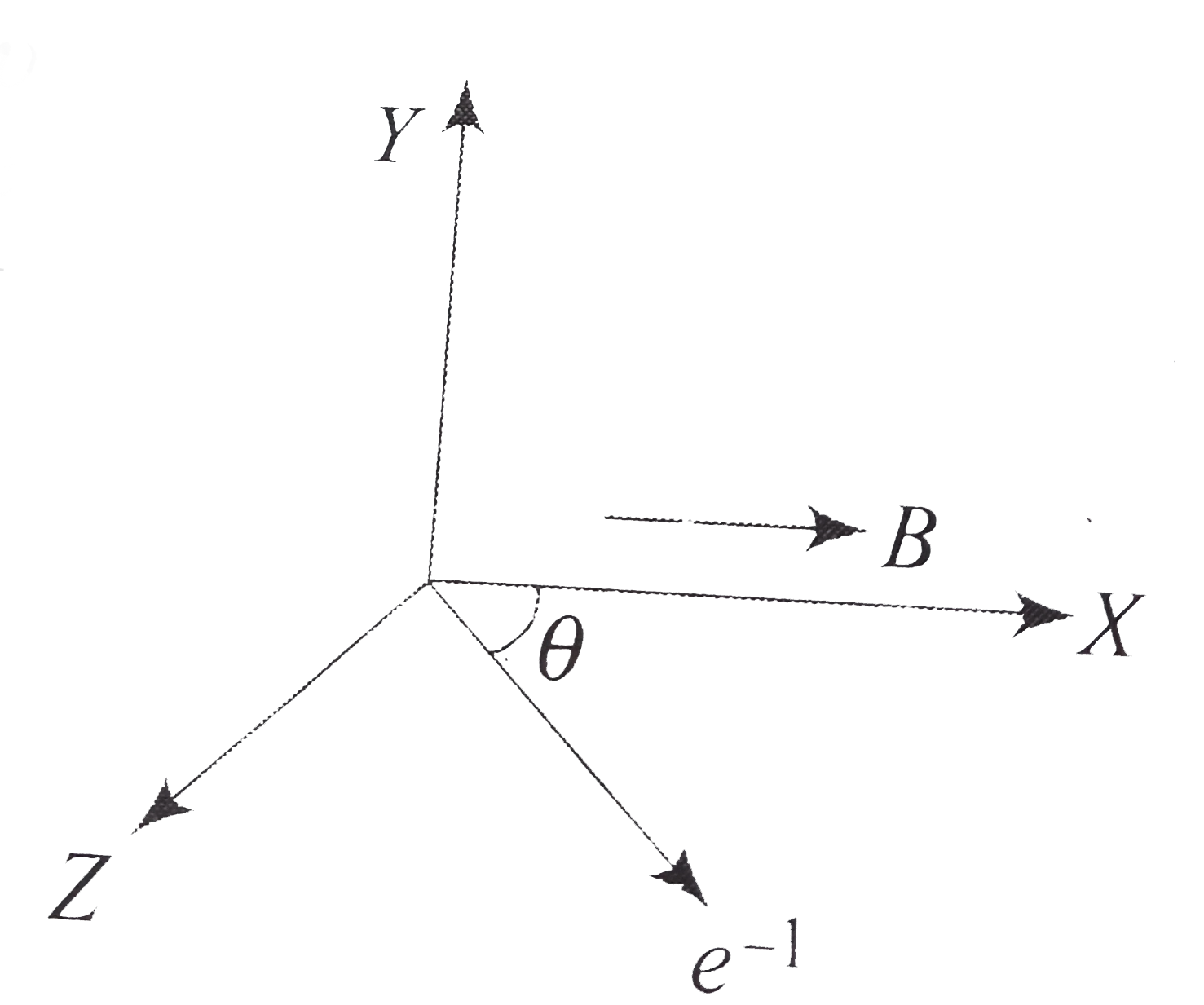
Light having photon energy `hupsilon` is incident on a metallic plate having work function `phi` to eject the electrons. The most energetic enectrons are then allowed to enter in a region of uniform magnetic field B as shown in Fig. The electrons are projected In X-Z plane making an angle `theta` with X-axis and magnetic field is `vecB=B_0hati` along X-axis maximum pitch of the helix described by an electron is found to be p. Take mass of electron as m and charge as q. Based on the above information, answer the following questions:
Q. Considering the instant of crossing origin at `t=0` ,the Z-coordinate of the location of electron as a function of time is

Promotional Banner

Similar Questions

Explore conceptually related problems

Light having photon energy hupsilon is incident on a metallic plate having work function phi to eject the electrons. The most energetic enectrons are then allowed to enter in a region of uniform magnetic field B as shown in Fig. The electrons are projected In X-Z plane making an angle theta with X-axis and magnetic field is vecB=B_0hati along X-axis maximum pitch of the helix described by an electron is found to be p. Take mass of electron as m and charge as q. Based on the above information, answer the following questions: Q. The correct relation between p and B_0 is

Light having photon energy hupsilon is incident on a metallic plate having work function phi to eject the electrons. The most energetic enectrons are then allowed to enter in a region of uniform magnetic field B as shown in Fig. The electrons are projected In X-Z plane making an angle theta with X-axis and magnetic field is vecB=B_0hati along X-axis maximum pitch of the helix described by an electron is found to be p. Take mass of electron as m and charge as q. Based on the above information, answer the following questions: Q. The correct relation between p and B_0 is

Light having photon energy hupsilon is incident on a metallic plate having work function phi to eject the electrons. The most energetic enectrons are then allowed to enter in a region of uniform magnetic field B as shown in Fig. The electrons are projected In X-Z plane making an angle theta with X-axis and magnetic field is vecB=B_0hati along X-axis maximum pitch of the helix described by an electron is found to be p. Take mass of electron as m and charge as q. Based on the above information, answer the following questions: Q. The plot between X-coordinate of the location of electron as a function of time for different frequencies upsilon of the incident light is

Light having photon energy hupsilon is incident on a metallic plate having work function phi to eject the electrons. The most energetic enectrons are then allowed to enter in a region of uniform magnetic field B as shown in Fig. The electrons are projected In X-Z plane making an angle theta with X-axis and magnetic field is vecB=B_0hati along X-axis maximum pitch of the helix described by an electron is found to be p. Take mass of electron as m and charge as q. Based on the above information, answer the following questions: Q. The plot between X-coordinate of the location of electron as a function of time for different frequencies upsilon of the incident light is

A beam of 450 nm light is incident on a metal having work function 2eV and placed in a magnetic field B. If the most energetic electrons emitted are bent into circular are of radius 0.2 m, find B.

An electron is moving along + X axis in a magnetic field along +Y axis. The electron will experience a force

An electron is moving along X axis and a magnetic field is directed along Y axis. What will he the direction of magnetic force acting on the electron?

A beam of 450 nm light is incident on a metal having work function 2.0 eV and placed in a magnetic field B. The most energetic electrons emitted perpendicular to the field are bent in circular arcs of radius 20 cm. Find the value of B.

A beam of 450 nm light is incident on a metal having work function 2.0 eV and placed in a magnetic field B. The most energetic electrons emitted perpendicular to the field are bent in circular arcs of radius 20 cm. Find the value of B.