

Home
Class 11
PHYSICS
Two block A of 6 kg and B of 4 kg are pl...

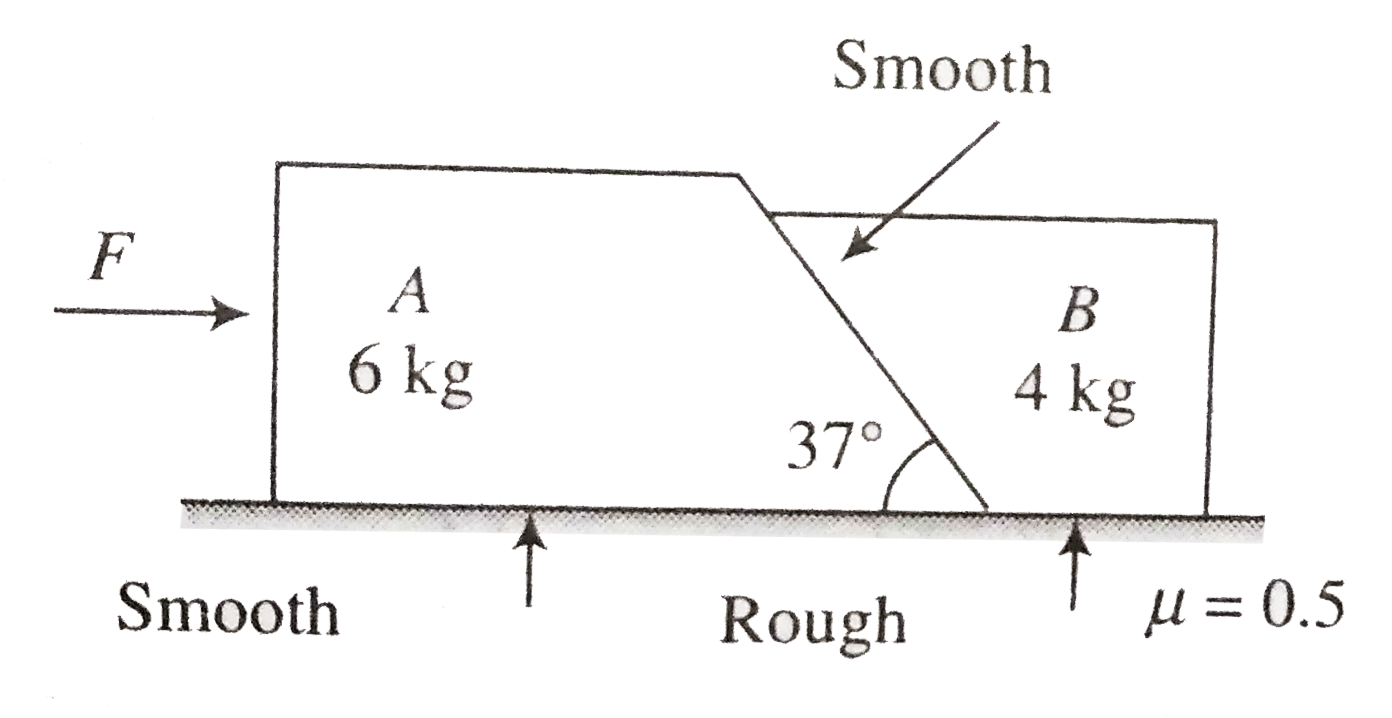
Two block A of `6 kg` and B of `4 kg` are placed in contact with each other as shown in figure

There is no friction A and ground and between both the blocks .The coefficient of friction between B and ground is `0.5` A horizontal force `F` is applied on A find the minimum and maximum value of `F` which can be applied so that both blocks can move combinely without any relative between them.

Promotional Banner

Similar Questions

Explore conceptually related problems

Two blocks A and B are lying on the table as shown in the figure. The coefficient of friciton between block A and block B is mu . The coefficient of friction between block B and ground also mu . An external force F is applied in the direction shown. The maximum value of the force F that can be applied without moving the blocks.

Two blocks A and B are lying on the table as shown in the figure. The coefficient of friciton between block A and block B is mu . The coefficient of friction between block B and ground also mu . An external force F is applied in the direction shown. The maximum value of the force F that can be applied without moving the blocks.

Two blocks A and B of masses 10 kg and 15 kg are placed in contact with each other rest on a rough horizontal surface as shown in the figure. The coefficient of friction between the blocks and surface is 0.2. A horizontal force of 200 N is applied to block A. The acceleration of the system is ("Take g"=10ms^(-2))

Two blocks A and B of masses 10 kg and 15 kg are placed in contact with each other rest on a rough horizontal surface as shown in the figure. The coefficient of friction between the blocks and surface is 0.2. A horizontal force of 200 N is applied to block A. The acceleration of the system is ("Take g"=10ms^(-2))

Consider the situation shown in the figure . The coefficient of friction between the blocks is mu . Find the minimum and the maximum force F that can be applied so that two blocks move together.

The two blocks, m= 10 kg and M = 50 kg are free to move as shown. The coefficient of static friction between the blocks is 0.5 and there is no friction between M and the ground. A minimum horizontal force F is applied to hold m against M that is equal to -

A plank of mass 10 kg and a block of mass 2 kg are placed on a horizontal plane as shown in the figure. There is no friction between plane and plank. The coefficient of friction between block and plank is 0.5 .A force of 60 N is applied on plank horizontally. In first 2 s the work done by friction on the block is

A plank of mass 10 kg and a block of mass 2 kg are placed on a horizontal plane as shown in the figure. There is no friction between plane and plank. The coefficient of friction between block and plank is 0.5 .A force of 60 N is applied on plank horizontally. In first 2 s the work done by friction on the block is

Two blocks A and B are as shown in figure. The minimum horizontal force F applied to the block B for which slipping behins between B and ground is :

Two block A and B are as shown in figure. The minimum horizantal force F applied to the block B for which slipping begins between B and ground is :