

Home
Class 11
PHYSICS
In the figure a uniform rod of mass 'm' ...

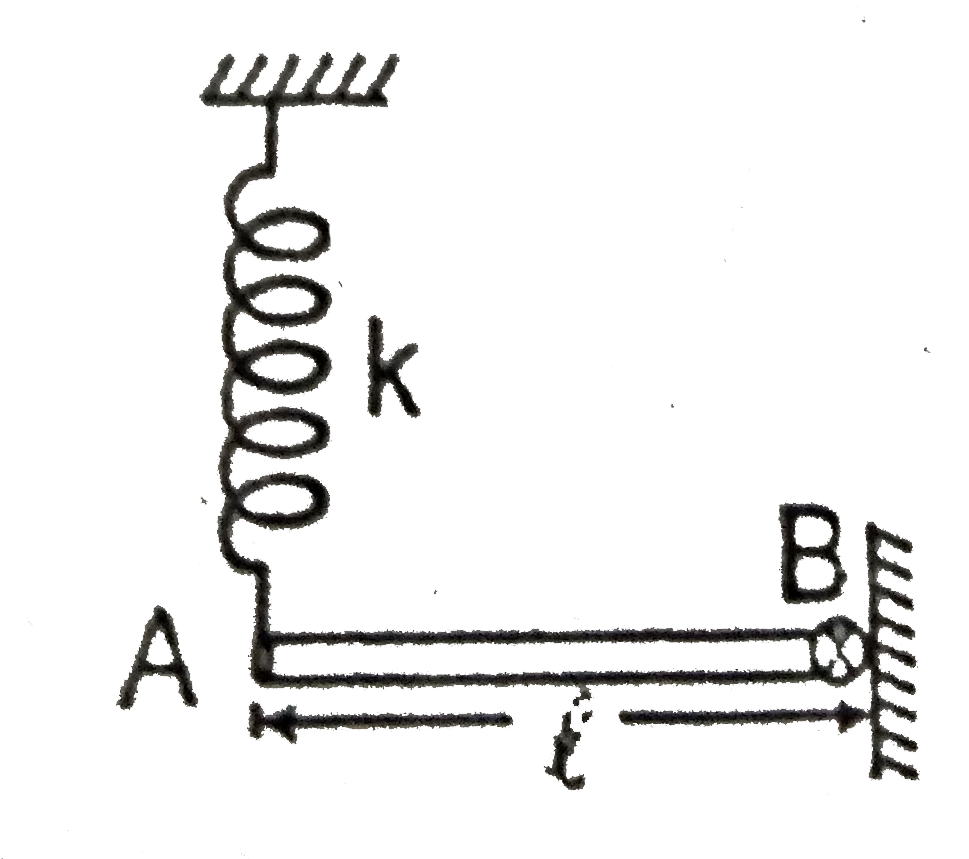
In the figure a uniform rod of mass `'m'` and length `'l'` is hinged at one end and the other end is connected to a light vertical of spring constant `'k'` as shown in figure. The spring has extension such that rod is equilibrium when it is horizontal . The rod rotate about horizontal axis passing through end `'B'`. Neglecting friction at the hinge find `(a)` extension in the spring `(b)` the force on the rod due to hinge.

Promotional Banner

Similar Questions

Explore conceptually related problems

A rod PQ of mass M and length L is hinged at end P. The rod is kept horizontal by a mass less than string tied at a point Q as shown in figure. When string is cut, the initial acceleration rod is:

A rod PQ of mass M and length L is hinged at end P. The rod is kept horizontal by a massless string tied to point Q as shown in figure. When string is cut, the initial angular acceleration of the rod is

A rod PQ of mass M and length L is hinged at end P. The rod is kept horizontal by a massless string tied to point Q as shown in figure. When string is cut, the intial angular acceleration of the rod is

A uniform rod of mass M and length L is hinged at its end. The rod is released from its vertical position by slightly pushing it. What is the reaction at the hinge when the rod becomes horizontal, again vertical.

A uniform rod of mass m is hinged at one end and other end is connected to a light extensible string having length L.If the Young s modulus and crosssectional area of the wire is Y and A respectively then the elongation in the string is

A rod PQ of mass M and length L is hinged at end P . The rod is kept horizontal by a massless string tied to point Q as shown in the figure. When string is cut, the initial angular accleration of the rod is.

A rod PQ of mass M and length L is hinged at end P . The rod is kept horizontal by a massless string tied to point Q as shown in the figure. When string is cut, the initial angular accleration of the rod is.