

Home
Class 11
PHYSICS
The two wires shown in figure are made o...

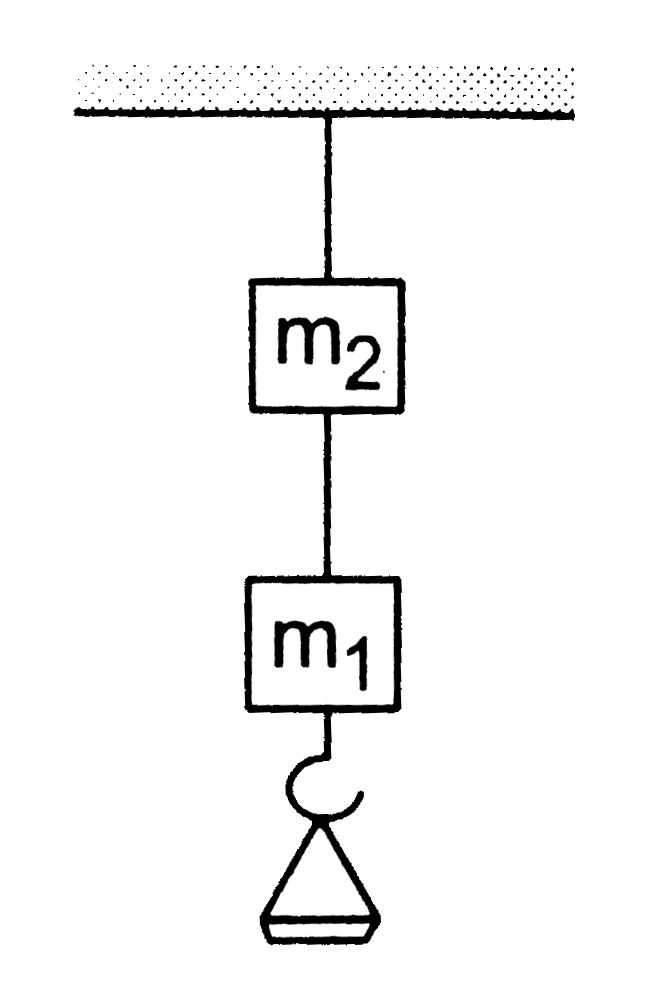
The two wires shown in figure are made of the same material which has a breaking stress of `8xx10^8Nm^-2`. The area of cross section of the upper wire is 0.006 cm^2 and that of the lower wire is 0.003 cm^2. The mass `m-1=10 kg, m_2=20kg` and teh hanger is light. a. Fidn the maximum load that casn be put on the hanger without breaking a wire. Which wire will break first if the load is increased? b. Repeat the above part `m_1=10 kg and m_2=36kg`.

Promotional Banner

Similar Questions

Explore conceptually related problems

The two wires shown in figure are made of the same material which has a breaking stress of 8xx10^8Nm^-2 . The area of cross section of the upper wire is 0.006 cm^2 and that of the lower wire is 0.003 cm^2 . The mass m_1=10 kg , m_2=20kg and the hanger is light. a. Find the maximum load that can be put on the hanger without breaking a wire. Which wire will break first if the load is increased? b. Repeat the above part m_1=10 kg and m_2=36kg .

The two wires shown in figure are made of the same material which has a breaking stress of 8xx10^8Nm^-2 . The area of cross section of the upper wire is 0.006 cm^2 and that of the lower wire is 0.003 cm^2 . The mass m_1=10 kg , m_2=20kg and the hanger is light. a. Find the maximum load that can be put on the hanger without breaking a wire. Which wire will break first if the load is increased? b. Repeat the above part m_1=10 kg and m_2=36kg .

Two wires shown in figure are made of the same material which has a breaking stress of 8xx10^(8) N/m^(2) . The area of cross- section of the upper wire is 0.006 cm^(2) and that of the lower wire is 0.003 cm^(2) . The mass m_(1) = 10 kg, m_(2) = 20 kg and the hanger is light . Find the maximum load that can be put on the hanger without breaking a wire. Which wire will break first if the load is increased ? ( Take g = 10 m//s^(2))

The breaking stress for a wire of unit cross-section is called

The breaking stress for a wire of unit cross-section is called

Wires W_(1) and W _(2) are made of same material having the breaking stress of 1.25 xx 10 ^(9) N//m ^(2). W _(1) and W _(2) have cross-sectional area of 8 xx 10 ^(-7) m ^(2) and 4 xx 10 ^(-7) m ^(2), respectively. Masses of 20 kg and 10 kg hang from them as shown in the figure. The maximum mass that can be placed in the pan without breaking the wires is kg. (Use g = 10 m//s ^(2) )

A bob of mass 10 kg is attached to a wire 0.3 m long. Its breaking stress is 4.8xx10^(7) N//m^(2) . Then area of cross-section of the wire is 10^(-6) m^(2) . What is the maximum angular velocity with which it can be rotated in a horizontal circle?

A bob of mass 10 kg is attached to a wire 0.3 m long. Its breaking stress is 4.8xx10^(7) N//m^(2) . Then area of cross-section of the wire is 10^(-6) m^(2) . What is the maximum angular velocity with which it can be rotated in a horizontal circle?

A bob of mass 10 kg is attached to wire 0.3 m long. Its breaking stress is 4.8 xx 10^(7) N//m^(2) . The area of cross section of the wire is 10^(-6) m^(2) . The maximum angular velocity with which it can be rotated in a horizontal circle