

Home
Class 9
MATHS
Over the past 200 working days , the num...

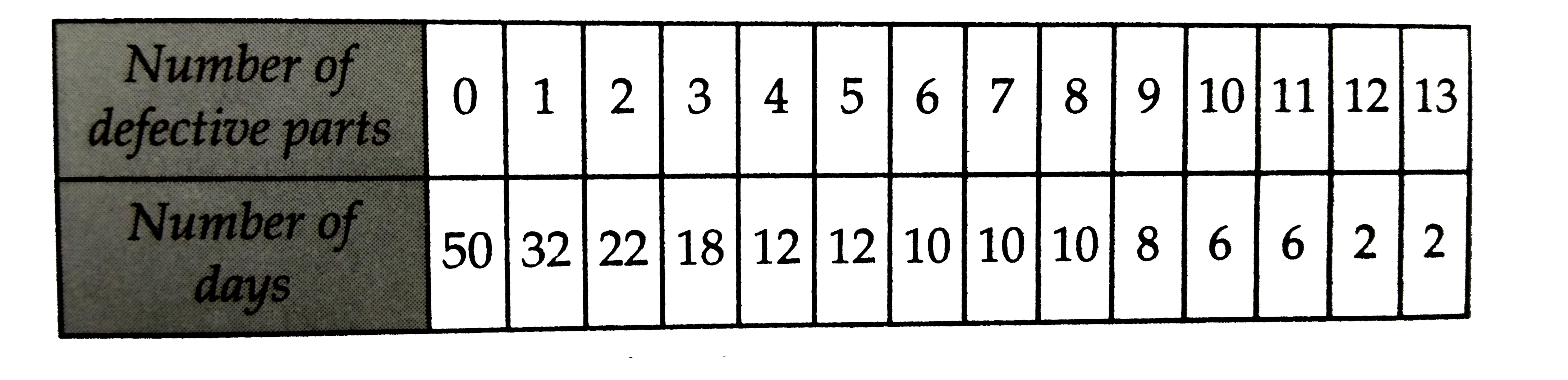
Over the past 200 working days , the number of defective parts produced by a machine is given in the following table :

From these days , one day is chosen at random . What is the probability that on that day , the output has
(i) no defective part ?
(ii) at least 1 defective part ?
(iii) not more than 5 defective parts ?
(iv) more than 5 , but less than 8 defective parts ?
(v) more than 13 defective parts ?

Promotional Banner

Similar Questions

Explore conceptually related problems

Over the past 200 working days, the number of defective parts produced by a machine is given is given in the followig table. Determine the probability that tomorrow's output will have

Over the past 200 working days, the number of defective parts produced by a machine is given is given in the followig table. Determine the probability that tomorrow's output will have

Over the apst 200 working days, the number of defective parts produced by a machine is given in the following table: Determine the probability that tommorow's output will have no defective part.

Over the apst 200 working days, the number of defective parts produced by a machine is given in the following table: Determine the probability that tommorow's output will have at least one defective part.

Over the apst 200 working days, the number of defective parts produced by a machine is given in the following table: Determine the probability that tommorow's output will have not more than 5 defective parts.

Over the apst 200 working days, the number of defective parts produced by a machine is given in the following table: Determine the probability that tommorow's output will have more than 13 defective parts.

Over the past 200 working days, the number of defective parts produced by a machine is given in the following table : |{:("Number of","0 1 2 3 4 5 6 7 8 9 10 11 12 13"),("defective parts",),("Days","50 32 22 18 12 12 10 10 10 8 6 6 2 2"):}| Determine the probability that tomorrow's output will have : (i) no defective part. (ii) at least one defective part, (iii) not more than 5 defective parts, (iv) more than 13 defective parts.

Over the past 200 working days, the number of defective parts produced by a machine is given in the following table : |{:("Number of","0 1 2 3 4 5 6 7 8 9 10 11 12 13"),("defective parts",),("Days","50 32 22 18 12 12 10 10 10 8 6 6 2 2"):}| Determine the probability that tomorrow's output will have : (i) no defective part. (ii) at least one defective part,(iii) more than 13 defective parts.

Bulbs are packed in cartons , each containing 40 bulbs . 700 cartons were examined for defective bulbs and the results are given in the following table : One carton is selected at random. What is the probability that it has (i) no defective bulb? (ii) defective bulbs less than 4 ? (iii) defective bulbs more than 3 but less than 6 ? (iv) defective bulbs 6 or more ?

In a batch of 10 light bulbs , 2 are defective . If 3 of the bulbs are chosen at random, what is the probability that at least 1 of the chosen bulbs is defective ?