

Home
Class 12
PHYSICS
A small cork ball A of mass m is suspend...

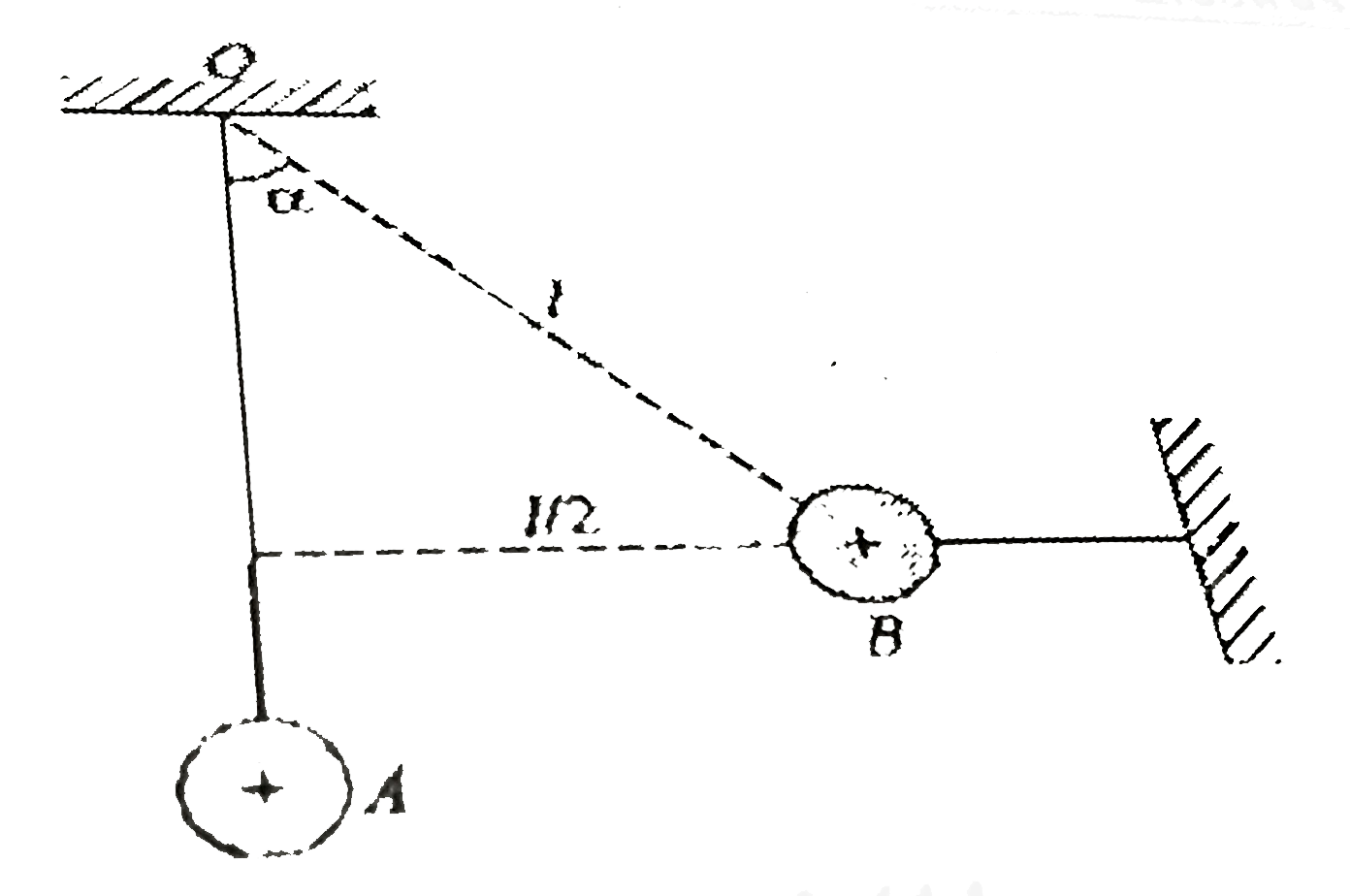
A small cork ball A of mass m is suspended by a thread of length I. Another ball B is fixed at a distance I from point of suspension and distance l/2 from thread when is vertical, as shown in figure-1.444. Balls A and B have charges (+ q) each. Ball A is held by an external force such that the thread remains vertical.

When ball A is released from rest, thread deflects through a . maximum angle of `beta = 30^(@)`, calculate m in terms of other parameters

Promotional Banner

Similar Questions

Explore conceptually related problems

A small cork ball with a mass 0.58 g is suspended from a thread 10 cm long. Another ball is fixed at a distance 10 cm from the point of suspension and at a distance of 5 cm from the thread as shown in the figure What shoud the magnitude of the like and equal charges on the balls be t deflect the thread through 30^@ ?

A ball of mass m is suspended by a thread of length l. With what minimum velocity has the point of suspension to be shifted in the horizontal direction for the ball to move along the circle about that point? What will be the tension of the thread at the moment it will be passing the horizontal position?

A sphere is suspended by a thread of length l. What minimum horizontal velocity has to be imparted the ball for it to reach the height of the suspension?

A spere is suspended by a thread of length l. What minimum horizontal velocity has to be imparted to the ball for it to reach the height of the suspension?

A sphere is suspended by a thread of length l. What minimum horizontal velocity has to be imparted to the ball for it to reach the height of the suspension?

A small ball of mass m having charge q is suspended by a string of length L . Another identical ball having the same charge is kept at the point of suspension. Determine the minimum horizontal velocity which should be imparted to ball at lowest point so that it can make complete revolution.

A small metal ball of mass m is suspended from a thread of length l between the plates of a large plane capacitor. How will the period of oscillations of such a pendulum change, if a charge + q is placed on the ball and the upper plate is negatively charged?

A small metal ball of mass m is suspended from a thread of length l between the plates of a large plane capacitor. How will the period of oscillations of such a pendulum change, if a charge + q is placed on the ball and the upper plate is positively charged