

Home
Class 12
PHYSICS
Three particles A, B and C each of mass ...

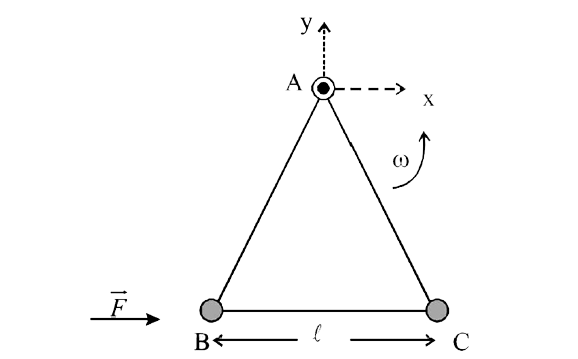
Three particles A, B and C each of mass m, are connected to each other by three massless rigid rods to form a rigid, equilateral triangular body of side l. This body is placed on a horizonta frictionsess table (x-y plane) and is hinged to it at the point A so that it can move without friction about the vertical axis through A . the body is set into rotational motion on the table about A with a constant angular velocity `omega`.

(a) Find the magnitude of the horizontal force exerted by the hinge on the body.
(b) At time T, when the side BC is parallel to the x-axis, a force F is applied on B along BC (as shown). Obtain the x-component and the y-component of the force exerted by the hinge on the body, immediately after time T.

Promotional Banner

Similar Questions

Explore conceptually related problems

Three particles each of mass 'm' are kept at the three vertices of an equilateral triangle of side 'a'. Moment of inertia of the system about an axis passing through the centroid and perpendicular to its plane is

Three equal masses m are rigidly connected to each other by massless rods of length l forming and equilateral triangle, as shown above. The assembly is to be given an angular velocity omega about an axis perpendicular to the triangle. For fixed omega , what is the ratio of the kinetic energy of the assembly for an axis through B t compared with that for an axis through A . .

Three equal masses m are rigidly connected to each other by massless rods of length l forming and equilateral triangle, as shown above. The assembly is to be given an angular velocity omega about an axis perpendicular to the triangle. For fixed omega , what is the ratio of the kinetic energy of the assembly for an axis through B t compared with that for an axis through A . .

Three particles each of mass 100 g are placed at the vertices of an equilateral triangle of side length 10 cm. Find the moment of inertia of the system about an axis passing through the centroid of the triangle and perpendicular to its plane.

Three particles each of mass m are kept at the vertices of an equilateral triangle of side L . What is the gravitational potential at the centroid of the triangle?

Three identical rods, each of length L , are joined to form a rigid equilateral triangle. Its radius of gyration about an axis passing thorugh a corner and perpendicular to plane of triangle is