

Home
Class 11
PHYSICS
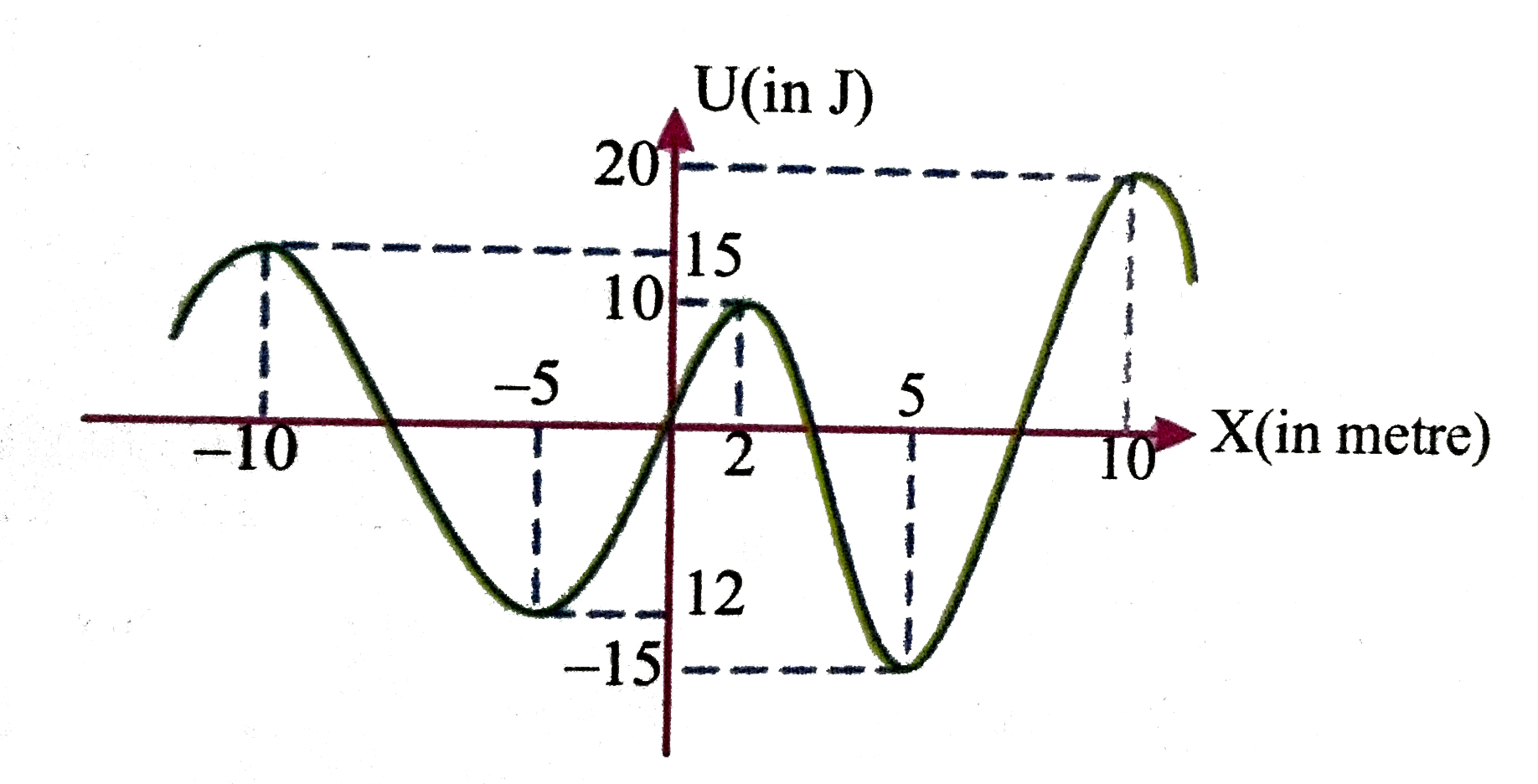
In the figure the variation of potential...

In the figure the variation of potential energy of a particle of mass `m = 2kg` is represented w.r.t. its x-coordinate. The particle moves under the effect of this conservative force along the x-axis.

`x = - 5m` and `x = 10 m` position of the particle are respectively of

Promotional Banner

Similar Questions

Explore conceptually related problems

In the figure the variation of potential energy of a particle of mass m = 2kg is represented w.r.t. its x-coordinate. The particle moves under the effect of this conservative force along the x-axis. If the particle is released at the origin then

In the figure the variation of potential energy of a particle of mass m=2kg is represented w.r.t. its x-coordinate. The particle moves under the effect of this conservative force along the x-axis. Which of the following statements are correct about the particle:

In the figure, the variation of potential energy of a particle of mass m = 2kg is represented with respect to its x-coordinate. The particle moves under the effect of this conservative force along the X-axis. If the particle is released at the origin, then

In figure, the variation of potential energy of a particle of mass m=2kg is represented w.r.t its x-coordinate. The particle moves under the effect of the conservative force along the x-axis. Which of the following statements is incorrect about the particle?

In figure, the variation of potential energy of a particle of mass m=2kg is represented w.r.t its x-coordinate. The particle moves under the effect of the conservative force along the x-axis. Which of the following statements is incorrect about the particle?

The variation of potential energy of a particle of mass m = 5kg to its x-coordinate . The particle moves under the effect of this conservative force only along the x-axis. Then, choose the correct option.

In the figure, the variation of potential energy of a particle of mass m = 2kg is represented with respect to its x-coordinate. The particle moves under the effect of this conservative force along the X-axis. If the particle is released at x = 2 + Delta where Delta rarr 0 (it is positive), then its maximum speed in subsequent motion will be

In the figure, the variation of potential energy of a particle of mass m = 2kg is represented with respect to its x-coordinate. The particle moves under the effect of this conservative force along the X-axis. If the particle is released at x = 2 + Delta where Delta rarr 0 (it is positive), then its maximum speed in subsequent motion will be

In the figure, the variation of potential energy of a particle of mass m = 2kg is represented with respect to its x-coordinate. The particle moves under the effect of this conservative force along the X-axis. If the particle is released at the origin, then (A)it will move towards positive x-axis (B)it will move towards negative x-axis (C)it will remain stationary at the origin (D)Either of (a) or (b)