

Home
Class 11
PHYSICS
A very stiff bar (AB) of negligible mass...

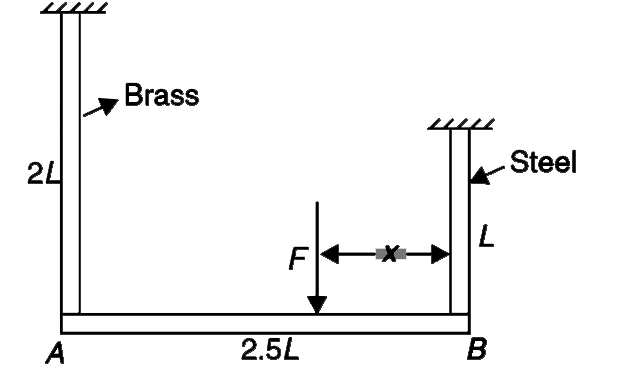
A very stiff bar (AB) of negligible mass is suspended horizontally by two vertical rods as shown in figure. Length of the bar is 2.5 L. The steel rod has length L and cross sectional radius of r and the brass rod has length 2L and cross sectional radius of 2r . A vertically downward force F is applied to the bar at a distance x from the steel rod and the bar remains horizontal. Find the value of x if it is given that ratio of Young’s modulus of steel and brass is `(Y_(s))/(Y_(B)) = 2`.

Promotional Banner

Similar Questions

Explore conceptually related problems

A uniform rod of length 3L and mass m is suspended from a horizontal roof by two strings of length L and 2L as shown. Then the tension in the left string of length L is :

Two light vertical springs with equal natural length and spring constants k_(1) and k_(2) are separated by a distance l . Their upper end the ends A and B of a light horizontal rod AB . A vertical downwards force F is applied at point C on the rod. AB will remain horizontal in equilibrium if the distance AC is

A steel uniform rod of length 2L cross sectional area A and mass Mis set rotating in a horizontal plane about an axis passing through the centre. If Y is the Young's modulus for steel, find the extension in the length of the rod.

A light rod of length 200 cm is suspended from the ceiling horizontally by means of two vertical wires of equal length tied on its end. One of the wires is made of steel and has area of cross-section 0.1 cm^2 and the order of brass of cross-sectional area 0.2 cm^2. An object of mass m is hung to the rod. (Y_"steel"=2xxY_"brass") At which distance from one end of the rod should a weight be hung to produce equal strains in both the wires?

A uniform cylindrical rod of length L and cross-sectional area by forces as shown in figure. The elongation produced in the rod is

A uniform rod weights W, has length L and cross sectional area a. The rod is suspended from one of its ends. The young's modulus of its material is Y. Increase in length of the rod will be

If breaking stress of a wire of length L and radius of cross-section r is P N//m^(2) , then breaking stress of wire of same material of length 2 L and radius of cross section (r/2) will be

A uniform cylindrical rod of length L, cross-sectional area A and Young's modulus Y is acted upon by the forces as shown in figure. The elongation of the rod is