

Home
Class 11
PHYSICS
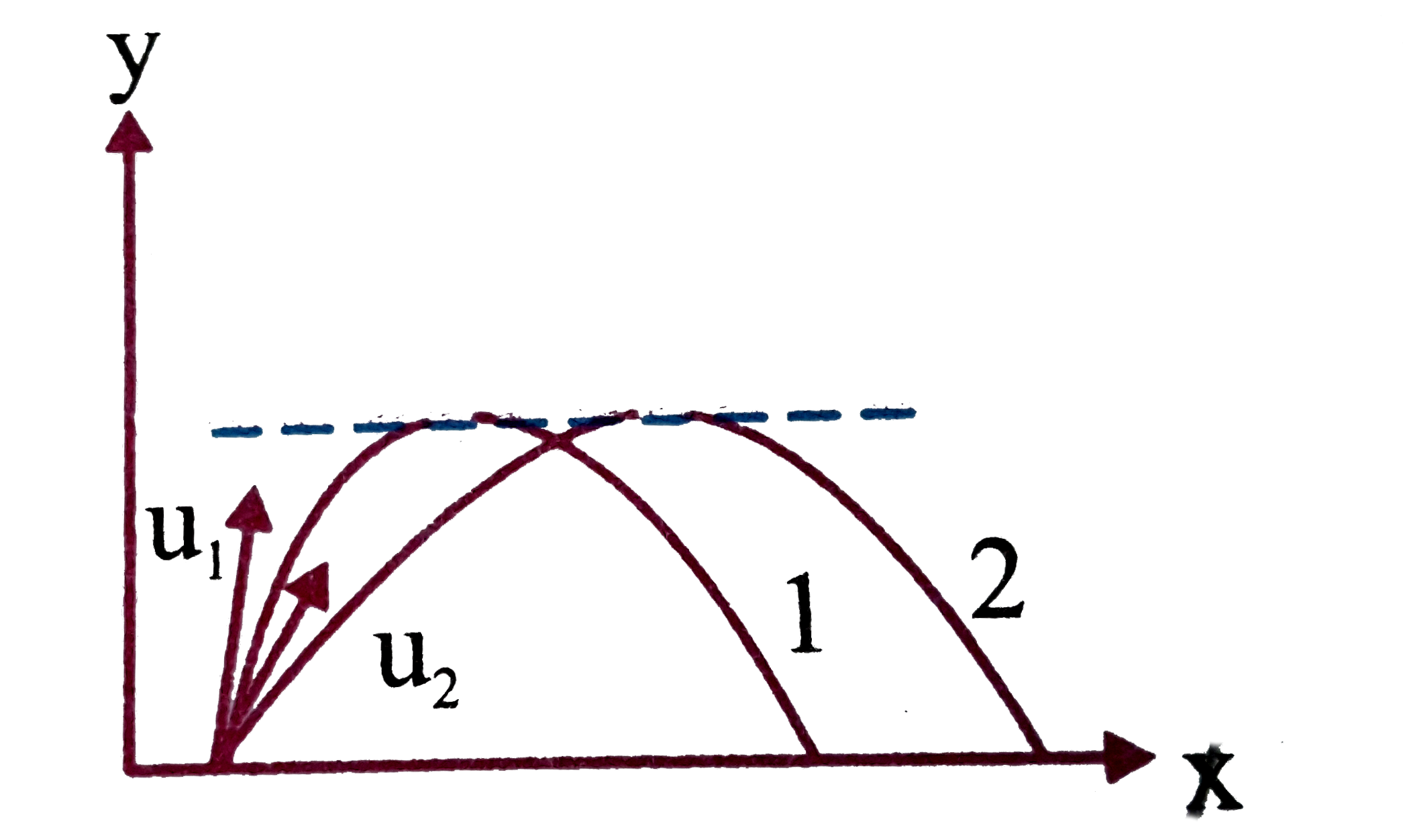
Trajectories of two projectiles are show...

Trajectories of two projectiles are shown in figure.Let `T_(1)` and `T_(2)` be the time periods and `u_(1)` and `u_(2)` their speeds of projection.Then

Promotional Banner

Similar Questions

Explore conceptually related problems

Trajectories of two projectiles are shown in the figure. Let T_(1) and T_(2) be the time period and u_(1) & u_(2) speeds of projection. Then

Two stones are projected from level ground. Trajectory of two stones are shown in figure. Both stones have same maximum heights above level ground as shown. Let T_(1) and T_(2) be their time of flights and u_(1) and u_(2) be their speeds of projection respectively (neglect air resistance). then

Two stones are projected from level ground. Trajectory of two stones are shown in figure. Both stones have same maximum heights above level ground as shown. Let T_(1) and T_(2) be their time of flights and u_(1) and u_(2) be their speeds of projection respectively (neglect air resistance). then

Path of three projectiles are shown. If T_(1),T_(2) and T_(3) are time of flights and ignoring air resistances-

A projectile has the same range R for two angles of projections but same speed. If T_(1) and T_(2) be the times of flight in the two cases, then Here theta is the angle of projection corresponding to T_(1) .

A projectile has the same range R for angles of projections. If T_(1) and T_(2) be the times of fight in the two cases, then ( using theta as the angle of projection corresponding to T_(1) )

A projectile has the same range R for angles of projections. If T_(1) and T_(2) be the times of fight in the two cases, then ( using theta as the angle of projection corresponding to T_(1) )

consider a head on collision between two particles of masses m_1 and m_2 . The initial speeds of the particles are u_1 and u_2 in the same direction. The collision starts at t=0 and the particles interact for a time interval /_\t. during the collision the speed of the first particle varies as v(t)=u_1+t//_\ t(v_1-u_1) Find the speed of the second particle as as function of time during the collision.

consider a head on collision between two particles of masses m_1 and m_2 . The initial speeds of the particles are u_1 and u_2 in the same direction. The collision starts at t=0 and the particles interact for a time interval /_\t. during the collision the speed of the first particle varies as v(t)=u_1+t//_\ t(v_1-u_1) Find the speed of the second particle as as function of time during the collision.

consider a head on collision between two particles of masses m_1 and m_2 . The initial speeds of the particles are u_1 and u_2 in the same directioin. The collision starts at t=0 and the particles interact for a time inteval /_\t. Lduring the collision the speed o the first particle varies as v(t)=u_1+t//_\(v_1-u_1) Find the speed of the second particle as as function of time during the collision.