

Home
Class 11
PHYSICS
A thin uniform bar lies on a frictionles...

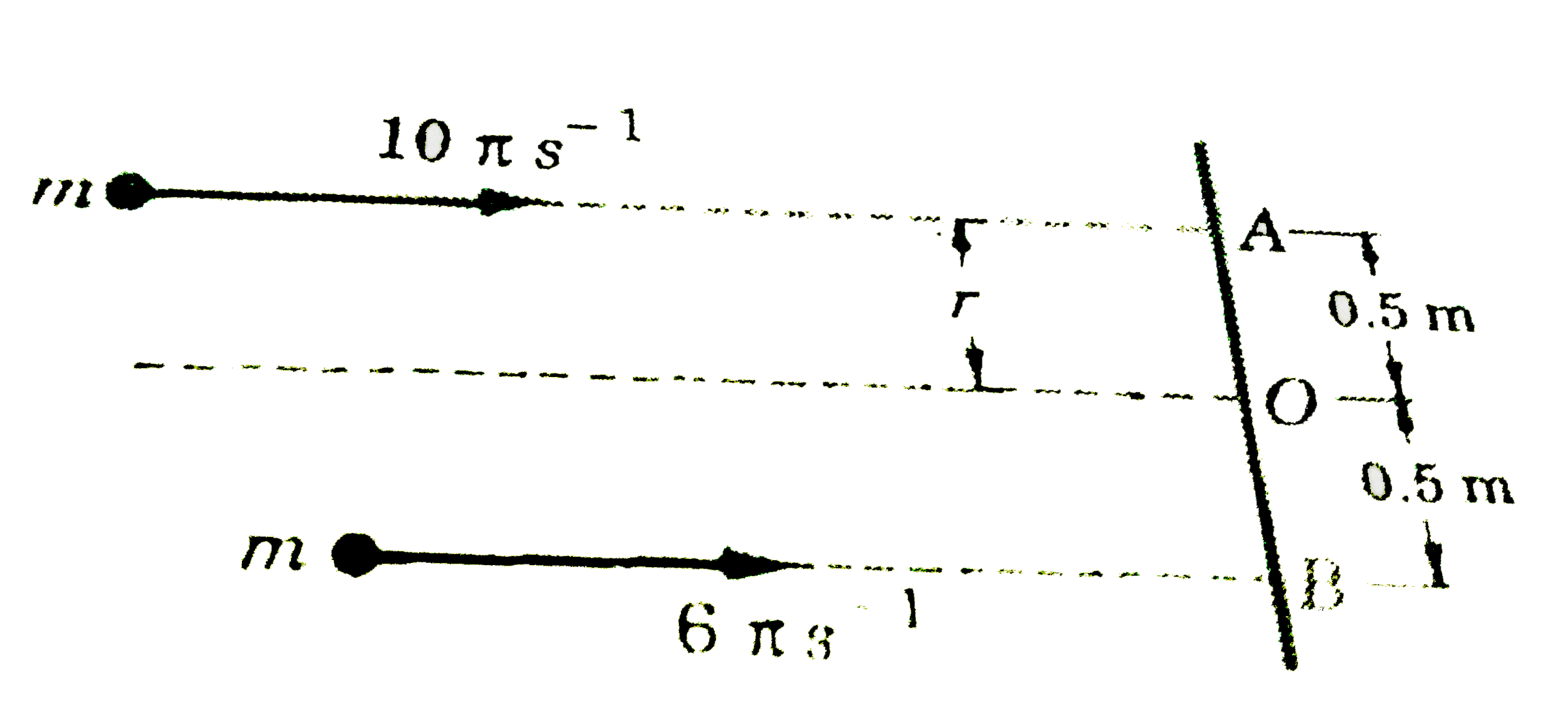
A thin uniform bar lies on a frictionless horizontal surface and is free to move in any way on the surface. Its mass is 0.16 kg and lengths is `sqrt(3)m`. Two particles, each of mass `0.08 kg`, are moving on the same surface and towards the bar in a direction perpendicular to the bar, one with a velocity of `10 ms^(-1)` and the other with `6ms^(-1)`, as shown in fig. The first particle strikes the bar at point A and the other at point B. Points A and B are at a distance 0.5 m from the centre of the bar. The particles strike the bar at same instant of time and stick to the bar on collision. Calculate the loss of kinetic energy of the system in the above collision process.

Promotional Banner

Similar Questions

Explore conceptually related problems

A thin uniform bar lies on a frictionless horizonta surface and is free to move in any way on th surface. Its mass is 0.16 kg and length sqrt3 meters. Two particless, each of mass 0.08 kg, are moving on the same surface and towards the bar in a direction perpendicular to the bar, one with a velocity of 10 m/s, and other with 6m/s as shown in fig. The first particle strikes the bar at point A and the other at point B. Points A and B are at a distane of 0.5m from the centre of the bar. The particles strike the bar at the same instant of time and stick to the bar on collision. Calculate the loss of the kinetic energy of the system in the above collision process.

A thin uniform bar lies on a frictionless horizonta surface and is free to move in any way on th surface. Its mass is 0.16 kg and length sqrt3 meters. Two particless, each of mass 0.08 kg, are moving on the same surface and towards the bar in a direction perpendicular to the bar, one with a velocity of 10 m/s, and other with 6m/s as shown in fig. The first particle strikes the bar at point A and the other at point B. Points A and B are at a distane of 0.5m from the centre of the bar. The particles strike the bar at the same instant of time and stick to the bar on collision. Calculate the loss of the kinetic energy of the system in the above collision process.

A body of mass 5 kg moving on a horizontal surface with a velocity of 10 ms^(-1) comes to rest in 2s. The force required to make this body move with a velocity of 10 ms^(-1) on the same surface is

A body of mass 5 kg moving on a horizontal surface with a velocity of 10 ms^(-1) comes to rest in 2s. The force required to make this body move with a velocity of 10 ms^(-1) on the same surface is

A body of mass 10 kg is moving on a horizonal surface be applying a force of 10 N in the forward direction. The body moves with a constant velocity of 0.2ms^(-1) . Work done by the force of friction in the first 10 seconds is

A body of mass 10 kg is moving on a horizonal surface be applying a force of 10 N in the forward direction. The body moves with a constant velocity of 0.2ms^(-1) . Work done by the force of friction in the first 10 seconds is