

Home
Class 11
PHYSICS
A block of mass 1 kg is kept on the tilt...

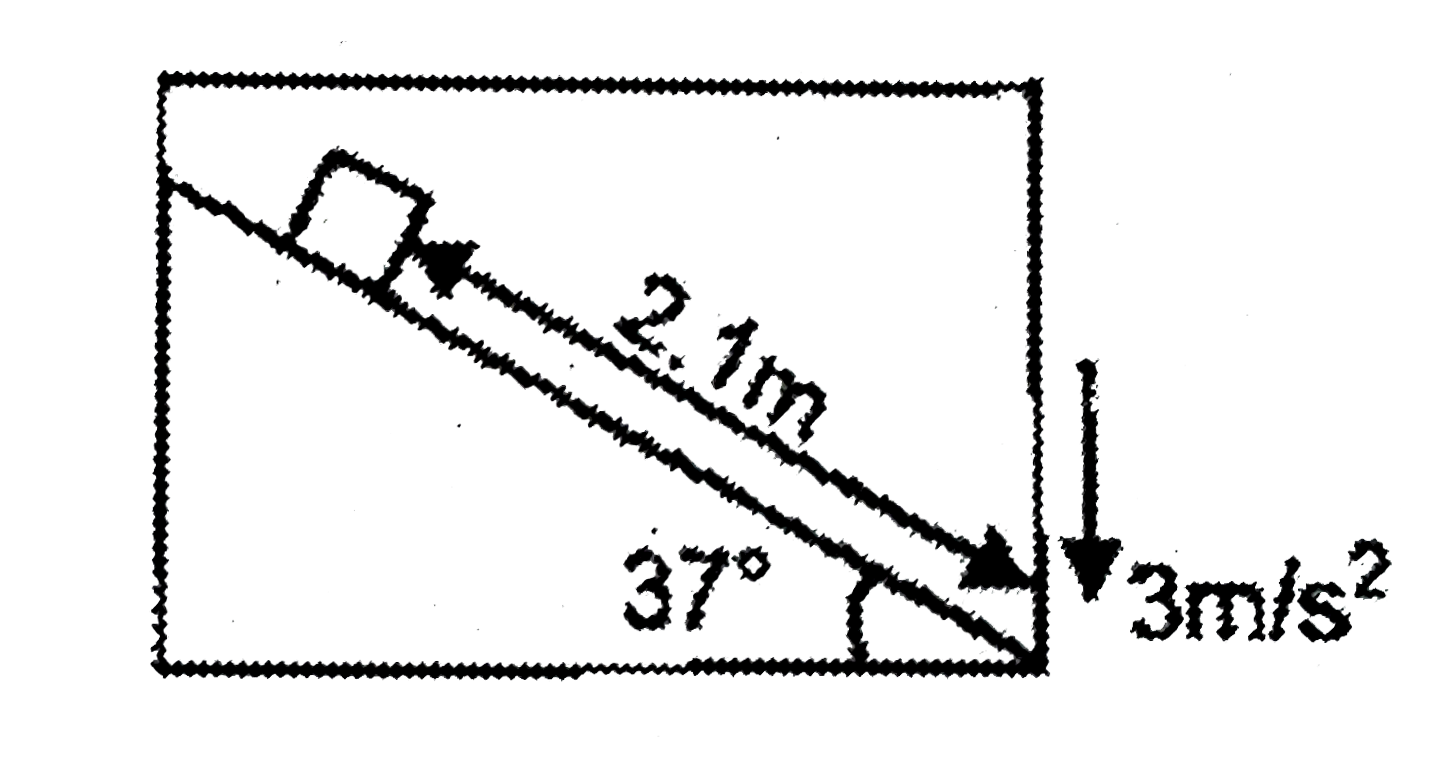
A block of mass 1 kg is kept on the tilted floor ofa lift moving, down with `3 m// s^(2)`. If the block is released from rest as shown, what will be the time taken by block to reach the bottom. What is the normal reaction on the block during the motion?

Promotional Banner

Similar Questions

Explore conceptually related problems

A block of mass 1kg is kept on the tilted floor of a lift moving down with 3ms^(-1) . If the block is released from rest as shown, what will be the time taken by block to reach the bottom? What is the normal reaction on the block during the motion?

A block of mass 1kg is kept on the tilted floor of a lift moving down with acceleration 3ms^(-2) . If the block is released from rest as shown, what will be the time taken by block to reach the bottom? What is the normal reaction on the block during the motion?

A block of mass m is released from a wedge of mass m as shown in figure . Find the time taken by the block to reach the end of the wedge.

A block of mass m is released from a wedge of mass m as shown in figure . Find the time taken by the block to reach the end of the wedge.

A block of mass m is kept on an inclined plane of a lift moving down with acceleration of 2 m//s^(-2). What should be the coefficient of friction to let the block move down with constant velocity relative to lift :

A block of mass m is kept on an inclined plane of a lift moving down with acceleration of 2m//s^(2) . What should be the coefficient of friction for the block to move down with constant velocity relative relative to lift?

In the arrangement shown, what is the normal reaction the block A ( mass = 5 kg) and ground

A block of mass is kept on an inclined plane of a lift moving down with acceleration of 2 ms^(-2) What should be the minimum coefficient of friction to let the block move down with constant velocity?