Home
Class 7
MATHS
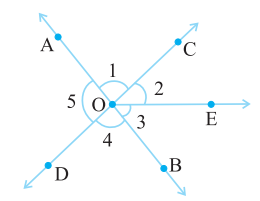
In the adjoining figure: (i) Is ∠...

In the adjoining figure:


(i) Is ∠1 adjacent to ∠2? (ii) Is ∠AOC adjacent to ∠AOE?
(iii) Do ∠COE and ∠EOD form a linear pair?
(iv) Are ∠BOD and ∠DOA supplementary?
(v) Is ∠1 vertically opposite to ∠4?
(vi) What is the vertically opposite angle of ∠5?

Text Solution

Verified by Experts

(i) Yes, in ∠AOE,OC is common arm.
(ii) No, they have no non-common arms on opposite side of common arm.
(iii) Yes, they form linear pair.
(iv) Yes, they are supplementary.
(v) Yes, they are vertically opposite angles.
(vi) Vertically opposite angles of ∠5 is ∠COB.
Promotional Banner

Topper's Solved these Questions

  • LINES AND ANGLES

    NCERT|Exercise SOLVED EXAMPLES|1 Videos
  • LINES AND ANGLES

    NCERT|Exercise SOLVED EXAMPLES|1 Videos
  • INTEGERS

    NCERT|Exercise EXERCISE 1.3|8 Videos
  • PERIMETER AND AREA

    NCERT|Exercise EXERCISE 11.2|8 Videos

Similar Questions

Explore conceptually related problems

In Fig.15, write down: (i) each linear pair (ii) each pair of vertically opposite angles.

In the adjoining figure, write another name for: (i) angle1 (ii) angle 2 (iii) angle 3

In the adjoining figure,identify ( i ) the pairs of corresponding angles.(ii) the pairs of alternate interior angles.(iii) the pairs of interior angles on the same side of the transversal.(iv) the vertically opposite angles.

Indicate which pairs of angles are: (i) Vertically opposite angles.(ii) Linear pairs.

In the adjoining figure,name the following pairs of angles.(i) Obtuse vertically opposite angles (ii) Adjacent complementary angles (iii) Equal supplementary angles (iv) Unequal supplementary angles ( iv) Adjacent angles that do not form a linear pair

Fill in the blanks: (i) If two angles are complementary, then the sum of their measures is _______. (ii) If two angles are supplementary, then the sum of their measures is ______. (iii) Two angles forming a linear pair are _______________. (iv) If two adjacent angles are supplementary, they form a ___________. (v) If two lines intersect at a point, then the vertically opposite angles are always _____________. (vi) If two lines intersect at a point, and if one pair of vertically opposite angles are acute angles, then the other pair of vertically opposite angles are __________.

In Fig (5.18) identify: (i) Five pairs of adjacent angles.( ii) Three linear pairs.(iii) Two pairs of vertically opposite angles

In each of the following figures, write, if any, (i) each pair of vertically opposite angles, and (ii) each linear pair.

In the adjoining figure, ABCD is a quadrilateral. (i) How many pairs of adjacent sides are there? Name them. (ii) How many pairs of opposite sides are there? Name them. (iii) How many pairs of adjacent angles are there? Name them. (iv) How many pairs of opposite angles are there? Name them. (v) How many diagonals are there? Name them.
