

Home
Class 12
PHYSICS
Two long parallel conducting rails are p...

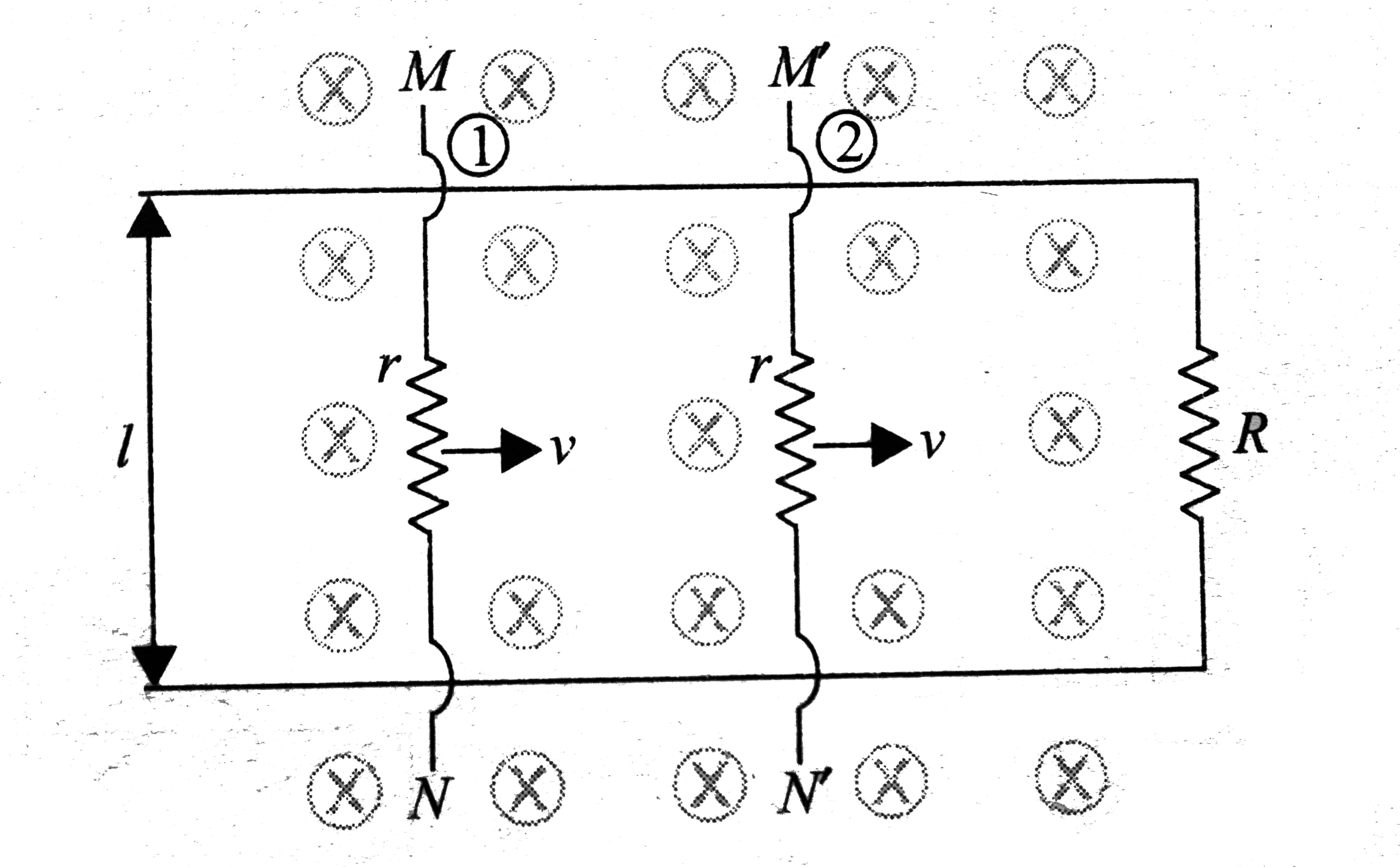
Two long parallel conducting rails are placed in a uniform magnetic field. On one side, the rails are connected with a resistance `R`. Two rods `MN and M'N'` each having resistance `r` are placed as showing in Fig. Now on the rods `MN and M'N'` forces are applied such that the rods move with constant velocity `v`.

The current flowing through resustance `R` if both the rods move with the same speed `v` toward right is

Promotional Banner

Similar Questions

Explore conceptually related problems

Two long parallel conducting rails are placed in a uniform magnetic field. On one side, the rails are connected with a resistance R . Two rods MN and M'N' each having resistance r are placed as showing in Fig. Now on the rods MN and M'N' forces are applied such that the rods move with constant velocity v . (i). The current flowing through resistance R if the rod Mn moves toward left and the rod M'N' moves toward the right is

Two long parallel conducting rails are placed in a uniform magnetic field. On one side, the rails are connected with a resistance R . Two rods MN and M'N' each having resistance r are placed as showing in Fig. Now on the rods MN and M'N' forces are applied such that the rods move with constant velocity v . (i). The current flowing through resistance R if the rod Mn moves toward left and the rod M'N' moves toward the right is

A conducting rod of length l is moving in a transverse magnetic field of strength B with veocity v. The resistance of the rod is R. The current in the rod is

A conducting rod of length l is moving in a transverse magnetic field of strength B with veocity v. The resistance of the rod is R. The current in the rod is

A sliding rod AB of resistance R is shown in the figure. Here magnetic field B is constant and is out of the paper. Parallel wires have no resistance and the rod is moving with constant velocity v. The current in the sliding rod AB when switch S is closed at time t=0 is

A rod having length l and resistance R is moving with velocity v on a pi shape conductor. Find the current in the rod.

A rod having length l and resistance R is moving with velocity v on a pi shape conductor. Find the current in the rod.

Figure shows a conducting rod PQ in contact with metal rails RP and SQ, which are 0.25 m apart in a uniform magnetic field of flux density 0.4T acting perpendicular to the plane of the paper. Ends R and S are connected through a 5 Omega resistance. What is the emf when the rod moves to the right with a velocity of 5ms^(-1) ? What is the magnitude and direction of the current through the 5 Omega resistance? If the rod PQ moves to the left with the same speed, what will be the new current and its direction?