

Home
Class 12
PHYSICS
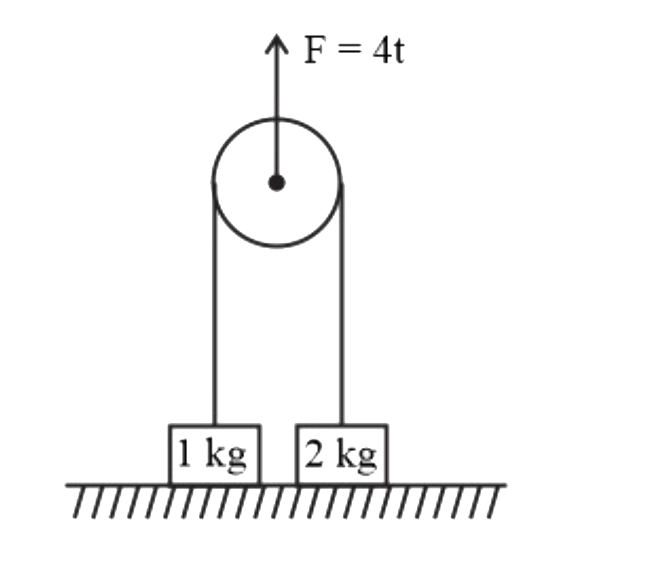
Two blocks of mass 1 kg & 2 kg are hange...

Two blocks of mass 1 kg & 2 kg are hanged from a light pulley and resting on a horizontal surface. A time varying force F = 4t N is acting on pulley in the direction shown . Time after which block will break off the surface will be -

Promotional Banner

Similar Questions

Explore conceptually related problems

Two blocks of masses 4 kg and 6 kg are kept on a rough horizontal surface as shown. If the acceleration of 6 kg block is 5n , then n is :

Two blocks of masses 4 kg and 6 kg are kept on a rough horizontal surface as shown. If the acceleration of 6 kg block is 5n , then n is :

Two blocks of masses 1 kg and 2 kg are placed in contact on a smooth horizontal surface as shown in fig. A horizontal force of 6N is applied d(a) on a 1-kg block. Find the force of interaction of the blocks. .

Two blocks of masses 1 kg and 2 kg are placed in contact on a smooth horizontal surface as shown in fig. A horizontal force of 6N is applied d(a) on a 1-kg block. Find the force of interaction of the blocks. .

Two blocks of mass 2 kg and 4 kg are accelerated with same acceleration by a force 10 N as shown in figure on a smooth horizontal surface. Then the spring force between the two blocks will be (spring is massless)

Two blocks of mass 2 kg and 4 kg are accelerated with same acceleration by a force 10 N as shown in figure on a smooth horizontal surface. Then the spring force between the two blocks will be (spring is massless)

Two blocks of masses 10 kg and 20 kg are connected by a massless string and are placed on a smooth horizontal surface as shown in the figure. If a force F=600 N is applied to 10 kg block, then the tension in the string is

Two blocks of masses 10 kg and 20 kg are connected by a massless string and are placed on a smooth horizontal surface as shown in the figure. If a force F=600 N is applied to 10 kg block, then the tension in the string is

Two blocks of masses of 0.2 kg and 0.5 kg which are placed 22m apart on a horizontal surface (mu = 0.5) are acted uponby two forces of magnitude 3 N each as shown in figure in time t = 0 Then the time t at which they collide with each other is