

Home
Class 11
PHYSICS
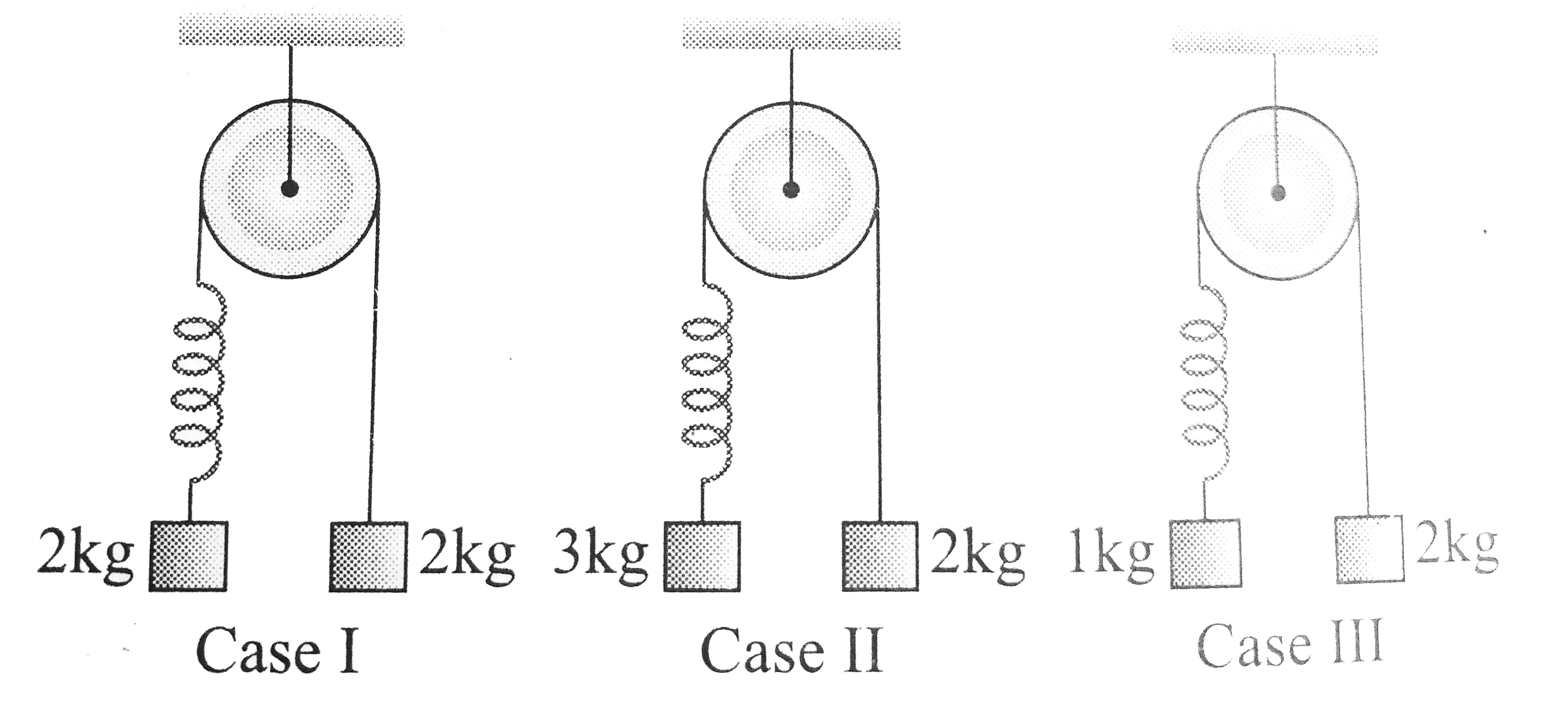
Consider three cases, same spring is att...

Consider three cases, same spring is attached with `2kg` , `3kg` and `1kg` blocks as shown in figure. If `x_(1)` , `x_(2)` , `x_(3)` be the extensions in the spring in the three cases, then.

Promotional Banner

Similar Questions

Explore conceptually related problems

Same spring is attached with 2kg , 3kg and 1kg blocks in three different cases as shown in figure. If x_(1) , x_(2) and x_(3) be the extensions in the spring in these cases then (Assume all the block s to move with uniform acceleration).

Same spring is attached with 2kg , 3kg and 1kg blocks in three different cases as shown in figure. If x_(1) , x_(2) and x_(3) be the extensions in the soring in these cases then (Assume all the block s to move with uniform acceleration).

Same spring is attached with 2kg, 3kg and lkg blocks in three different cases as shwon in figure. Then,

In the arrangement shown in figure , find the retio of tension in the strings attached with 4kg block and the with 1kg block

From the fixed pulley, masses 2kg, 1kg and 3kg are suspended as shown in the figure. Find the extension in the spring if k=100 N//m . (Neglect oscillations due to spring)

From the fixed pulley, masses 2kg, 1kg and 3kg are suspended as shown in the figure. Find the extension in the spring if k=100 N//m . (Neglect oscillations due to spring)

Three blocks are connected as shown in the figure If m_(1)=5kg, m_(2)=10kg and m_(3)=15kg , find the tension T_(1) given that T_(3)=60N

A block of mass 20 kg is hung with the help of ideal string, pulleys and spring (Spring constant k = 1000 N/m) as shown in figure. If block is in equilibrium position then extension in the spring will be (g = 10 ms^-2)

In the arrangement shown in figure , find the ratio of tension in the strings attached with 4kg block and the with 1kg block

From the fixed pulley, masses 2 kg, 1 kg and 3 kg are suspended as shown is figure. Find the extension in the spring when acceleration of 3 kg and 1 kg is same if spring constant of the spring k = 100 N/m. (Take g = 10 ms^(-2) )