Home
Class 12
PHYSICS
Find the moment of inertia of solid sphe...

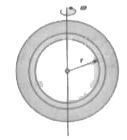
Find the moment of inertia of solid sphere of mass M about a diameter as shown in Fig.

Text Solution

Verified by Experts

The sphere can be considered as made up of many concentric thin shells. From previous example, a spherical subshell of radius r has moment of inertia:
`dI=2/3dMr^(2)`.
Calculations: We know that
`dM=M/(4/3piR^(3))xx4pir^(2)dr`
= `(3M)/R^(3)xxr^(2)dr`.
Substituting for dM in the equation for moment of inertia, we get
`dI=2/3xx(3M)/R^(3)r^(2)(dr)r^(2)`.
Integrating over the whole volume, we get
`I=(2M)/(R^(3))int_(0)^(R)r^(2)dr`
= `(2MR^(2))/5`.
Promotional Banner

Topper's Solved these Questions

  • RIGID BODY DYNAMICS - I

    RESNICK AND HALLIDAY|Exercise CHECKPOINT|18 Videos
  • RIGID BODY DYNAMICS - I

    RESNICK AND HALLIDAY|Exercise PROBLEMS|100 Videos
  • RELATIVITY

    RESNICK AND HALLIDAY|Exercise PRACTICE QUESTIONS (Integer Type)|5 Videos
  • RIGID BODY DYNAMICS-II

    RESNICK AND HALLIDAY|Exercise PRACTICE QUESTIONS (Integer Type)|2 Videos

Similar Questions

Explore conceptually related problems

What is moment of inertia of a solid sphere about its diameter ?

Find the moment of inertia of a solid sphere of mass M and radias R about an axis XX shown in figure. Also find radius of gyration about the given axis.

The moment of inertia of a solid sphere of mass M and radius R about its diameter is I. The moment of inertia of the same sphere about a tangent parallel to the diameter is

Find the moment of inertia of a hemisphere of mass M and radius R shown in the figure, about an axis A A' tangential to the hemisphere.

If moment of inertia of a solid sphere of mass 5kg about its diameter is 50kg m^(2) . Its moment of inertia about its tangent in kg m^(2) is

The moment of inertia of a solid sphere of radius R about its diameter is same as that of a disc of radius 2R about its diameter. The ratio of their masses is

Find the moment of inertia of the two uniform joint rods about point P as shown in Fig. Use parallel axis theorem. Mass of each rod is M .
