Home
Class 12
PHYSICS
In Fig., three forces, each of magnitude...

In Fig., three forces, each of magnitude 2.0 N, act on a particle. The particle is in the xz' plane at point A given by position vector `vecr`, where r = 3.0 m and `theta=30^(@)`. What is the torque, about the origin O, due to each force?

Text Solution

Verified by Experts
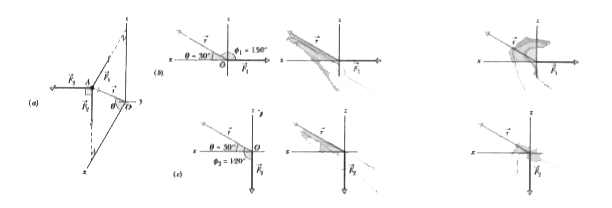
Because the three force vectors do not lie in a plane, we must use cross products, with magnitudes given by Eq. `(tau=rFsinphi)` and direction given by the right-hand rule.
Calculations: Because we want the torque with respect to the origin O, the vector `vecr` required for each cross product is the given position vector. To determine the angle `phi` between `vecr` and each force, we shift the force vectors of Fig. each in turn, so that their tails are at the origin. Fig., c, and d, which are direct views of the xz plane, show the shifted force vectors `vecF_(1),vecF_(2)andvecF_(3)`,


respectively. In the angle between the direction of `vecr` and `vecF_(3)" is "90^(@)` and the symbol means `vecF_(3)` is directed into the page.
`tau_(1)=rF_(1)sinphi_(1)=(3.0m)(2.0N)(sin150^(@))=3.0N*m`,
`tau_(2)=rF_(2)sinphi_(2)=(3.0m)(2.0N)(sin120^(@))=5.2N*m`
and `tau_(3)=rF_(3)sinphi_(3)=(3.0m)(2.0N)(sin90^(@))=6.0N*m`.
Promotional Banner

Topper's Solved these Questions

  • RIGID BODY DYNAMICS - I

    RESNICK AND HALLIDAY|Exercise CHECKPOINT|18 Videos
  • RIGID BODY DYNAMICS - I

    RESNICK AND HALLIDAY|Exercise PROBLEMS|100 Videos
  • RELATIVITY

    RESNICK AND HALLIDAY|Exercise PRACTICE QUESTIONS (Integer Type)|5 Videos
  • RIGID BODY DYNAMICS-II

    RESNICK AND HALLIDAY|Exercise PRACTICE QUESTIONS (Integer Type)|2 Videos

Similar Questions

Explore conceptually related problems

If vec F is the force acting in a particle having position vector vec r and vec tau be the torque of this force about the origin, then

The force 7 hat i+ 3 hat j - 5 hat k acts on a particle whose position vector is hat i- hat j + hat k . What is the torque of a given force about the origin ?

Let vecF be a force acting on a particle having positon vector vecr. Let vecr be the torque of this force about the origin then

Three forces of magnitude 30, 60 and P Newton acting on a particle and particle is in equilibrium. If the angle between the first two forces is 60^(@) , the value of P is

If is the force acting on a particle having position vector and be the torque of this force about the origin, then-

Find the torque about the origin when a force of 3 hatj N acts on a particle whose position vector is 2 hatk m


