Home
Class 12
PHYSICS
Figure shows an overhead view of two par...

Figure shows an overhead view of two particles moving at constant momentum along horizontal paths.
Particle 1, with momentum magnitude `p_(1)=5.0kg*m//s`, has position vector `vecr_(1)` and will pass 2.0 m from point O.
Particle 2, with momentum magnitude `p_(2)=2.0kg*m//s`, has position vector `vecr_(2)` and will pass 4.0 m from point O. What are the magnitude and direction of the net angular momentum `vecL` about point O of the two particle system?

Text Solution

Verified by Experts
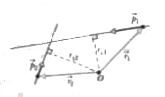
To find `vecL`, we can first find the individual angular momenta `vecl_(1)andvecl_(2)` and then add them. To evaluate their magnitudes, we can use any one of Eqs. Through. However, Eq. is easiest, because we are given the perpendicular distances `r_(bot1)(=2.0m)andr_(bot2)(=4.0m)` and the momentum magnitudes `p_(1)andp_(2)`.
Calculations: For particle 1, Eq. yields
`l_(1)=r_(bot1)p_(1)=(2.0)(5.0kg*m//s)`
= `10kg*m^(2)//s`.
To find the direction of vector `vecl_(1)`, we use Eq. and the right-hand rule for vector products. For `vecr_(1)xxvecp_(1)`, the vector product is out of the page, perpendicular to the plane of Fig. This is the positive direction, consistent with the counterclockwise rotation of the particle.s position vector `vecr_(1)` around O as particle 1 moves. Thus, the angular momentum vector for particle 1 is
`l_(1)=+10kg*m^(2)//s`.

Similarly, the magnitude of `vecl_(2)` is
`l=r_(bot2)p_(2)=(4.0m)(2.0kg*m//s)`
= `8.0kg*m^(2)//s`,
and the vector product `vecr_(2)xxvecp_(2)` is into the page, which is the negative direction, consistent with the clockwise rotation momentum vector for particle 2 is
`l_(2)=-8.0kg*m^(2)//s`
The net angular momentum for the two particle system is
`L=l_(1)+l_(2)=+10kg*m^(2)//s+(-8.0kg*m^(2)//s)`
= `+2.0kg*m^(2)//s`.
Promotional Banner

Topper's Solved these Questions

  • RIGID BODY DYNAMICS - I

    RESNICK AND HALLIDAY|Exercise CHECKPOINT|18 Videos
  • RIGID BODY DYNAMICS - I

    RESNICK AND HALLIDAY|Exercise PROBLEMS|100 Videos
  • RELATIVITY

    RESNICK AND HALLIDAY|Exercise PRACTICE QUESTIONS (Integer Type)|5 Videos
  • RIGID BODY DYNAMICS-II

    RESNICK AND HALLIDAY|Exercise PRACTICE QUESTIONS (Integer Type)|2 Videos

Similar Questions

Explore conceptually related problems

The position vector vecr and linear momentum vecp and vecr=hati and vecp=4hatj the angular momentum vector is perpendicular to

A particle with the position vector r has linear momentum p. Which of the following statements is true is respect of its angular momentum L about the origin ?

A particle is projected at time t=0 from a point P on the ground with a speed v_0, at an angle of 45^@ to the horizontal. Find the magnitude and direction of the angular momentum of the particle about P at tiem t= v_0//g

Two particles A and B are moving , as shown in the figure . Their total angular momentum about the point O is

A particle of mass m is projected at t=0 from the point P on the ground with speed v_(0) at an angle of theta to the horizontal. Find the magnitude and direction of the angular momentum of the particle at time t=(v_(0)sintheta)/(2g) .

A particle of mass 0.01 kg having position vector vecr = ( 10 hati + 6 hatj) meters is moving with a velocity 5 hati m/s . Calculate its angular momentum about the origin.

A particle of mass 1kg is moving about a circle of radius 1m with a speed of 1m//s . Calculate the angular momentum of the particle.

