Home
Class 12
PHYSICS
The conical pendulum is in steady circul...

The conical pendulum is in steady circular motion with constant angular velocity `omega` as shown in Fig. Mass of the particle is M and string makes angle `alpha` with vertical.
(a) Find angular momentum of the particle about the center C of the circle and the hinge O about which the string is attached.
(b) Also check whether L is changing or is constant.

Text Solution

Verified by Experts
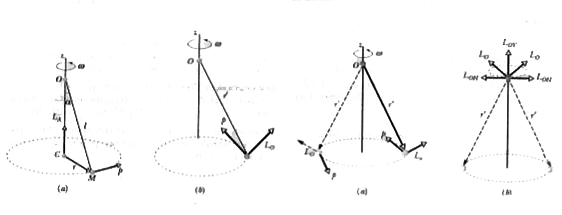
(a) Conceptualize/Classify: We start by finding `L_(C)`, angular momentum of mass M about point C. We can see from Fig. that velocity of the particle is always going to be perpendicular to the line joining particle with the center C. Also, both vectors r and v are lying on horizontal (xy) plane, so the angular momentum, `L_(C)` will be in the positive z direction. It has magnitude `|r_(bot)||p|=|r||p|=rp`, where r is the radius of the circular motion as we can see from Fig.
Calculation: The magnitude of momentum is given by
`|p|=Mv=Mromega`
The angular momentum about the center C of the circle
`L_(C)=rxxp`
= `Mr^(2)omegahatk`
Now let us evaluate the angular momentum `L_(O)` about the point O located at the hinge. From Fig.
`vecL_(0)=vecrxxvecp`

Velocity of the particle is perpendicular to the line OA as shown in the figure.
`|L_(O)|=|r.xxp||r.||p|=l|p|`
or `|L_(O)|=Mlromega`
where `|r.|=l`, is the length of the string.
(b) Calculation: We must note that `L_(C)` is constant, both in magnitude and direction. The magnitude of `L_(O)` is constant, but its direction is not constant as can be seen from Fig. `L_(O)` is always perpendicular to the plane containing r. and p. As the particle moves, the plane containing r. and p vector hinges, thus changing the direction of `L_(O)` at different times. As the bob swings around, `L_(O)` rotates as shown in fig. The vertical component of `L_(O)` is not moving, but the horizontal component rotates in the circle with the bob. We can draw the angular momentum at any position we choose, only the magnitude and direction of L have to be same.
Promotional Banner

Topper's Solved these Questions

  • RIGID BODY DYNAMICS - I

    RESNICK AND HALLIDAY|Exercise CHECKPOINT|18 Videos
  • RIGID BODY DYNAMICS - I

    RESNICK AND HALLIDAY|Exercise PROBLEMS|100 Videos
  • RELATIVITY

    RESNICK AND HALLIDAY|Exercise PRACTICE QUESTIONS (Integer Type)|5 Videos
  • RIGID BODY DYNAMICS-II

    RESNICK AND HALLIDAY|Exercise PRACTICE QUESTIONS (Integer Type)|2 Videos

Similar Questions

Explore conceptually related problems

A particle of mass m moves along line PC with velocity v as shown. What is the angular momentum of the particle about O ?

A particle of mass m is describing a circular path of radius r with uniform speed. If L is the angular momentum of the particle (about the axis of the circle), then the kinetic energy of the particle is given by

A particle moves in a circle with constant angular velocity omega about a point P on its circumference. The angular velocity of the particle about the centre C of the circle is

A particle mass parallel to x-axis with constant velocity v as shown in the figure. The angular velocity of the particle about the origin O

A conical pendulum consists of a bob of mass m in motion in a circular path in a horizontal plane as shown in figure. During the motion, the supporting wire of length l . Maintains a constant angle theta with the vertical. The magnitude of the angular momentum of the bob about the vertical dashed line is. .

A particle attached to a string is rotating with a constant angular velocity and its angular momentum is L. If the string is halved and angular velocity is kept constant, the angular momentum will be

