Home
Class 12
PHYSICS
A block of mass M(1) and a block of mass...

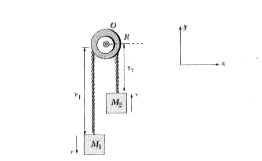
A block of mass `M_(1)` and a block of mass `M_(2)` are connected by a string that passes over a pulley as shown in Fig. The pulley is a uniform disk of radius R and mass M. Find the acceleration of the two object, using the concepts of angular momentum and torque.

Text Solution

Verified by Experts

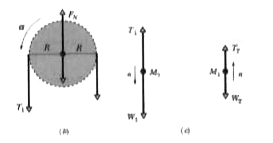
(1) If the block `M_(1)` moves upward, the block `M_(2)` moves downward, and the pulley will rotate counterclockwise. This problem is same as Sample Problem we have already solved, except that now we have to use angular momentum and torque to find acceleration.
(2) We define the blocks and pulley as our system. We consider the axle of the pulley as our axis. We can write the angular momentum of the system considering the ball and the block that are moving translationally and the pulley which is undergoing pure rotation. The external torque on the system about the axis is due to the weights of the blocks.
Calculations: Due to constraint, the blocks have same speed n. We can find angular momentum using the definition of angular momentum about the axle, given by equation `vecL=vecrxxvecp`.
The momentum and position vectors are given by
`vecP_(1)=-M_(1)nuhatjandr_(1)=-Rhati-y_(1)hatj`
Using `vecL=vecrxxvecp`, the angular momentum of block 1 is `M_(1)nuRhatk`.
Similarly, for block 2, momentum and position vectors are given by
`vecP_(2)=+M_(2)nuhatjandr_(1)=Rhati+y_(2)hatj`
Using `vecL=vecrxxvecp`, the angular momentum of block 2 is `M_(2)nuRhatk` about our chosen axis.
The angular momentum of the pulley can be found using `L=Iomega`. It is given by `M_(p)R^(2)omegahatk//2` about our chosen axis.
We calculate the external torque acting on the system about the pulley axle. The force is being exerted by the axle on the pulley, but it does not produce torque about the axle as the length of moment arm is zero.
The gravitational force `M_(1)vecg` acting on block 1 produces a torque about the axle equal to `M_(1)gRhatk` and the gravitational force `M_(2)vecg` acting on block 2 produces a torque about the axle equal in magnitude to `-M_(2)gRhatk`, where R is the moment arm of the force about the axle. Thus, the total external torque about the pulley axle is
`sumtau_(ext)=M_(1)gRhatk-M_(2)gRhatk`
Writing an expression for the total angular momentum of the system,
`L=(M_(1)nuR+M_(2)nuR+MnuR)hatk`
Substituting this expression and the total external torque in
`sumt_(ext)=(dL)/(dt)`
`M_(1)gRhatk-M_(2)gRhatk=d/dt[(M_(1)+M_(2)+M)nuR]hatk`
`M_(1)gR-M_(2)gR=(M_(1)+M_(2)+M)R(dnu)/(dt)`
Recognizing that `dnu//dt=a` and solving Eq. for a
`a=((M_(1)-M_(2))g)/(M_(1)+M_(2)+M)`
Promotional Banner

Topper's Solved these Questions

  • RIGID BODY DYNAMICS - I

    RESNICK AND HALLIDAY|Exercise CHECKPOINT|18 Videos
  • RIGID BODY DYNAMICS - I

    RESNICK AND HALLIDAY|Exercise PROBLEMS|100 Videos
  • RELATIVITY

    RESNICK AND HALLIDAY|Exercise PRACTICE QUESTIONS (Integer Type)|5 Videos
  • RIGID BODY DYNAMICS-II

    RESNICK AND HALLIDAY|Exercise PRACTICE QUESTIONS (Integer Type)|2 Videos

Similar Questions

Explore conceptually related problems

Blocks of mass M_(1) and M_(2) are connected by a cord which passes over the pulleys P_(1) and P_(2) as shown in the figure. If there is no friction, the acceleration of the block of mass M_(2) will be

Two blocks of masses of 40 kg and 30 kg are connected by a weightless string passing over a frictionless pulley as shown in the figure.

Two masses m_(1) and m_(2) are connected to the ends of a massless string that passes over a pulley fixed at the top of a double incline as shown. Assuming m_(1) gtm_(2) acceleration of the system is:

Two blocks A and B , each of mass 10 kg , are connected by a light string passing over a smooth pulley as shown in the figure. Block A will remain at rest if the friction on it is

Find the acceleration of the block of mass m. Assume pulleys are massless and frictionless.

Two bodies of masses m_(1) " and " m_(2) are connected a light string which passes over a frictionless massless pulley. If the pulley is moving upward with uniform acceleration (g)/(2) , then tension in the string will be

Two block of masses m_(1) and m_(2) are connected as shown in the figure. The acceleration of the block m_(2) is:

Figure shows two blocks of mass m and m connected by a string passing over a pulley. The horizontal table over which the mass m slides is smooth. The pulley (uniform disc) has mass m and it can freely rotate about this axis. Find the acceleration of the mass m assuming that the string does not slip on the pulley.

Two masses m_(1) and m_(2) are connected to the end of a string passing over a smooth pulley . The magnitude of tension in the string is T and the masses are moving with magnitude of acceleration a . If the masses are interchanged , then