Home
Class 12
PHYSICS
Figure shows a student, again sitting on...

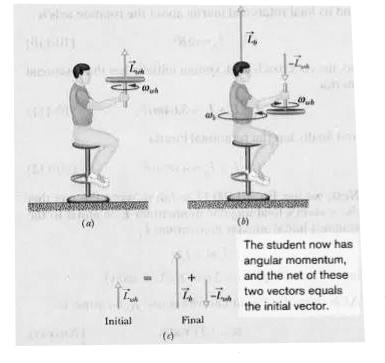
Figure shows a student, again sitting on a stool that can rotate freely about a vertical axis. The student, initially at rest, is holding a bicycle wheel whose rim is loaded with lead and whose rotational inertia `I_(wh)` about its central axis is `1.2kg*m^(2)`.
The wheel is rotating at an angular speed `omega_(wh)` of 3.9 rev/s, as seen from overhead, the rotation is counterclockwise. The axis of the wheel is vertical, and the angular Momentum `vecL_(wh)` of the wheel points vertically upward.

The student now inverts the wheel so that, as seen from overhead, it is rotating clockwise. Its angular momentum is now `-vecL_(wh)`. The inversion results in the student, the stool, and the wheel's center rotating together as a composite rigid body about the stool's rotation axis, with rotational inertia `I_(b)=6.8kg*m^(2)`. With what angular speed `omega_(b)` and in what direction does the composite body rotate after the inversion of the wheel?

Text Solution

Verified by Experts

1. The angular speed `omega_(b)` we seek is related to the final angular momentum `vecL_(b)` of the composite body about the stool.s rotation axis by `(L=Iomega)`.
2. The initial angular speed `omega_(wh)` of the wheel is related to the angular momentum `vecL_(wh)` of the wheel.s rotation about its center by the same equation.
3. The vector addition of `vecL_(b)andvecL_(wh)` gives the total angular momentum `L_("tot")` of the system of the student, stool, and wheel.
4. As the wheel is inverted, no net external torque acts on that system to change `vecL_("tot")` about any vertical axis. So, the system.s total angular momentum is conserved about any vertical axis, including the rotation axis through the stool.
Calculations: The conservation of `vecL_("tot")` is represented with vectors in Fig. We can also write this conservation in terms of components along a vertical axis as
`L_(bf)+L_(wh.f)=L_(b,i)+L_(wh,i)`.
Where i and f refer to the initial state and the final state. Because inversion of the wheel inverted the angular momentum vector of the wheel.s rotation, we substitute `-L_(wh,i)" for "L_(wh,f)`. Then, if we set `L_(b,i)=0`.
`L_(b,f)=2L_(wh,i)`.
Using Equation, we next substitute `I_(b)omega_(b)" for "L_(b.f)andI_(wh)omega_(wh)" for "L_(wh,i)` and solve for `omega_(b)`, finding
`omega_(b)=(2I_(wh))/I_(b)omega_(wh)`
= `((2)(1.2kg*m^(2))(3.9rev//s))/(6.8kg*m^(2))=1.4rev//s`.
Promotional Banner

Topper's Solved these Questions

  • RIGID BODY DYNAMICS - I

    RESNICK AND HALLIDAY|Exercise CHECKPOINT|18 Videos
  • RIGID BODY DYNAMICS - I

    RESNICK AND HALLIDAY|Exercise PROBLEMS|100 Videos
  • RELATIVITY

    RESNICK AND HALLIDAY|Exercise PRACTICE QUESTIONS (Integer Type)|5 Videos
  • RIGID BODY DYNAMICS-II

    RESNICK AND HALLIDAY|Exercise PRACTICE QUESTIONS (Integer Type)|2 Videos
