Home
Class 12
PHYSICS
On a horizontal smooth plane there is a ...

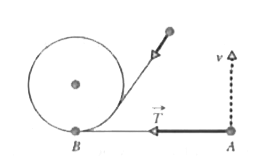
On a horizontal smooth plane there is a fixed vertical cylinder and a particle A connected to the cylinder by a thread AB. The particle is set in motion with the initial velocity v as shown in the figure. Is there any fixed point relative to which the angular

momentum of the particle is constant in the process of motion?

Text Solution

Verified by Experts

The only force acting on the particle A in this case is the tension `vecT` of the thread. It is easy to see that there is no point here relative to which the torque of the tension is always zero. Therefore, there is no point relative to which the angular momentum of the particle would be constant. The tension acting on the particle is along the string. Thus, any point lying on the line of string, will have zero torque due to tension, about itself. Since particle is moving, this line keeps on changing.
This example illustrates that sometimes a point relative to which the angular momentum of a particle is constant cannot be found at all.
Promotional Banner

Topper's Solved these Questions

  • RIGID BODY DYNAMICS - I

    RESNICK AND HALLIDAY|Exercise CHECKPOINT|18 Videos
  • RIGID BODY DYNAMICS - I

    RESNICK AND HALLIDAY|Exercise PROBLEMS|100 Videos
  • RELATIVITY

    RESNICK AND HALLIDAY|Exercise PRACTICE QUESTIONS (Integer Type)|5 Videos
  • RIGID BODY DYNAMICS-II

    RESNICK AND HALLIDAY|Exercise PRACTICE QUESTIONS (Integer Type)|2 Videos

Similar Questions

Explore conceptually related problems

A particle P is moving along a straight line as shown in the figure. During the motion of the particle from A to B the angular momentum of the particle about O

A particle mass parallel to x-axis with constant velocity v as shown in the figure. The angular velocity of the particle about the origin O

A horizontal plane supports a fixed vertical cylinder of radius R and a particle is attached to the cylinder by a horizontal thread AB as shown in Fig. The particle initially rest on a horizontal plane. A horizontal velocity v_(0) is imparted to the particle, normal to the threading during subsequent motion. Point out the false statements:

A particle is moving in a horizontal uniform circular motion. The angular momentum of the particle is conserved about the point :

A horizontal plane supports a stationary vertical cylinder of radius R and a disc A attached to the cylinder by a horizontal thread AB of length l_0 (figure, to view). An initial velocity v_0 is imparted to the disc as shown in the figure. How long will it move along the plane until it strikes against the cylinder? The friction is assumed to be absent.

A particle is moving with constant speed v in xy plane as shown in figure. The magnitude of its angular velocity about point O is

A particle of mass m is moving with constant velocity v parallel to the x-axis as shown in the figure. Its angular momentum about origin O is

A particle undergoes uniform circular motion. About which point on the plane of the circle, will the angular momentum of the particle remain conserved?
