A horizontal, homogeneous cylinder of mass M and radius R is pivoted about its axis of symmetry. A string is wrapped several times around the cylinder and tied to a body of mass m resting on a support positioned so that the string has no slack. The body of mass m is then lifted vertically to a distance h, and then released.
(a) Evaluate the angular velocity `omega_(0)` of the cylinder, the speed `v_(0)` of the falling body of mass m, and the kinetic energy `K_(0)` of the system, just before the string becomes taut.
(b) Evaluate the corresponding quantities, `omega_(1),v_(1),andK_(1)`, for the instant just after the string becomes taut.
A horizontal, homogeneous cylinder of mass M and radius R is pivoted about its axis of symmetry. A string is wrapped several times around the cylinder and tied to a body of mass m resting on a support positioned so that the string has no slack. The body of mass m is then lifted vertically to a distance h, and then released.
(a) Evaluate the angular velocity `omega_(0)` of the cylinder, the speed `v_(0)` of the falling body of mass m, and the kinetic energy `K_(0)` of the system, just before the string becomes taut.
(b) Evaluate the corresponding quantities, `omega_(1),v_(1),andK_(1)`, for the instant just after the string becomes taut.
(a) Evaluate the angular velocity `omega_(0)` of the cylinder, the speed `v_(0)` of the falling body of mass m, and the kinetic energy `K_(0)` of the system, just before the string becomes taut.
(b) Evaluate the corresponding quantities, `omega_(1),v_(1),andK_(1)`, for the instant just after the string becomes taut.
Text Solution
Verified by Experts
(a) Since string is slack we can expect that the block will fall freely for distance l. Till this time tension in string will be zero.
Calculation: Just before the string becomes taut, the cylinder is still at rest. Since the tension remained zero nothing has caused the cylinder to begin turning. That is, `omega_(0)=0`. Since the string has exerted no force on the body of mass m, it has fallen freely with acceleration g thus `v_(0)=2gh`. Same result can be derived by writing
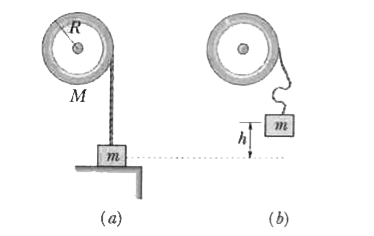
work-kinetic energy theorem for the system. The kinetic energy of the system is given by
`K_(0)=1/2mv_(0)^(2)+1/2I_(C)omega_(0)^(2)=mgh`
where `I_(c)` is the inertia of the cylinder.
Putting `omega_(0)=0`, we get
`v_(0)=sqrt(2gh)`
(b) (1) The end attached to the block will be moving and it will pull the part of string touching the cylinder as the string becomes taut. (2) Thus, when string becomes tight an impulse/jerk will develop in the string. This jerk will start the motion of cylinder. There will be also an impulse due to axis of the cylinder. Here we can take cylinder, string and clock as our system. We will take axle of cylinder as the axis for writing angular momentum.
Calculations: The impulse due to jerk in string will produce internal angular impulse, and the impulse due to the angular momentum will produce zero angular impulse about the axle. Further, the angular momentum of the system must be conserved, since the impulse due to the snap of the string is of very short duration and the weight mg contributes negligibly in that time. The string is assumed to be inextensible, so `v_(1)=omega_(1)R`.
Thus, we have `L_(1)=mv_(1)R+(1//2)MR^(2)omega_(1)=L_(0)`, where `L_(0)=mv_(0)R=msqrt(2gh)R`. Solving for the angular speed, we get
`omega_(1)=v_(0)/(R[1+(M//2)m))=sqrt(2gh)/(R[1+((M//2)m)])`
The corresponding speed is given by
`v_(1)=omega_(1)R=v_(0)/(1+((M//2)m))=(sqrt(2gh))/([1+((M//2)m)])`
The final kinetic energy `K_(1)` is given by
`K_(1)=1/2mv_(1)^(2)+1/2I_(c)omega_(1)^(2)=mgh`
= `1/2mv_(1)^(2)+1/2(1/2MR^(2))`
`(v_(1)^(2)/R^(2))=1/2(m+M/2)v_(1)^(2)`
= `1/2((mv_(0)^(2))/(1+((M//2)m)))`
Calculation: Just before the string becomes taut, the cylinder is still at rest. Since the tension remained zero nothing has caused the cylinder to begin turning. That is, `omega_(0)=0`. Since the string has exerted no force on the body of mass m, it has fallen freely with acceleration g thus `v_(0)=2gh`. Same result can be derived by writing
work-kinetic energy theorem for the system. The kinetic energy of the system is given by
`K_(0)=1/2mv_(0)^(2)+1/2I_(C)omega_(0)^(2)=mgh`
where `I_(c)` is the inertia of the cylinder.
Putting `omega_(0)=0`, we get
`v_(0)=sqrt(2gh)`
(b) (1) The end attached to the block will be moving and it will pull the part of string touching the cylinder as the string becomes taut. (2) Thus, when string becomes tight an impulse/jerk will develop in the string. This jerk will start the motion of cylinder. There will be also an impulse due to axis of the cylinder. Here we can take cylinder, string and clock as our system. We will take axle of cylinder as the axis for writing angular momentum.
Calculations: The impulse due to jerk in string will produce internal angular impulse, and the impulse due to the angular momentum will produce zero angular impulse about the axle. Further, the angular momentum of the system must be conserved, since the impulse due to the snap of the string is of very short duration and the weight mg contributes negligibly in that time. The string is assumed to be inextensible, so `v_(1)=omega_(1)R`.
Thus, we have `L_(1)=mv_(1)R+(1//2)MR^(2)omega_(1)=L_(0)`, where `L_(0)=mv_(0)R=msqrt(2gh)R`. Solving for the angular speed, we get
`omega_(1)=v_(0)/(R[1+(M//2)m))=sqrt(2gh)/(R[1+((M//2)m)])`
The corresponding speed is given by
`v_(1)=omega_(1)R=v_(0)/(1+((M//2)m))=(sqrt(2gh))/([1+((M//2)m)])`
The final kinetic energy `K_(1)` is given by
`K_(1)=1/2mv_(1)^(2)+1/2I_(c)omega_(1)^(2)=mgh`
= `1/2mv_(1)^(2)+1/2(1/2MR^(2))`
`(v_(1)^(2)/R^(2))=1/2(m+M/2)v_(1)^(2)`
= `1/2((mv_(0)^(2))/(1+((M//2)m)))`



Topper's Solved these Questions
RIGID BODY DYNAMICS - I
RESNICK AND HALLIDAY|Exercise CHECKPOINT|18 VideosRIGID BODY DYNAMICS - I
RESNICK AND HALLIDAY|Exercise PROBLEMS|100 VideosRELATIVITY
RESNICK AND HALLIDAY|Exercise PRACTICE QUESTIONS (Integer Type)|5 VideosRIGID BODY DYNAMICS-II
RESNICK AND HALLIDAY|Exercise PRACTICE QUESTIONS (Integer Type)|2 Videos
Similar Questions
Explore conceptually related problems
A string is wrapped several times on a cylinder of mass M and radius R . the cylinder is pivoted about its adxis of block symmetry. A block of mass m tied to the string rest on a support positioned so that the string has no slack. The block is carefully lifted vertically a distance h , and the support is removed as shown figure. a. just before the string becomes taut evalute the angular velocity omega_(0) of the cylinder ,the speed v_(0) of the falling body, m and the kinetic energy K_(0) of the system. b. Evaluate the corresponding quanitities omega_(1), v_(1) and K_(1) for the instant just after the string becomes taut. c. Why is K_(1) less than K_(0) ? Where does the energy go? d. If M=m , what fraction of the kinetic energy is lost when the string becomes taut?
A solid cylindrical pulley of mass m and radius R = 10 cm is hinged about its horizontal axis of symmetry. A light spring is wrapped around it, and small block of mass 'm' is suspended from the string. Now the block is lefted vertically by a distance h = 1.8 m and released. Just after the string becomes taut again, find the angular velocity of the cylinder in rad/s (Take g = 10 m//sec^(2) )
A solid cylinder of mass M and radius R rotates about its axis with angular speed omega . Its rotational kinetic energy is
A cylinder of mass M and radius R can rotate about its axis of symmetry. Can mass inside the cylinder can be distributed such that the moment of inertia of it become more than MR^(2) .
A string is wrapped several time on a cylinder of mass M and radius R , the cylinder is pivoted about its axis of symmetery . A block mass of m tied to the string rests on support so that the string is black. The block is lifted upto a height h and the support is removed. (shown in figure) What is the angular velocity of cylinder just before the string becomes taut
A uniform disc of radius R and mass M is free to rotate only about its axis. A string is wrapped over its rim and a body of mass m is tied to the free end of the string as shown in the figure. The body is released from rest. Then the acceleration of the body is
A solid cylinder of mass M and of radius R is fixed on a frictionless axle over a well. A rope negligible mass is wrapped around the cylinder. A bucket of uniform mass m is suspended from it. The linear acceleration bucket will:
A ring of mass m and radius R is being rotated about its axis with angular velocity omega . If a increases then tension in ring
A string is wrapped several time on a cylinder of mass M and radius R , the cylinder is pivoted about its axis of symmetery . A block mass of m tied to the string rests on support so that the string is black. The block is lifted upto a height h and the support is removed. (shown in figure) If M=m , what friction of KE is lost due to the jerk developed in the string
Find the moment of inertia of a solid cylinder of mass M and radius R about a line parallel to the axis of the cylinder and on the surface of the cylinder.
RESNICK AND HALLIDAY-RIGID BODY DYNAMICS - I-PRACTICE QUESTIONS (INTEGER TYPE))
- A horizontal, homogeneous cylinder of mass M and radius R is pivoted a...
Text Solution
|
- Four solid sphereas each of diameter sqrt(5) cm and mass 0.5 kg are pl...
Text Solution
|
- A point mass is tied to one end of a cord whose other end passes throu...
Text Solution
|
- Two small bals A and B, each of mass m, are joined rigidlyl by a light...
Text Solution
|