Home
Class 12
PHYSICS
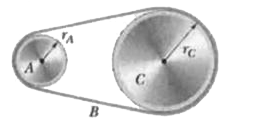
In Fig. 10-54, wheel A of radius r(A)=10...

In Fig. 10-54, wheel A of radius `r_(A)=10cm` is coupled by belt B to wheel C of radius `r_(C)=25cm`. The angular speed of wheel A is increased from rest at a constant rate of `2.0rad//s^(2)`. Find the time needed for wheel C to reach an angular speed of 100 rev/min, assuming the belt does not slip.

Text Solution

Verified by Experts

13 s
Promotional Banner

Topper's Solved these Questions

  • RIGID BODY DYNAMICS - I

    RESNICK AND HALLIDAY|Exercise PRACTICE QUESTIONS (SINGLE CORRECT CHOICE TYPE)|43 Videos
  • RIGID BODY DYNAMICS - I

    RESNICK AND HALLIDAY|Exercise PRACTICE QUESTIONS (MORE THAN ONE CORRECT CHOICE TYPE)|7 Videos
  • RIGID BODY DYNAMICS - I

    RESNICK AND HALLIDAY|Exercise CHECKPOINT|18 Videos
  • RELATIVITY

    RESNICK AND HALLIDAY|Exercise PRACTICE QUESTIONS (Integer Type)|5 Videos
  • RIGID BODY DYNAMICS-II

    RESNICK AND HALLIDAY|Exercise PRACTICE QUESTIONS (Integer Type)|2 Videos

Similar Questions

Explore conceptually related problems

In figure whell A of radius r_A = 10 cm is coupled by belt B to whell C of radius r_C = 25 cm . The angular speed of whell A is increased from rest at a constant rate of 1.6 rad//s^2 . Find the time needed for whell C to reach an angular speed of 12.8 rad//s , assuming the belt does not slip. .

A wheel having radius 10 cm is coupled by a belt to another wheel of radius 30 cm . 1st wheel increases its angular speed from rest at a uniform rate of 1.5 "rads"^(-2) . The time for 2nd wheel to reach a rotational speed of 100rev/min is ... (assume that the belt does not slip )

Wheel A of radius r_(A)=10cm is coupled by a belt C to another wheel of radius r_(B)=25 cm as in the figure. The wheels are free to rotate and the belt does not slip . At time t=0 wheel A increases it's angular speed from rest at a uniform rate pi//2 rad //sec^(2) Find the time in which wheel B attains a speed of 100 rpm [ Hint : v_(A)=v_(B)]

The angular velocity of a wheel increases from 100 to 300 in 10 s. The number of revolutions made during that time is

Calculate the angular speed of againt wheel of radius 10 m, moving with a speed of 10m//s .

A wheel rotates with a constasnt acceleration of 2.0rad/s^2 . If the wheel starts from rest, how many evolutions wil it make in the first 10 senconds?

A belt passes over a wheel of radius 25 cm. If a point on the belt has a speed of 5m//s , the belt is moving with an angular velocity of

A wheel of radius 15 cm is rotating about its axis at angluar speed of 20 rad//s . Find the linear speed and total acceleration of a point on the rim.

A wheel has angular acceleration of 3.0 rad//s^2 and an initial angular speed of 2.00 rad//s . In a tine of 2 s it has rotated through an angle (in radian) of

Two wheels having radii in the ratio 1 : 3 are connected by a common belt. If the smaller wheel is accelerated from rest at a rate 1.5 rads^2 for 10 s, find the angular velocity of bigger wheel

RESNICK AND HALLIDAY-RIGID BODY DYNAMICS - I-PROBLEMS
  1. The flywheel of a steam engine runs with a constant angular velocity o...

    Text Solution

    |

  2. A seed is on a turntable rotating at 331/3 rev/min, 6.0 cm from the ro...

    Text Solution

    |

  3. In Fig. 10-54, wheel A of radius r(A)=10cm is coupled by belt B to whe...

    Text Solution

    |

  4. Figure 10-55 shows an early method of measuring the speed of light tha...

    Text Solution

    |

  5. A disk, with a radius of 0.25 m, is to be rotated like a merry-go-roun...

    Text Solution

    |

  6. A car starts from rest and moves around a circular track of radius 32....

    Text Solution

    |

  7. (a) A uniform 2.00 kg disk of radius 0.300 m can rotate around its cen...

    Text Solution

    |

  8. Figure 10-56 gives angular speed versus time for a thin rod that rotat...

    Text Solution

    |

  9. A meter stick of negligible mass can rotate about a vertical axis thro...

    Text Solution

    |

  10. Figure 10-57 a shows a disk that can rotate about an axis at a radial ...

    Text Solution

    |

  11. A 0.50 kg meter stick can rotate around an axis perpendicular to the s...

    Text Solution

    |

  12. Figure 10-58 shows three 0.0100 kg particles that have been glued to a...

    Text Solution

    |

  13. A wheel with a rotational inertia of 0.50kg*m^(2) about its central ax...

    Text Solution

    |

  14. Figure 10-59 shows an arrangement of 15 identical disks that have been...

    Text Solution

    |

  15. In Fig. 10-60, two particles, each with mass m = 0.85 kg, are fastened...

    Text Solution

    |

  16. Figure 10-61 is an overhead view of a rod of length 1.0 m and mass 1.0...

    Text Solution

    |

  17. The uniform solid block in Fig. 10-62 has mass 0.172 kg and edge lengt...

    Text Solution

    |

  18. Four identical particles of mass 0.75 kg each are placed at the vertic...

    Text Solution

    |

  19. The body shown in Fig. is pivoted at point O. Three forces act on it F...

    Text Solution

    |

  20. A 60 kg father and 20 kg child sit on opposite ends of a seesaw consis...

    Text Solution

    |
