Home
Class 12
PHYSICS
Figure 10-58 shows three 0.0100 kg parti...

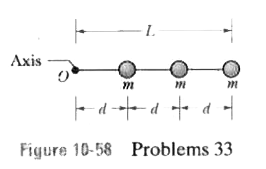
Figure 10-58 shows three 0.0100 kg particles that have been glued to a rod of length L = 8.00 cm and negligible mass. The assembly can rotate around a perpendicular axis through point O at the left end. If we remove one particle (that is, 33% of the mass), by what percentage does the rotational inertia of the assembly around the rotation axis decrease when that removed particle is (a) the inner-most one and (b) the outermost one?

Text Solution

Verified by Experts

(a) `~~7.1%`, (b) `~~64%`
Promotional Banner

Topper's Solved these Questions

  • RIGID BODY DYNAMICS - I

    RESNICK AND HALLIDAY|Exercise PRACTICE QUESTIONS (SINGLE CORRECT CHOICE TYPE)|43 Videos
  • RIGID BODY DYNAMICS - I

    RESNICK AND HALLIDAY|Exercise PRACTICE QUESTIONS (MORE THAN ONE CORRECT CHOICE TYPE)|7 Videos
  • RIGID BODY DYNAMICS - I

    RESNICK AND HALLIDAY|Exercise CHECKPOINT|18 Videos
  • RELATIVITY

    RESNICK AND HALLIDAY|Exercise PRACTICE QUESTIONS (Integer Type)|5 Videos
  • RIGID BODY DYNAMICS-II

    RESNICK AND HALLIDAY|Exercise PRACTICE QUESTIONS (Integer Type)|2 Videos

Similar Questions

Explore conceptually related problems

In Figure, three particles of mass m = 23 g are fastened to three rods of length d = 12 cm and negligible mass. The rigid assembly rotates around point O at the angular speed omega=0.85rad//s . About O, what are (a) the rotational inertia of the assembly, (b) the magnitude of the angular momentum of the middle particle, and ( c) the magnitude of the angular momentum of the assembly?

Figure 10-59 shows an arrangement of 15 identical disks that have been glued together in a rod-like shape of length L = 1.0000 m and (total) mass M = 100.0 mg. The disks are uniform, and the disk arrangement can rotate about a perpendicular axis through its central disk at point O. (a) What is the rotational inertia of the arrangement about that axis? (b) If we approximated the arrangement as being a uniform rod of mass M and length L, what percentage error would we make in using the formula in Table 10-2e to calculate the rotational inertia?

Find radius of gyration of a rod of length l and mass m about an axis perpendicular its length through one end.

Figure a rigid body consisting of two particles of mass m connected by a rod of length L and negligible mass. (a) What is the rotational inertia I_(com) about an axis through the center of mass, perpendicular to the rod as shown? (b) What is the rotational inertia I of the body about an axis through the left end of the rod and parallel to the first axis.

Two point masses of 0.3 kg and 0.7kg are fixed at the ends of a rod of length 1.4 m and of negligible mass. The rod is set rotating about an axis perpendicular to its length with a uniform angular speed. The point on the rod through which the axis should pass in order that the work required for rotation of the rod is minimum, is located at a distance of

Figure 10-74 is an overhead view of a rod of length d and negligible mass that rotates at angular speed omega in the horizontal plane about a vertical axis through point O. Particle A of mass m is attached at the center point and an identical particle B is attached at the far end. Find the angular momentum of particle B with respect to particle A.

Four particles of mass m are connected by massless rods to form a rectangle-of sides 2a and 2b as shown. The assembly, rotates about an axis in the plane of the figure through the centre. Find the moment of inertia about the axis:,

Two point masses A of mass M and B of mass of 4M are fixed at the ends of a rod of length l and of negligible mass. The rod is set rotation about an axis perpendicular to its length with a uniform angular speed. The work required for rotating the rod will be minimum when the distance of axis of rotation from the mass A is at

RESNICK AND HALLIDAY-RIGID BODY DYNAMICS - I-PROBLEMS
  1. Figure 10-57 a shows a disk that can rotate about an axis at a radial ...

    Text Solution

    |

  2. A 0.50 kg meter stick can rotate around an axis perpendicular to the s...

    Text Solution

    |

  3. Figure 10-58 shows three 0.0100 kg particles that have been glued to a...

    Text Solution

    |

  4. A wheel with a rotational inertia of 0.50kg*m^(2) about its central ax...

    Text Solution

    |

  5. Figure 10-59 shows an arrangement of 15 identical disks that have been...

    Text Solution

    |

  6. In Fig. 10-60, two particles, each with mass m = 0.85 kg, are fastened...

    Text Solution

    |

  7. Figure 10-61 is an overhead view of a rod of length 1.0 m and mass 1.0...

    Text Solution

    |

  8. The uniform solid block in Fig. 10-62 has mass 0.172 kg and edge lengt...

    Text Solution

    |

  9. Four identical particles of mass 0.75 kg each are placed at the vertic...

    Text Solution

    |

  10. The body shown in Fig. is pivoted at point O. Three forces act on it F...

    Text Solution

    |

  11. A 60 kg father and 20 kg child sit on opposite ends of a seesaw consis...

    Text Solution

    |

  12. A 100 kg cubical box lies on a floor. A child pushes horizontally at a...

    Text Solution

    |

  13. A cord with negligible mass is wrapped around a pulley that is a unifo...

    Text Solution

    |

  14. If a 42.0N*m torque on a wheel causes angular acceleration 25.0rad//s^...

    Text Solution

    |

  15. In Fig. 10-64, block 1 has mass m(1)=460g, block 2 has mass m(2)=500g,...

    Text Solution

    |

  16. In Fig. 10-65, a cylinder having a mass of 3.0 kg can rotate about its...

    Text Solution

    |

  17. Figure shows a uniform disk that can rotate around its center like a m...

    Text Solution

    |

  18. In a judo foot-sweep move, you sweep your opponent's left foot out fro...

    Text Solution

    |

  19. Figure shows particles 1 and 2, each of mass m, fixed to the ends of a...

    Text Solution

    |

  20. A pulley, with a rotational inertia of 1.0xx10^(-3)kg*m^(2) about its ...

    Text Solution

    |
