Home
Class 12
PHYSICS
In Fig. 10-64, block 1 has mass m(1)=460...

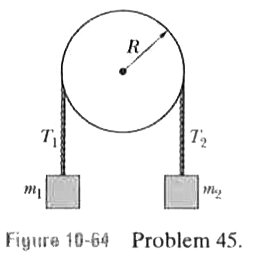
In Fig. 10-64, block 1 has mass `m_(1)=460g`, block 2 has mass `m_(2)=500g`, and the pulley, which is mounted on a horizontal axle with negligible friction, has radius R = 5.00 cm. When released from rest, block 2 falls 75.0 cm in 5.00 s without the cord slipping on the pulley. (a) What is the magnitude of the acceleration of the blocks? What are (b) tension `T_(2)` and ( c) tension `T_(1)`? (d) What is the magnitude of the pulley's angular acceleration? (e) What is its rotational inertia?

Text Solution

Verified by Experts

(a) `6.00xx10^(-2)m//s^(2)`, (b) 4.87 N, ( c) 4.54 N, (d) `1.20rad//s^(2)`, (e) `1.38xx10^(-2)kg*m^(2)`
Promotional Banner

Topper's Solved these Questions

  • RIGID BODY DYNAMICS - I

    RESNICK AND HALLIDAY|Exercise PRACTICE QUESTIONS (SINGLE CORRECT CHOICE TYPE)|43 Videos
  • RIGID BODY DYNAMICS - I

    RESNICK AND HALLIDAY|Exercise PRACTICE QUESTIONS (MORE THAN ONE CORRECT CHOICE TYPE)|7 Videos
  • RIGID BODY DYNAMICS - I

    RESNICK AND HALLIDAY|Exercise CHECKPOINT|18 Videos
  • RELATIVITY

    RESNICK AND HALLIDAY|Exercise PRACTICE QUESTIONS (Integer Type)|5 Videos
  • RIGID BODY DYNAMICS-II

    RESNICK AND HALLIDAY|Exercise PRACTICE QUESTIONS (Integer Type)|2 Videos

Similar Questions

Explore conceptually related problems

When we ignore friction and mass of pulley what would be the accelerations of the two blocks m_(1) and m_(2) .

A block is connected to a disc pulley of same mass m radius R. If the acceleration of the block is (2g)/(Z) , find Z.

A uniform disc of mass M and radius R is mounted on a fixed horizontal axis. A block of mass m hangs from a massless string that is wrapped around the rim of the disc. The magnitude of the acceleration of the falling block (m) is

In Fig. 5-29, a block of mass m = 5.00 kg is pulled along a horizonttal frictionless floor by a cord that exerts a force of magnitude F = 12.0 at an angle theta=25.0^(@) . Figure 5-29 A block is pulled along a horizontal floor. (a) What is the magnitude of the block's acceleration?

A block of mass m_(1)=3.70 kg on a frictionless plane inclined at angle 30.0^(@) is connected by a cord over a massless, frictionless pulley to a second block of mass m_(2)=2.30 kg (see Fig. 5-32). (a) What is the magnitude of the acceleration of each block? (b) What is the direction of the acceleration of the hanging block ? (c) What is the tension in the cord?

In Fig. 6-50, block A of mass 2.0 kg, block B of 3.0kg, and block Cof 6.0 kg are connected by strings of negligible mass that run over pulleys of negligible mass and friction. The coef ficient of kinetic friction between block B and the table top is 0.40. When the system is released, the blocks move. What is the magnitude of their acceleration?

Two blocks are connected by a string that passes over a pulley of radius R and moment of inertia I . The block of mass m_(1) sides on a frictionless, horizontal surface, the block of mass m_(2) is suspended from the string. Find the acceleration a of the blocks and the tension T_(1) and T_(2) assuming that the string does not slip on the pulley.

In terms of masses m_(1),m_(2) and g, find the acceleration of both the blocks shown in Fig. Neglect all friction and masses of the pulley.

A block with mass 0.50 kg is forced against a horizontal spring of negligible mass , compressing the spring a distance of 0.20 m (figure). When released, the block moves on a horizontal table top for 1.00N//m . What is the coefficient of kinetic friction mu _(k) , between the block and the block and the table?

The three blocks in figure-2.25 are released from rest and accelerate at the rate of 5m//s^(2) . If M = 4kg, what is the magnitude of the frictional force on the block that slides horizontally? [140 N]

RESNICK AND HALLIDAY-RIGID BODY DYNAMICS - I-PROBLEMS
  1. A cord with negligible mass is wrapped around a pulley that is a unifo...

    Text Solution

    |

  2. If a 42.0N*m torque on a wheel causes angular acceleration 25.0rad//s^...

    Text Solution

    |

  3. In Fig. 10-64, block 1 has mass m(1)=460g, block 2 has mass m(2)=500g,...

    Text Solution

    |

  4. In Fig. 10-65, a cylinder having a mass of 3.0 kg can rotate about its...

    Text Solution

    |

  5. Figure shows a uniform disk that can rotate around its center like a m...

    Text Solution

    |

  6. In a judo foot-sweep move, you sweep your opponent's left foot out fro...

    Text Solution

    |

  7. Figure shows particles 1 and 2, each of mass m, fixed to the ends of a...

    Text Solution

    |

  8. A pulley, with a rotational inertia of 1.0xx10^(-3)kg*m^(2) about its ...

    Text Solution

    |

  9. (a) If R = 15 cm, M = 350 g, and m = 50 g in Fig. 10-19, find the spee...

    Text Solution

    |

  10. A uniform metal pole of height 30.0 m and mass 100 kg is initially sta...

    Text Solution

    |

  11. A thin rod of length 0.75 m and mass 0.42 kg is suspended freely from ...

    Text Solution

    |

  12. A metre stick is held vertically with one end on the floor and is then...

    Text Solution

    |

  13. A uniform cylinder of radius 12 cm and mass 25 kg is mounted so as to ...

    Text Solution

    |

  14. A tall, cylindrical chimney falls over when its base is ruptured. Trea...

    Text Solution

    |

  15. A uniform spherical shell of mass M = 4.5 kg and radius R = 8.5 cm can...

    Text Solution

    |

  16. Figure shows a rigid assembly of a thin hoop (of mass m and radius R =...

    Text Solution

    |

  17. In unit vector notation, find the net torque about the origin on a par...

    Text Solution

    |

  18. In unit vector notation, find the torque about a point at coordinates ...

    Text Solution

    |

  19. In unit vector notation, what is the torque about the origin on a part...

    Text Solution

    |

  20. A particle moves through an xyz coordinate system while a force acts o...

    Text Solution

    |
