Home
Class 12
PHYSICS
At the instant of Figure, a 2.0 kg parti...

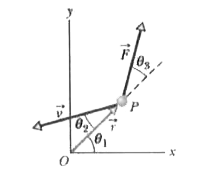
At the instant of Figure, a 2.0 kg particle P has a position vector `vecr` of magnitude 5.0 m and angle `theta_(1)=45^(@)` and a velocity vector `vecv` of magnitude 4.0 m/s and angle `theta_(2)=30^(@)`, Force `vecF`, of magnitude 2.0 N and angle `theta_(3)=30^(@)`, acts on P. All three vectors lie in the xy plane. About the origin, what are the (a) magnitude and (b) direction of the angular momentum of P and the ( c) magnitude and (d) direction of the torque acting on P?

Text Solution

Verified by Experts

(a) `20kg*m^(2)//s`, (b) Using the right-hand rule for vector products, we find `vecrxxvecp` point out of the page, or along the +z axis, perpendicular to the plane of the figure, ( c) `5.0N*m`, (d) Using the right-hand rule for vector products, we find `rxxvecF` is also out of the page, or along the +z axis, perpendicular to the plane of the figure.
Promotional Banner

Topper's Solved these Questions

  • RIGID BODY DYNAMICS - I

    RESNICK AND HALLIDAY|Exercise PRACTICE QUESTIONS (SINGLE CORRECT CHOICE TYPE)|43 Videos
  • RIGID BODY DYNAMICS - I

    RESNICK AND HALLIDAY|Exercise PRACTICE QUESTIONS (MORE THAN ONE CORRECT CHOICE TYPE)|7 Videos
  • RIGID BODY DYNAMICS - I

    RESNICK AND HALLIDAY|Exercise CHECKPOINT|18 Videos
  • RELATIVITY

    RESNICK AND HALLIDAY|Exercise PRACTICE QUESTIONS (Integer Type)|5 Videos
  • RIGID BODY DYNAMICS-II

    RESNICK AND HALLIDAY|Exercise PRACTICE QUESTIONS (Integer Type)|2 Videos

Similar Questions

Explore conceptually related problems

Find the magnitude and direction of the resultant of two vectors A and B in the terms of their magnitudes and angle theta between them.

In the overhead view of Fig. 4-40, Jeeps P and B race along straight lines, across flat terrain, and past stationary border guard A. Relative to the guard, B travels at a constant speed of 25.0 m/s, at the angle theta_(2)=30.0^(@) . Relative to the guard, P has accelerated from rest at a constant rate of 0.400m//s^(2) at the angle theta_(1)=60.0^(@) . At a certain time during the acceleration, P has a speed of 40.0 m/s. At that time, what are the (a) magnitude and (b) direction of the velocity of P relative to B and the ( c) magnitude and (d) direction of the acceleration of P relative to B?

Two vectors having equal magnitudes A make an angle theta with eahc other. Find the magnitude and direction of the resultant.

A vector of magnitude 30 and direction eastwards is added with another vector of magnitude 40 and direction Northwards . Find the magnitude and direction of resultant with the east.

Two vectors having equal magnitudes A make an angle theta with each each other.Find the magnitude and direction of the resultant.

A vector of magnitude a is turned through angle theta . The magnitude of change in the vector is given by:

If the angle between two vectors of equal magnitude "P" is theta the magnitude of the difference of the vectors is

If the angle between two vectors of equal magnitude P is "theta" ,the magnitude of the difference of the vectors is

A vector of magnitude b is rotated through angle theta . What is the change in magnitude of the vector?

Figure shows a 0.300 kg baseball just before and just after it collides with a bat. Just before, the ball has velocity vecv_1 of magnitude 12.0 m/s and angle theta_1=35.0^@ Just after, it is traveling directly upward with velocity vecv_2 of magnitude 10.0 m/s The duration of the collision is 2.00 ms. What are the (a) magnitude and (b) direction (relative to the positive direction of the x axis) of the impulse on the ball from the bat? What are the (c) magnitude and (d) direction of the average force on the ball from the bat?

RESNICK AND HALLIDAY-RIGID BODY DYNAMICS - I-PROBLEMS
  1. Force vecF=(2.0N)hati-(3.0N)hatk acts on a pebble with position vector...

    Text Solution

    |

  2. A force vecF=(6.00hati-4.00hatj)N acts on a particle with position vec...

    Text Solution

    |

  3. At the instant of Figure, a 2.0 kg particle P has a position vector ve...

    Text Solution

    |

  4. A particle of mass m is shot from ground level at initial speed u and ...

    Text Solution

    |

  5. A 3.0 kg particle-like object moves in a plane with velocity component...

    Text Solution

    |

  6. Two particles each of mass m and speed v, travel in opposite direction...

    Text Solution

    |

  7. At the instant the displacement of a 1.50 kg object relative to the or...

    Text Solution

    |

  8. In Fig. 10-72, a 0.400 kg ball is shot directly upward at initial spee...

    Text Solution

    |

  9. A particle is acted on by two torques about the origin: vectau(1) has ...

    Text Solution

    |

  10. In Fig. 10-73, a particle of mass m is released from rest at point A, ...

    Text Solution

    |

  11. Figure 10-74 is an overhead view of a rod of length d and negligible m...

    Text Solution

    |

  12. A force (2.00hati-4.00hatj+2.00hatk)N acts on a particle located at (3...

    Text Solution

    |

  13. Figure 10-75 shows three rotating, uniform disks that are coupled by b...

    Text Solution

    |

  14. In Figure, three particles of mass m = 23 g are fastened to three rods...

    Text Solution

    |

  15. A sanding disk with rotational inertia 8.6xx10^(-3)kg*m^(2) is attache...

    Text Solution

    |

  16. The angular momentum of a flywheel having a rotational inertia of 0.14...

    Text Solution

    |

  17. A disk with a rotational inertia of 7.00kg*m^(2) rotates like a merry-...

    Text Solution

    |

  18. Figure 10-77 shows a rigid structure consisting of a circular hoop of ...

    Text Solution

    |

  19. In Fig. 10-78, two skaters, each of mass 50 kg, approach each other al...

    Text Solution

    |

  20. A cockroach of mass 0.20 kg runs counterclockwise around the rim of a ...

    Text Solution

    |
