

Home
Class 11
PHYSICS
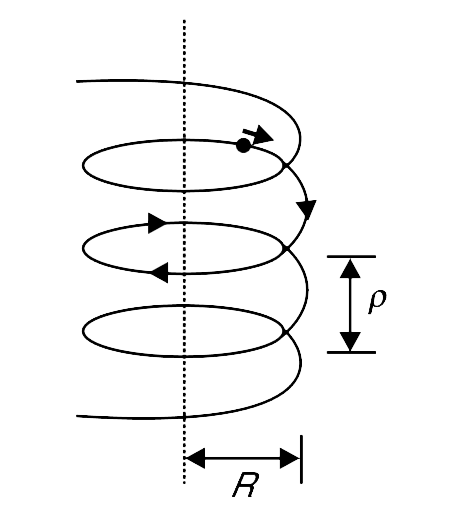
A long helix made of thin wire is held v...

A long helix made of thin wire is held vertical. The radius and pitch of the helix are R and `rho` respectively. A bead begins to slide down the helix.
(a) Find the normal force applied by the wire on the bead when the speed of the bead is `upsilon`.
(b) Eventually, the bead acquires a constant speed of `v_(0)`. Find the coefficient of friction between the wire and the bead.

Promotional Banner

Similar Questions

Explore conceptually related problems

A horizontal wooden block has a fixed rod OA standing on it. From top point A of the rod, two wires have been fixed to points B and C on the block. The plane of triangle OAB is perpendicular to the plane of the triangle OAC. There are two identical beads on the two wires. One of the wires is perfectly smooth while the other is rough. The wooden block is moved with a horizontal acceleration (a) that is perpendicular to the line OB and it is observed that both the beads do not slide on the wire. Find the minimum coefficient of friction between the rough wire and the bead.

A small, electrically charged bead can slide on a circular, frictionless, thin, insulating ring. Charge on the bead is Q and its mass is m . A small electric dipole, having dipole moment P is fixed at the centre of the circle with the dipole’s axis lying in the plane of the circle. Initially, the bead is held on the perpendicular bisector of the dipole (see fig.) Ignore gravity and answer the following questions. (a) Write the speed of the bead when it reaches the position theta shown in the figure. (b) Find the normal force exerted by the ring on the bead at position theta . (c) How does the bead move after it is released? Where will the bead first stop after being released? (d) How would the bead move in the absence of the ring?

Find the ratio of the first quantity to the second. 25 beads, 40 beads

Find the ratio of the first quantity to the second. 25 beads, 40 beads

A rod can rotate in a horizontal plane about its one end. A bead which can move along the rod is placed at certain distance from the axis or rotation. The bead does not to friction. The rod has a constant angular acceleration A. the normal reaction on the bead will be constant h magnitude and direction both B. the magnitude of the normal reaction on the bead will be variable C. the magnitude of friction force on the bead will be constant D. the magnitude of friction force on the bead will be variable

A bead can slide on a smooth circular wire frame of radius R which is fixed in a vartical plane. The bead is displaced slightly from the highest point of the wire frame. The speed of the bead subsequently as a function of the angle theta made by the bead with the vertical line is

A bead can slide on a smooth circular wire frame of radius r which is fixed in a vertical plane. The bead is displaced slighty from the highest point of the wire frame. The speed of the bead subsequently as a function of the angle theta made by the bead with the verticle line is