Text Solution
Verified by Experts



Topper's Solved these Questions
RAY OPTICS AND OPTICAL INSTRUMENTS
OSWAAL PUBLICATION|Exercise TOPIC-2(SHORT ANSWER TYPE QUESTIONS-II)|1 VideosRAY OPTICS AND OPTICAL INSTRUMENTS
OSWAAL PUBLICATION|Exercise TOPIC-2(LONG ANSWER TYPE QUESTIONS)|1 VideosRAY OPTICS AND OPTICAL INSTRUMENTS
OSWAAL PUBLICATION|Exercise TOPIC-2(VERY SHORT ANSWER TYPE QUESTIONS)|4 VideosNUCLEI
OSWAAL PUBLICATION|Exercise TOPIC -2 (Numerical Problems)|3 VideosSample Paper 1
OSWAAL PUBLICATION|Exercise Exercise|36 Videos
Similar Questions
Explore conceptually related problems
OSWAAL PUBLICATION-RAY OPTICS AND OPTICAL INSTRUMENTS-TOPIC-2(SHORT ANSWER TYPE QUESTIONS-I)
- What is the thin prism?
Text Solution
|
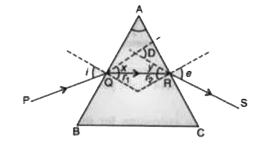
- Draw the ray diagram to show the refraction of light through a prism.
Text Solution
|
- Draw the ray diagram to show the refraction of light through a prism.
Text Solution
|
- Two monochromatic rays of light are incident normally on the face AB o...
Text Solution
|
- Figure shows a ray of light passing through a prism. If the refracted ...
Text Solution
|
- A ray of light, incident on an equilateral glass prism mu(g) = sqrt(3...
Text Solution
|
- Explain why the colour of the sky is blue (Cyan).
Text Solution
|