Home
Class 12
PHYSICS
Arrive at an expression for drift veloci...

Arrive at an expression for drift velocity.

Text Solution

Verified by Experts
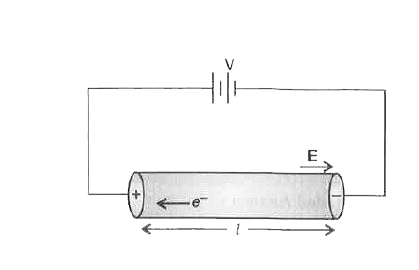
`F=-eE and a=-(F)/(m)=-(evec(E))/(m)`
`vecV_(d)=vecV_(0)+vec(a)tau=0+((-evec(E))/(m))tau`
Arriing `vecV_(d)=-(evecE)/(m) tau or |vecV_(d)|=(eEtau)/(m)`
Detailed Answer
If V is the potential difference applied across the ends of a conductor of length 1, the magnitude of electric field set up is `E=(V)/(l)`
The charge of electron is `-e`, each free electron in the conductor experience force `overline(F)=-e.overline(E)`
If m is the mass of an electron, the acceleration of each electron is `veca=(-e.vec(E))/(m)`
At any instant of time, the velocity acquired by electron having velocity`vecu_(1)` will be `vecv_(1)=vecu_(1)+vec(at)_(1),vecv_(2)=vecu_(2)+vec(at)_(2)`
`therfore` The average velocity of all the electrons in the conductor under the effect of external electric field is the drift velocity of the free electrons.
Thus `vecv_(d)=(vecv_(1)+vecv_(2)+vecv_(3) . . +vecv_(n))/(n)`
`vecv_(d)=(vecu_(1)+vecu_(2)+vecu_(3) . . .+vecu_(n))/(n)+(veca(t_(1)+t_(2)+t_(3) . . +t_(n)))/(n)`
`vecv_(d)=0+vec(a)t`
where `t=(T_(1)+T_(2)+T_(3) . . .T_(n))/(n)`
`therefore vecv_(d)=at,vecv_(d)=(-evecE)/(m)T`
`therefore V_(d)=(eET)/(m)`
Promotional Banner

Topper's Solved these Questions

  • SOLVED PAPER (II PUC MARCH-2016)

    OSWAAL PUBLICATION|Exercise PART-D|11 Videos
  • SOLVED PAPER (II PUC MARCH-2016)

    OSWAAL PUBLICATION|Exercise PART-B|8 Videos
  • SOLVED PAPER (II PUC JULY 2016)

    OSWAAL PUBLICATION|Exercise PART D|11 Videos
  • SOLVED PAPER 1

    OSWAAL PUBLICATION|Exercise Exercise|39 Videos

Similar Questions

Explore conceptually related problems

Write the expression for drift velocity in terms of current and explain the terms.

Write the expression for the drift velocity of charge carriers in a conductor of length l across which a potential difference V is applied.

Arrive at the expression for velocity selector using Lorentz force.

Arrive at an expression for pressure at point due to a liquid.

Arrive at the expression for the wavelength of electron in terms of electric potential.

