

Home
Class 11
PHYSICS
The acceleration of a particle which mov...

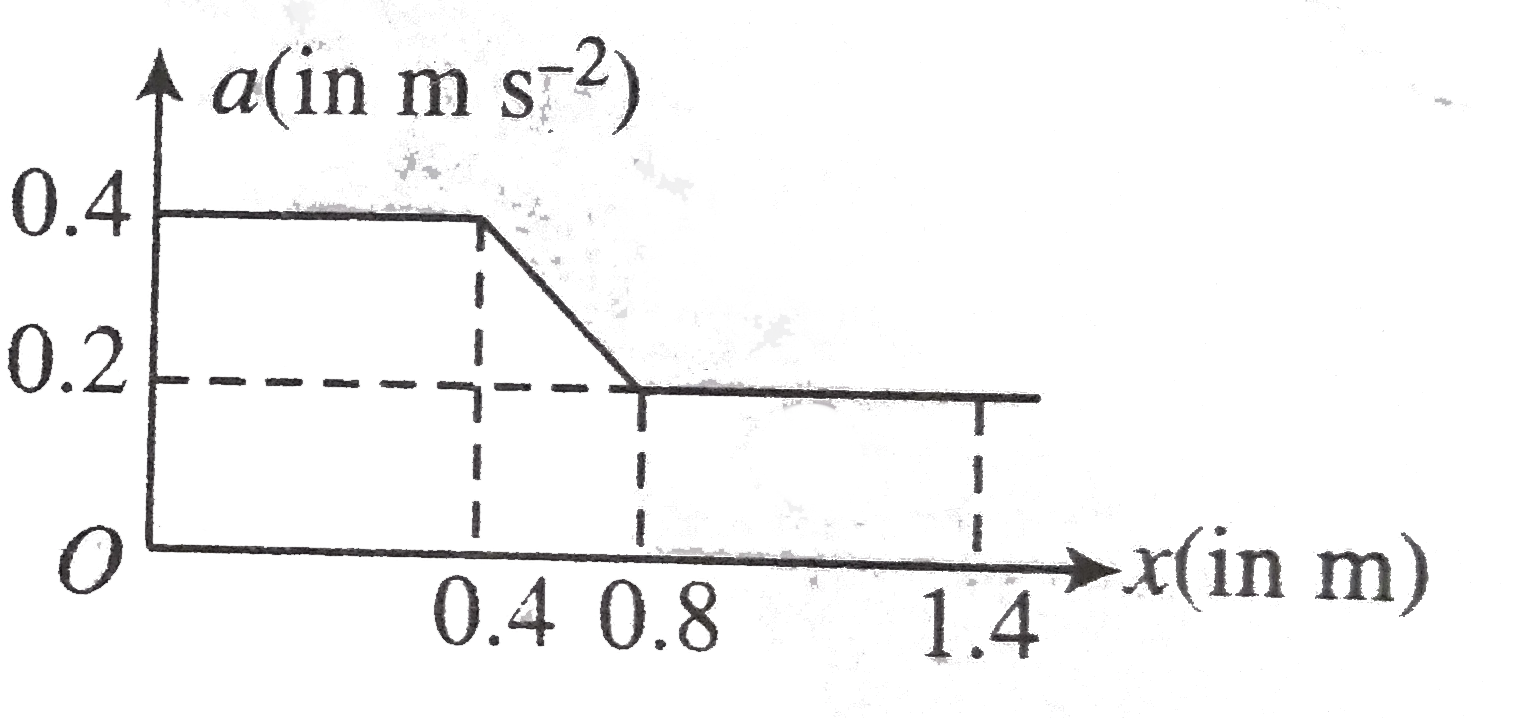
The acceleration of a particle which moves along the positive x-axis varies with its position as shown in figure. If the velocity of the particle is `0.8 ms^(-1)` at x = 0, then velocity of the particle at `x = 1.4 m` is `(in ms^(-1))`.

Promotional Banner

Similar Questions

Explore conceptually related problems

The velocity (upsilon) of a particle moving along X-axis varies with its position x as shown in figure. The acceleration (a) of particle varies with position (x) as

The velocity (upsilon) of a particle moving along X-axis varies with its position x as shown in figure. The acceleration (a) of particle varies with position (x) as

The magnitude of force acting on a particle moving along x-axis varies with time (t) as shown in figure. If at t = 0 the velocity of particle is v_(0) , then its velocity at t=T_(0) will be

The magnitude of force acting on a particle moving along x-axis varies with time (t) as shown in figure. If at t = 0 the velocity of particle is v_(0) , then its velocity at t=T_(0) will be

The force versus position (F-x) graph of a particle of mass 2 kg is shown in the figure. If at x = 0 velocity of particle is 2 m/s then velocity of the particle at x = 8 m will be

The kinetic energy K of a particle moving along x - axis varies its position (x) as shown in figure. The magnitude of force acting on particle at x = 9m is

A particle moves along the positive x -axis with an acceleration a_(x) which increases linearly with x , as shown in the graph. If the velocity of the particle at x=4cm is 0.40m//s determine the velocity at x=12cm

A particle moves along the positive x -axis with an acceleration a_(x) which increases linearly with x , as shown in the graph. If the velocity of the particle at x=4cm is 0.40m//s determine the velocity at x=12cm