

Home
Class 12
PHYSICS
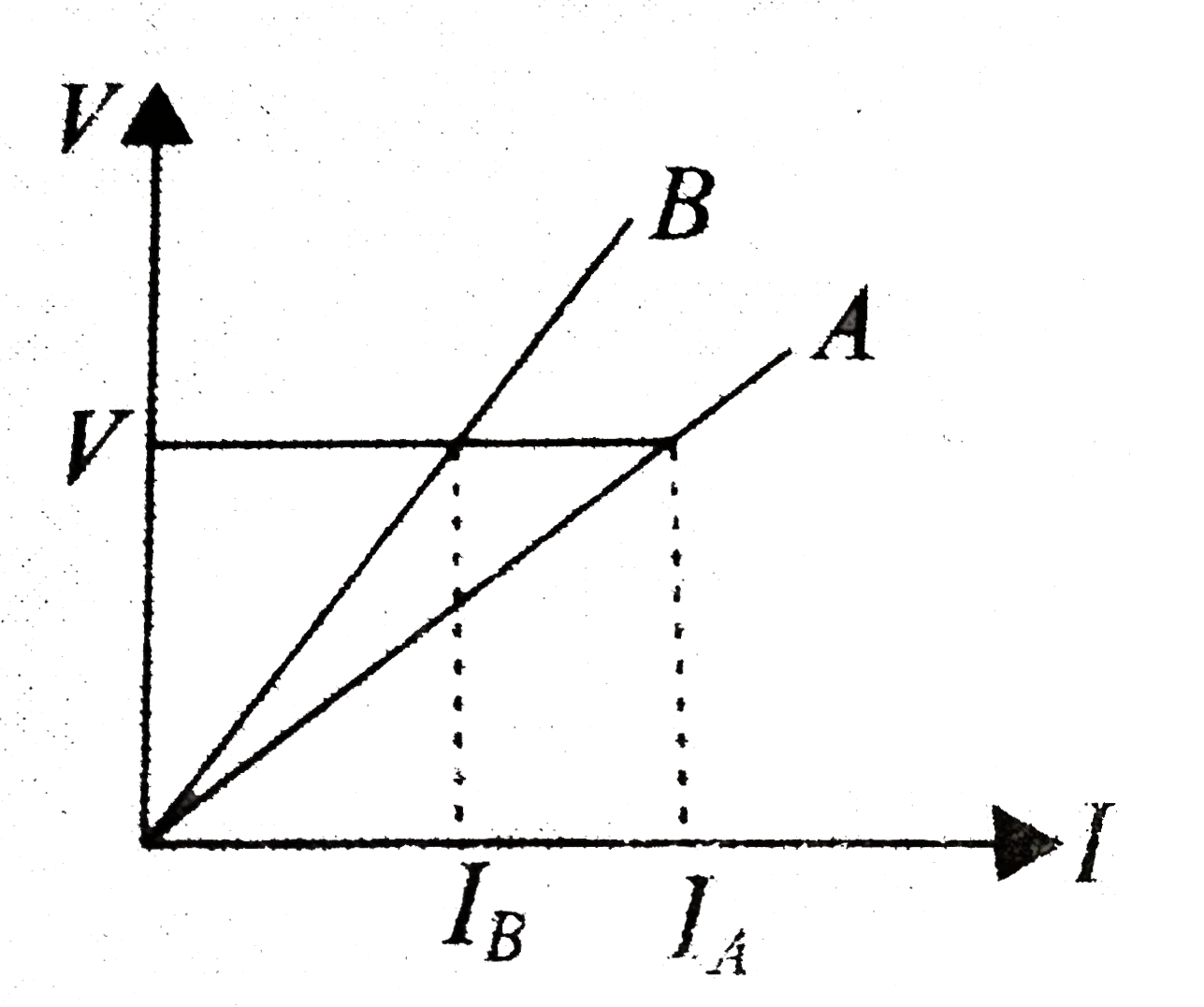
The voltage-current graphs for two resis...

The voltage-current graphs for two resistor of the same meterial and the same radius with lengths, `L_1 and L_2` are shown in fig 5.2. if `L_1 gt L_2`, state with reason which of these graphs represents votage- current change of `L_1.`

Promotional Banner

Similar Questions

Explore conceptually related problems

The voltage-current graphs for two resistors of the same material and same radii with lengths L_1 and L_2 are shown in the figure. If L_1 >L_2 state with reason, which of these graphs represents voltage current change for L_1 ?

The graph between L and Tis correctly shown by (Fig. 7.2)

An LCR circuit is equivalent to a damped pendulum. In an LCR circuit the capacitor is charged to Q_0 and then connected to the L and R as shown below: If a student plots graphs of the square of maximum charge (Q_"Max"^2) on the capacitor with time (t) for two different values L_1 and L_2 (L_1 gt L_2) of L then which of the following represents this graph correctly ? (plots are schematic and not drawn to scale)

Two lenses L_1 and L_2 are placed in contact as shown in figures. The focal length of each lens is 10cm.What is power of L_1

In fig. if l_1||l_2 and l_2||l_4 what is y in term of x

In the circuit shown in Fig. If both the lamps L_(1) and L_(2) are identical.

In a sonometer, two adjacent wires of the same material are stretched under the same tension. The first wire is thicker than the other. The corresponding frequencies of length l_(1) and l_(2) of the sonometer wires are in unison with a tuning fork. Which of the following is correct ? Give reasons. (i) l_(1) = l_(2) (ii) l_(1) lt l_(2) (iii) l_(1) gt l_(2)

In Fig., there are two convex lenses L_1 and L_2 having focal lengths F_1 and F_2 respectively. The distance between L_1 and L_2 will be : .