Home
Class 10
MATHS
A life insurance agent found the followi...

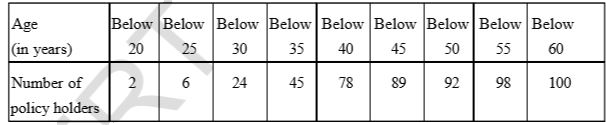
A life insurance agent found the following data about distribution of ages of 100 policy holders. Calculate the median age. [ Policies are given only to persons having age 18 years onwards but less than 60 years.]

Text Solution

Verified by Experts

The correct Answer is:

Median age = 35.76 years
Promotional Banner

Topper's Solved these Questions

  • STATISTICS

    NCERT BANGLISH|Exercise Exercise 14.4|3 Videos
  • STATISTICS

    NCERT BANGLISH|Exercise Do this|6 Videos
  • STATISTICS

    NCERT BANGLISH|Exercise Exercise 14.2|6 Videos
  • SIMILAR TRIANGLES

    NCERT BANGLISH|Exercise TRY THIS|6 Videos
  • TANGENTS AND SECANTS TO A CIRCLE

    NCERT BANGLISH|Exercise Try this|5 Videos

Similar Questions

Explore conceptually related problems

An insurance company selected 2000 drivers at random (i.e., without any preference of one driver over another) in a particular city to find a relationship between age and accidents. The data obtained is given in the following table: Find the probabilities of the following events for a driver chosen at random from the city: (i) The driver being in the age group 18-29 years and having exactly 3 accidents in one year. (ii) The driver being in the age group of 30-50 years and having one or more accidents in a year. (iii) Having no accidents in the year.

In the atmosphere, carbon dioxide is found in two forms, i.e., ^12CO_2 and ^14CO_2 . Plants absord CO_2 during photosynthesis in presence of chlorophyll, plants synthesise glucose 6CO_2 +6 H_2O rarr C_6H_12O_6 + 6O_2uarr Half life of ^14CO_2 is 5760 years. The analysis of wooden artifacts for ^14C and ^12C gives useful information for determination of its age. All living organisms, because of their constant exchange of Carbon dioxide with the surroundings have the same ratio of C-14 to C-12, i.e. 1.3xx10^-12 . When an organism dies, the C-14 in it keeps on decaying as follows: 6^14Crarr7^14N+(-1)^0e +Energy Thus, the ratio of C-14 and C-12 decreases with the passage of time. We can measure the proportion of C-14 in the remains of dead organism and determine how long ago it died. The method of carbon dating can be used to date anything made or organic matter, e.g., bone, skeleton, wood, etc. Using carbon dating, materials have been dated to about 50,000 years with accuracy. C-14 exists in atmosphere due to:

In the atmosphere, carbon dioxide is found in two forms, i.e., ^12CO_2 and ^14CO_2 . Plants absord CO_2 during photosynthesis in presence of chlorophyll, plants systhesise glucose 6CO_2 +6 H_2O rarr C_6H_12O_6 + 6O_2uarr Half life of ^14CO_2 is 5760 years. The analysis of wooden artifacts for ^14C and ^12C gives useful information for determination of its age. All living organisms, because of their constant exchange of Carbon dioxide with the surroundings have the same ratio of C-14 to C-12, i.e. 1.3xx10^-12 . When an organism dies, the C-14 in it keeps on decaying as follows: 6^14Crarr7^14N+(-1)^0e +Energy Thus, the ratio of C-14 and C-12 decreases with the passage of time. We can measure the proportion of C-14 in the remains of dead organism and determine how long ago it died. The method of carbon dating can be used to date anything made or organic matter, e.g., bone, skeleton, wood, etc. Using carbon dating, materials have been dated to about 50,000 years with accuracy. A piece of wood from an archeological source shows a C-14 activity which is 60% of the activity found in fresh wood today. The age of archeological sample will be:

IQ of a person is given by the formula IQ= (MA)/(CA) xx 100 , where MA is mental age and CA is chronological age. If 80 le IQ le 140 for a group of 12 years old children, find the range of their mental age.

The half-life of a radioactive isotope X is 50 years . It decays to another element Y which is stable . The two elements X and Y were found to be in the ratio of 1:15 in a sample of a given rock. The age of the rock was estimated to be

The formula of IQ of a person is given below: IQ=m/ctimes100 where m is mental age and c is chronological age. If 80leIQle140 for a group of 12-year children, find the range of their mental age.

The half-life for radioactive decay of .^(14)C is 5730 years . An archaeological artifact containing wood had only 80% of the .^(14)C found in a living tree. Estimate the age of the sample.
