Home
Class 11
PHYSICS
The figure given below depicts two circu...

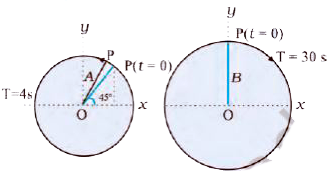
The figure given below depicts two circular motions. The radius of the circle, the period of revolution, the initial position and the sense of revolution are indicated in the figures. Obtain the simple harmonic motions of the x-projection of the radius vector of the rotating particle P in each case.

Text Solution

Verified by Experts

(a) At t = 0, OP makes an angle of `45^(@) = pi//4` rad with the (positive direction of ) x-axis. After time t, it covers an angle `(2pi)/Tt` in the anticlockwise sense, and makes an angle of `(2pi)/Tt+pi/4` with the x-axis.
The projection of OP on the x-axis at time t is given by,
`x(t)=Acos((2pi)/Tt+pi/4)`
For `T=4s`.
`x(t)=Acos((2pi)/4t+pi/4)`
which is a SHM of amplitude A, period 4 s,
and an initial phase*=`pi/4`.
(b) In this case at t = 0, OP makes an angle of `90^(@)=pi/2` with the x-axis. After a time t, it covers an angle of `(2pi)/Tt` in the clockwise sense and makes an angle of `(pi/2-(2pi)/Tt)` with the x-axis. The projection of OP on the x-axis at time t is given by
`x(t)=Bcos(pi/2-(2pi)/Tt)`
`=Bsin((2pi)/Tt)`
For T = 30 s,
`x(t)=Bsin(pi/15t)`
Writing this as x (t ) = B cos`(pi/15t-pi/2)`, and comparing with Eq. (14.4). We find that this represents a SHM of amplitude B, period 30 s, and an initial phase of `-pi/2`.
Promotional Banner

Topper's Solved these Questions

  • OSCILLATIONS

    NCERT BANGLISH|Exercise Exercises|27 Videos
  • OSCILLATIONS

    NCERT BANGLISH|Exercise Additional Exercises|6 Videos
  • MOTION IN A STRAIGHT LINE

    NCERT BANGLISH|Exercise ADDITIONAL EXERCISES|5 Videos
  • SYSTEMS OF PARTICLES AND ROTATIONAL MOTION

    NCERT BANGLISH|Exercise EXERCISES (TRUE OR FALSE)|3 Videos

Similar Questions

Explore conceptually related problems

For each natural number k, let C_k denotes the circle with radius k units and centre at the origin. On the circle C_k , a particle moves k units in the counter clockwise direction. After completing its motion on C_k , the particles moves to C_(k + l) , in some well defined manner, where l gt 0 . The motion of the particle continues in this manner. Answer the following question based on above passage : Let l= 1, the particles starts at (1, 0), if the particles crossing the positive direction of the x-axis for the first time on the circle C_n then n is equal to

There are some experiment in which the outcomes cannot be identified discretely. For example, an ellipse of eccentricity 2sqrt(2)//3 is inscribed in a circle and a point within the circle is chosen at random. Now, we want to find the probability that this point lies outside the ellipse. Then, the point must lie in the shaded region shown in Figure. Let the radius of the circle be a and length of minor axis of the ellipse be 2b. Given that 1 - (b^(2))/(a^(2)) = (8)/(9) or (b^(2))/(a^(2)) = (1)/(9) Then, the area of circle serves as sample space and area of the shaded region represents the area for favorable cases. Then, required probability is p= ("Area of shaded region")/("Area of circle") =(pia^(2) - piab)/(pia^(2)) = 1 - (b)/(a) = 1 - (1)/(3) = (2)/(3) Now, answer the following questions. Two persons A and B agree to meet at a place between 5 and 6 pm. The first one to arrive waits for 20 min and then leave. If the time of their arrival be independant and at random, then the probability that A and B meet is
