Home
Class 11
PHYSICS
Two identical springs of spring constant...

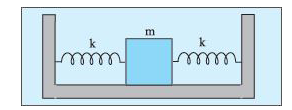
Two identical springs of spring constant k are attached to a block of mass m and to fixed supports as shown in Fig. 14.14. Show that when the mass is displaced from its equilibrium position on either side, it executes a simple harmonic motion. Find the period of oscillations.

Text Solution

Verified by Experts
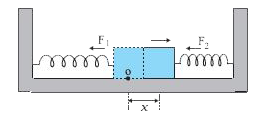
Let the mass be displaced by a small distance x to the right side of the equilibrium position, as shown in Fig. 14.15. Under this situation the spring on the left side gets

elongated by a length equal to x and that on the right side gets compressed by the same length. The forces acting on the mass are then,
`F_(1)=-kx` (force exerted by the spring on the left side, trying to pull the mass towards the mean position)
`F_(2)=-kx` (force exerted by the spring on the right side, trying to push the mass towards the mean position)
The net force, F, acting on the mass is then given by,
`F=-2kx`
Hence the force acting on the mass is proportional to the displacement and is directed towards the mean position, therefore, the motion executed by the mass is simple harmonic. The time period of oscillations is,
`T=2pisqrt(m/(2k))`
Promotional Banner

Topper's Solved these Questions

  • OSCILLATIONS

    NCERT BANGLISH|Exercise Exercises|27 Videos
  • OSCILLATIONS

    NCERT BANGLISH|Exercise Additional Exercises|6 Videos
  • MOTION IN A STRAIGHT LINE

    NCERT BANGLISH|Exercise ADDITIONAL EXERCISES|5 Videos
  • SYSTEMS OF PARTICLES AND ROTATIONAL MOTION

    NCERT BANGLISH|Exercise EXERCISES (TRUE OR FALSE)|3 Videos

Similar Questions

Explore conceptually related problems

An ideal spring with spring constant k is hung from the ceiling and a block of mass M is attached to its lower end. The mass is released when the spring is initially unstretched. Then the maximum extension in the spring is

The speed of a body of mass m, when it is at a distance x from the orign, is v. Its total energy is 1/2mv^(2)+1/2kx^(2) , where k is constant. Prove that the body executes a simple harmonic motion.

When a particle executing SHM is at a distance of 0.03 m from the equilibrium position, its acceleration is 0.296m*s^(-2) . What is the time period of oscillation of the particle?

